

Choosing a random-orbit sander is easier when you match its speed, pad size, dust setup, and power source to your projects. The best orbital sander for smoothing furniture may not suit someone who wants to sand without a cord or remove material quickly from a large surface.
This guide compares options for controlled finishing, budget-conscious home projects, cordless work, and more aggressive sanding. Check the supplied specifications against your abrasives, dust collector, and existing battery system before choosing.

Pros
- Variable speed control
- Detachable dust canister
- Includes carrying bag and vacuum adapter
Cons
- Corded design limits placement near outlets
- Who should skip it: users needing cordless mobility

Pros
- 12,000 OPM operating speed
- Shorter height for closer workpiece access
- Vibration-reducing counterweight design
Cons
- Who should skip it: buyers needing a different pad size or speed

Pros
- Variable-speed 3.0-amp motor
- Vibration-reducing counterweight design
- One-handed locking dust bag
Cons
- Other 1-1/4-inch vacuum hoses require DWV9000 connector
- Who should skip it: users needing a different stated dust-port setup

Pros
- Variable speed control
- Transparent, easy-to-empty dust container
- Compact design for tight spaces
Cons
- Who should skip it: buyers needing a different sanding size

Pros
- Variable-speed control
- Low-profile design
- Quick-change hook-and-loop pad
Cons
- Tool-only package
- Dust collectors and universal connector sold separately
- Who should skip it: buyers needing battery or dust-collection accessories included

Pros
- Two sanding modes
- Variable-speed motor
- Multi-hole pad system
Cons
- Dust collection requires a vacuum and hose
- Who should skip it: users without a vacuum
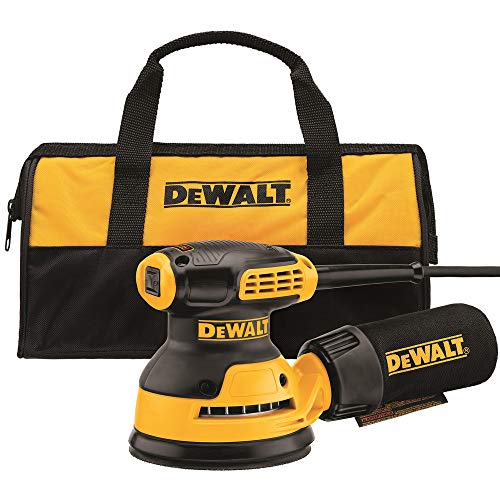
Pros
- 12,000 OPM motor speed
- Shorter height for closer work
- One-handed locking dust bag
- Dust port fits DWV010 and DWV012 collectors
Cons
- Corded design requires outlet access
- Skip if cordless mobility is a priority

Pros
- Variable speed control
- Rubber overmold grip
- Dust-sealed switch
- One-handed locking dust bag
Cons
- Corded electric power
- Who should skip it: buyers seeking cordless operation

Pros
- Cordless design
- Variable-speed control
- Battery and charger included
- Replaceable hook-and-loop sanding pad
Cons
- Runtime is not specified
- Skip if you need specified runtime or dust-collection details
The Best Orbital Sanders by Use Case
Best for Controlled Finishing: BOSCH ROS20VSC Palm Sander
The BOSCH ROS20VSC Palm Sander combines a 5-inch pad with variable speed from 7,500 to 12,000 OPM, giving you room to adjust pace for different workpieces. Bosch specifies a pad-dampening system intended to reduce swirl marks, plus a microfilter dust canister that traps particles as small as 1/2 micron. Its included vacuum adapter adds an option for connecting dust collection, while the bag keeps the supplied kit together.
Reasons to buy:
- Variable speed supports matching sanding pace to the task.
- The listing specifies a microfilter and a dust-level window on the canister.
- The kit includes a vacuum adapter, sanding disc, and carrying bag.
Reasons to avoid:
- It is corded, so your work area needs a suitable outlet and cord management.
- Confirm the included vacuum adapter fits your dust-extraction setup.
Skip it if you need cordless mobility or a larger 6-inch sanding pad.
Best Budget Option: SKIL 5” Random Orbital Sander with Cyclonic Dust
The SKIL 5” Random Orbital Sander with Cyclonic Dust is a corded 5-inch option with a 2.8-amp motor, variable speed, and a stated maximum of 13,000 OPM. Its transparent X-flow dust container uses cyclonic collection, according to the listing, and the compact design is described as suited to tighter spaces. Three sanding sheets are included, which gives you some abrasive material to start with.
Reasons to buy:
- Variable speed provides adjustment for different materials and tasks.
- The transparent container makes collected dust visible and is described as easy to empty.
- The listing includes three sanding sheets.
Reasons to avoid:
Reasons to avoid:
- The listed dust setup is a container; the product data does not specify a vacuum adapter.
- The 5-inch pad may be less suitable than a larger pad for broad surfaces.
Skip it if you need a specified vacuum-hose connection or a cordless tool.
Best for Cord-Free Work: DEWALT 20V MAX Orbital Sander Cordless
The DEWALT 20V MAX Orbital Sander Cordless pairs a brushless motor with a 5-inch pad and variable speed from 8,000 to 12,000 OPM. This kit listing says it includes a 2 Ah battery, charger, and storage bag, so it is a ready-to-use choice for buyers who do not already own a compatible battery and charger. Its low-profile design and replaceable 8-hole hook-and-loop pad are useful details for close work and quick abrasive changes.
Reasons to buy:
- Cordless power supports work away from an outlet.
- The kit listing specifies a battery and charger, unlike tool-only models.
- Variable speed and an 8-hole replaceable pad support task adjustment and paper changes.
Reasons to avoid:
- Battery runtime is not specified, so plan around the included 2 Ah battery and task length.
- Buyers with DEWALT 20V MAX batteries should compare this kit with the tool-only version before selecting.
Skip it if you prefer a corded tool or need a larger battery capacity included.
Best for Aggressive Stock Removal: BOSCH GET75-6N Electric Orbital Sander, Polisher
The BOSCH GET75-6N Electric Orbital Sander, Polisher has a 6-inch disc, a 7.5-amp variable-speed motor, and two operating modes. Bosch describes its turbo, driven-eccentric mode as intended for faster, more aggressive stock removal than its normal random-orbit mode, while the standard mode supports sanding and finishing. The larger pad and dual modes make it a specialized option for jobs such as furniture work and wood floors, rather than the simplest pick for occasional small repairs.
Reasons to buy:
- Two modes cover normal random-orbit sanding and more aggressive removal.
- The 6-inch disc covers a broader area per pass than the 5-inch models in this guide.
- The package includes a backing pad, disc, front handle, and vacuum hose adapters.
Reasons to avoid:
- Its passive dust collection requires a vacuum cleaner and hoses.
- Confirm that your vacuum hose or adapter matches the listed connections; compatible Bosch hoses are sold separately.
Skip it if you want a basic, compact sander with a self-contained dust canister.
Also Considered
The DEWALT Orbital Sander, 5 Inch Palm Sander Tool may suit buyers seeking a straightforward corded 5-inch sander, but its fixed 12,000 OPM gives less speed adjustment than variable-speed alternatives.
The DEWALT Orbital Sander Kit, 5-Inch offers a 3-amp motor and variable 8,000 to 12,000 OPM speed, though the supplied details make its included kit contents less clear than those of the selected Bosch corded option.
The DEWALT 20V MAX Orbital Sander, Tool Only (DCW210B) can suit buyers who already own compatible batteries and chargers; those items are not included in this tool-only listing.
The DEWALT Orbital Sander Kit, 5 inch, 3 amp, Corded could fit buyers wanting a corded 12,000 OPM tool with a dust bag, but its supplied details do not specify variable speed.
The DEWALT Random Orbit Sander, Variable Speed has variable 8,000 to 12,000 OPM speed and a dust bag, but the supplied listing does not distinguish it with a clear advantage over the other corded DEWALT variable-speed model.
How to Choose the Best Orbital Sander
Choose a pad size for your work surface
Most models here use 5-inch pads, a common size for furniture, trim, and general home projects. The Bosch GET75-6N uses a 6-inch disc, which can cover more area per pass, but its larger format and more specialized modes may be unnecessary for small pieces. Check both the pad diameter and the abrasive attachment style on the product listing before buying replacement discs.
A larger pad does not automatically make a sander the better choice. Consider whether you can control it comfortably on your workpiece and whether your existing abrasives fit. The supplied descriptions identify hook-and-loop pads on several models, but do not establish that every accessory or disc is interchangeable.
Match speed control to the material and finish
Variable-speed control lets you adjust the tool’s orbit rate instead of working at one listed speed. That can matter when moving between material removal and a finer finishing pass. The Bosch ROS20VSC lists 7,500 to 12,000 OPM, while several DEWALT variable-speed models list 8,000 to 12,000 OPM; the SKIL listing specifies variable speed and a maximum of 13,000 OPM.
Do not treat a higher maximum OPM as proof of a smoother finish or faster work in every situation. Abrasive grit, pressure, the surface, and your technique also affect results. Check whether the listing gives a speed range or only a fixed rate, then choose the control range that suits your expected tasks.
Decide between corded and cordless power
A corded sander avoids battery changes during a session but ties your movement to an outlet and cord. A cordless model can be more convenient for work in different locations, though runtime depends on the battery and use. The cordless DEWALT kit here includes a 2 Ah battery and charger; its listing does not state runtime, so do not assume how long a charge will last.
If you already own compatible DEWALT 20V MAX batteries, compare the tool-only DEWALT 20V MAX Orbital Sander, Tool Only (DCW210B) with the battery-included kit. Verify battery-system compatibility and the kit contents before purchase. For a first cordless tool, account for the battery and charger rather than comparing tool-only listings as if they were complete kits.
Check dust collection and vacuum connections
Dust collection affects cleanup and how easily a sander connects to your existing shop vacuum. The Bosch ROS20VSC and SKIL models list self-contained dust containers, while selected DEWALT corded models list locking dust bags and dust ports. The Bosch GET75-6N uses passive dust collection and requires a vacuum cleaner and hoses, so it is a better fit when you already have suitable extraction equipment.
Do not assume that a dust port fits every hose. For some DEWALT models, the supplied information specifies direct fit with the DWV010 or DWV012 dust collectors and calls for the DWV9000 Universal Quick Connector with other 1-1/4-inch hoses. Check the exact model’s listing and your hose diameter before relying on a connection.
Consider included accessories and comfort features
Included sanding discs, sheets, bags, handles, and adapters vary by model. A kit with the accessory you need can reduce the number of separate items to source, but verify the package contents because products with similar model names may differ. For example, one DEWALT listing is explicitly tool-only, while the cordless kit listing specifies a battery and charger.
Vibration and grip features may also affect comfort during longer sessions. Product descriptions mention rubber overmolding or counterweight designs on several models, but those claims do not provide comparative comfort measurements. If you are deciding between models, compare their listed features and think about how you hold the tool and how long your typical sanding session lasts.
How We Compared
This comparison uses supplied product specifications, listed design details, package contents, and available customer feedback. Recommendations focus on supported differences such as pad size, speed range, power source, dust collection, and included accessories. Where details such as runtime, adapter fit, or kit contents are not specified, the guide identifies what buyers should verify rather than assuming compatibility or performance.
Frequently Asked Questions
What is the difference between an orbital sander and a random-orbit sander?
Product names can use “orbital” loosely, so check the listed motion and intended use rather than relying on the title alone. The models in this guide are described as random-orbit sanders, and the Bosch GET75-6N listing specifically describes both random-orbit mode and a driven-eccentric turbo mode. If a project calls for a particular sanding motion, confirm that the manufacturer’s description matches it.
Can I connect any orbital sander to a shop vacuum?
No. Dust ports, adapters, and hose connections vary. Check the exact sander model’s listing, then compare the stated connection with your vacuum hose. The Bosch GET75-6N requires a vacuum and hoses, and the DEWALT models specify particular dust collectors or an adapter for some 1-1/4-inch hoses.
Should I buy a tool-only cordless sander or a kit?
A tool-only model may suit you if you already own batteries and a charger from the compatible system. A kit that includes them may be more practical if you are starting without those parts. Check the included battery capacity, charger, and any bag or accessories in the specific listing; do not assume similarly named packages include identical items.
Does a higher OPM rating mean faster sanding?
Not by itself. OPM describes the number of orbits per minute, but sanding results also depend on the abrasive, material, pressure, and tool mode. A variable-speed model gives you more control over the listed range, while a fixed-speed model may suit buyers whose tasks fit its stated rate.
Which sander is more suitable for furniture or wood-floor work?
For smaller furniture tasks, a 5-inch model with variable speed and a dust canister or bag may be easier to match to the work. The Bosch GET75-6N listing specifically names wood floors and furniture finishing among its applications and offers a 6-inch pad with two modes. Choose it only if its larger format and vacuum-based dust collection suit your setup.


Write Your Review
No reviews yet. Be the first to share your experience!