

Wind can carry warmth away from an outdoor seating area, so choosing a heater involves more than checking its maximum power. This guide assesses the listed heater’s infrared design, power settings, weather rating, and mounting options, then explains what to verify for an exposed patio.
Only one product is included in the available listings, so this is not a head-to-head comparison. The product may suit some outdoor spaces, but the published details do not establish how well it performs in strong wind or how much area it can heat.
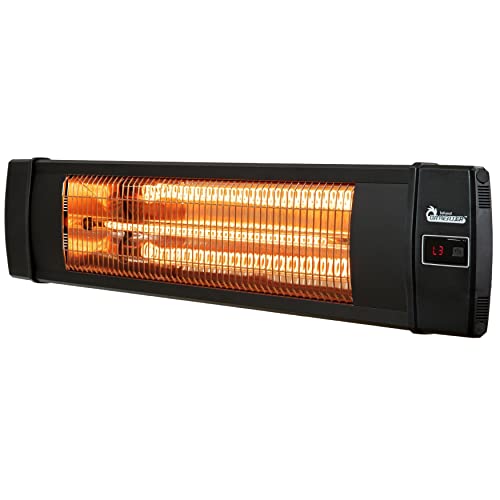
Pros
- Three power settings
- Remote controlled
- Wall and ceiling brackets included
- Listed for indoor and outdoor use
Cons
- No thermostat; skip if automatic temperature control matters
The Best Patio Heaters by Use Case
With one listed model, there is not enough evidence to name separate picks for different budgets, patio sizes, or wind conditions. The recommendation below is limited to the features provided. Check the manufacturer’s complete instructions and the needs of your space before deciding.
Best for Flexible Indoor and Outdoor Use: DR. INFRARED HEATER Portable Infrared Indoor
The DR. INFRARED HEATER Portable Infrared Indoor is an electric infrared heater listed for indoor and outdoor use, including patios, garages, and open-air restaurant spaces. Its listing specifies an IP55 rating, three power settings of 900W, 1200W, and 1500W, and operation from a standard 120V supply. The infrared design may be worth considering for a seating area where you want heat directed toward people rather than relying only on warming surrounding air, but the published information does not quantify coverage or wind performance.
Reasons to buy:
- Three listed power settings give you options to adjust output for the setting and conditions.
- The listing specifies indoor and outdoor use and an IP55 rating; confirm the rating’s limits and installation guidance for your exact location.
- Included wall and ceiling mounting brackets offer fixed placement options, while remote control supports operation from a distance.
Reasons to avoid:
- The listing provides no heating-area estimate or wind-performance measurements, so suitability for a large or highly exposed patio is unclear.
- It has no thermostat, according to the product title. You may need to select a power setting manually rather than set a target temperature.
Skip it if you need documented coverage for a large outdoor area, automatic thermostat control, or evidence of performance in strong wind.
How to Choose the Best Patio Heater for Windy Areas
Wind exposure, heating method, placement, electrical access, and weather protection all affect whether a patio heater fits your use. Product listings do not always provide enough information to settle every question. Use the criteria below to identify what the published specifications support and what you still need to verify.
1. Match the heating method to the seating area
Infrared heaters warm people and objects they reach rather than depending solely on heating all the air in a space. That can make infrared a useful design to investigate for outdoor seating, where moving air can make a space feel colder. It does not mean every infrared heater will keep people comfortable in every wind condition: distance, direction, mounting position, and exposure still matter.
The listed DR. INFRARED HEATER model uses infrared heat, but its published details give no coverage area, recommended mounting height, or wind rating. Look for those details in the manufacturer’s complete documentation, and ask the seller or manufacturer if they are not available. Do not treat the word “infrared” as proof that a heater can overcome strong gusts.
2. Treat wattage as one part of the decision
The listing specifies 900W, 1200W, and 1500W settings at 120V and 60Hz. More available wattage gives you a higher listed power setting, but wattage alone does not establish the area that will feel warm or the heater’s results in a breeze. The product data supplies no room-size or patio-coverage figure, so avoid using its highest setting as a substitute for a coverage specification.
Think about where people sit and whether the heater can be aimed or installed to serve that zone. If you want to heat several seating areas, confirm that the manufacturer supports the proposed placement and coverage. For another type of indoor heating comparison, see our guide to space heaters for large rooms; its room-heating context differs from an exposed patio.
3. Check mounting and heat direction before installation
The product listing says wall and ceiling mounting brackets are included. Fixed mounting can keep a heater in a chosen position, but it also makes placement and installation important. Check the manual for approved mounting locations, clearances, orientation, and any restrictions before installing it. The available product information does not state those measurements, so do not guess at safe distances or assume every wall or ceiling is suitable.
Consider whether the heater can be positioned to serve the seats without exposing it to direct weather beyond what its instructions allow. A wall or ceiling location may suit a stable seating arrangement, while a space that changes layout frequently may call for a different style. This model is described as portable, but its published details do not give dimensions or weight. Confirm those details if you expect to move it often.
4. Read the outdoor rating and installation instructions carefully
The listing describes the heater as IP55 approved for indoor and outdoor use. An IP rating is relevant to protection from dust and water, but the rating alone does not tell you that a device can be left uncovered in every storm or installed in every location. Follow the manufacturer’s instructions for exposure, storage, mounting, and operation. Verify that the exact model documentation matches the listing before relying on its outdoor-use claim.
This is an electrical appliance for outdoor use, so plan for a suitable power source and keep cords and connections within the limits in the manual. The listing specifies standard 120V power, but does not provide cord length, plug details, or a required outlet type. Do not improvise an installation or use an extension cord unless the manufacturer permits it. Have a qualified electrician assess fixed wiring or mounting questions when needed.
Also check which product-safety certifications, if any, apply to the exact model and appear in its documentation. The published information does not identify a UL listing or other safety certification, so this guide does not claim one. General advice about outdoor electrical equipment cannot replace the manufacturer’s safety instructions or local electrical requirements.
5. Decide whether manual controls fit your routine
The listing specifies a remote control and three power settings, but the product title says the heater is without a thermostat. That distinction matters if you want the heater to maintain a chosen temperature automatically. With no thermostat specified, plan to select a setting and adjust it as needed rather than assuming the heater will regulate room temperature for you.
Check the full listing or manual for remote functions, control range, and whether the heater also has controls on the unit. Those details are not included in the published information. If automatic temperature control is essential, compare models that explicitly list a thermostat and confirm how it operates outdoors.
Shoppers comparing indoor comfort options can also browse our Space Heaters category. For outdoor cooling rather than heating, the Air Conditioners and Fans category covers a different set of needs.
How We Compared
This guide uses the published product listing, including its stated infrared heating method, power settings, voltage, IP55 rating, remote control, mounting brackets, and lack of a thermostat in the title. The listing describes indoor and outdoor use, but supplies no coverage estimate, wind-performance data, dimensions, cord details, or customer-review evidence. Recommendations therefore stay within those published details, and buyers should confirm missing installation and safety information with the manufacturer.
Frequently Asked Questions
Can an infrared patio heater work in a windy area?
Infrared heating directs warmth toward people and objects rather than relying only on warming surrounding air, which can make it worth considering outdoors. Actual comfort depends on the heater’s output, distance, direction, placement, and wind exposure. The published listing does not provide wind-performance results, so it cannot establish how well this model will work in a particular gusty location.
Does the IP55 rating mean this heater can stay outside in any weather?
No. The listing specifies an IP55 rating and outdoor use, but that does not establish suitability for every weather condition or permanent uncovered installation. Follow the exact model’s instructions for exposure, operation, and storage, and verify the rating in the manufacturer’s documentation.
What power supply does the listed heater need?
The product data specifies 120V, 60Hz operation and three power settings: 900W, 1200W, and 1500W. It does not state cord length, plug configuration, or outlet requirements beyond standard 120V power. Check the manual and your available electrical supply before installation, and do not use an extension cord unless the manufacturer permits it.
Can I install this heater on a wall or ceiling?
The listing says wall and ceiling mounting brackets are included. That does not establish that every surface or location is appropriate. Check the manual for mounting instructions, required clearances, orientation, and installation limits before fixing the heater in place.
Does the heater automatically keep a set temperature?
The product title identifies this model as being without a thermostat. Its listing also specifies a remote control and three power settings, so expect to choose a setting manually unless the manufacturer’s documentation says otherwise. If automatic temperature control matters, confirm that a competing model explicitly includes a thermostat.
Is this model suitable for a large or fully exposed patio?
The published information does not give a heating-area estimate or measured performance in strong wind. That leaves its suitability for a large or highly exposed patio uncertain. Ask the manufacturer for coverage guidance for your layout, and compare that guidance with the distance and placement you can use safely.

Write Your Review
No reviews yet. Be the first to share your experience!