

Cold mornings put extra demands on a car battery, but buying the battery with the highest cold-cranking-amp rating is not enough. Your vehicle’s battery group size, terminal layout, and electrical system must match, while insulation and plug-in heaters solve different problems from replacing a weak battery.
This guide to the best car battery for cold weather compares three AGM starting batteries with insulation wraps and electric warmers. Use it to narrow choices by vehicle fit, starting power, reserve capacity, and whether you have access to household power.

Pros
- One-piece design needs no tools
- Specified 40 x 7-inch size
- Designed for year-round temperature protection
Cons
- Universal sizing may not fit every battery
- Skip if dimensions do not match your battery
Pros
- 540 CCA rating
- Sealed AGM design
- 80-minute reserve capacity
- Three-year warranty listed
Cons
- Skip if vehicle does not require BCI Group 26R
- Wire harness and mounting accessories not included

Pros
- 720 CCA starting rating
- Maintenance-free AGM design
- 90-minute reserve capacity
- 31.7-pound listed weight
Cons
- Skip if your vehicle requires a different battery size or terminal type

Pros
- Customizable roll size
- Adhesive backing
- Thicker than cited 3mm options
Cons
- Requires trimming for a custom fit
- Keep foil away from terminals and cables
- Who should skip it: buyers seeking pre-cut coverage
Pros
- Automatic thermostat cutoff at approximately 122°F
- Thin design fits beneath most battery trays
- No installation modifications required
Cons
- Requires 120V AC power and unplugging after use
- Not suitable for lithium-ion, Ni-Cd, ABS-case, or insulated-box batteries
- Skip if your battery or battery box is incompatible

Pros
- Adjustable hook-and-loop closure
- Long 74-inch power cord
- Sized for large vehicle batteries
Cons
- No thermostat for automatic temperature control
- Must be unplugged after 3–5 hours
- Skip it if you need unattended heating

Pros
- 760 CCA rating
- 120-minute reserve capacity
- Sealed, spill-proof AGM design
- Three-year warranty stated
Cons
- Confirm vehicle fitment and terminal polarity before installation
- Who should skip it: drivers needing a different battery group size

Pros
- Two wraps included
- No cutting required
- Adjustable hook-and-loop closure
Cons
- Contains fiberglass; avoid direct skin contact
- Who should skip it: buyers seeking a fiberglass-free wrap

Pros
- 650 CCA rating
- 100-minute reserve capacity
- Spill-proof AGM design
- Mounting screws included
Cons
- Wire harness and mounting accessories not included
- Skip if your vehicle requires a different group size or terminal layout

Pros
- Trimmable 40 x 7-inch sheet
- Edge-sealing tape included
- Instructions cover battery removal and installation
Cons
- Fit depends on battery size and shape
- Who should skip it: buyers needing confirmed fit for a specific battery
The Best Car Battery and Cold-Weather Aids by Use Case
Best for Higher Listed CCA: OPTIMA® Batteries High Performance 25 REDTOP®
The OPTIMA® Batteries High Performance 25 REDTOP® is a starting battery for drivers whose vehicle takes Group 25 and SAE terminals. Its listed 720 CCA is the highest among the three batteries in this guide, and its 90-minute reserve capacity may suit vehicles that need more reserve than the smaller listed options. OPTIMA specifies SpiralCell technology and maintenance-free AGM construction, but fit and terminal orientation still need to match your vehicle.
Reasons to buy:
- 720 CCA gives it the highest listed cold-cranking rating among the batteries compared here.
- 90-minute reserve capacity and 44 Ah C20 capacity are specified.
- Maintenance-free AGM construction and SAE posts are listed.
Reasons to avoid:
- Group 25 fit, dimensions, and SAE terminal compatibility must match the vehicle.
- Its 44 Ah capacity is lower than the listed 70 Ah of the Mighty Max H6, so CCA alone does not tell the full story.
Skip it if your vehicle specifies another battery group or terminal type. See the Car Tech category for more vehicle-focused buying guides.
Product: OPTIMA® Batteries High Performance 25 REDTOP®
Best for Group 48 Fit: Mighty Max Battery MM-H6 Start and Stop Car BCI
The Mighty Max Battery MM-H6 Start and Stop Car BCI is a Group 48 AGM battery with 760 CCA, 70 Ah capacity, and 120-minute reserve capacity in its listing. Those figures make it a strong candidate when your vehicle calls for Group 48 and benefits from the listed capacity and reserve. Its dimensions are 10.94 x 6.88 x 7.48 inches, with positive terminal on the right and negative on the left, so check the battery tray and cable reach before ordering.
Reasons to buy:
- 760 CCA is the highest listed rating among the three Mighty Max batteries here.
- 70 Ah and 120-minute reserve capacity are specified.
- Sealed AGM design is described as spill-proof and resistant to shock and vibration.
Reasons to avoid:
- Group 48 size, dimensions, and right-positive terminal layout may not fit every vehicle.
- The listing does not provide vehicle-specific compatibility information.
Skip it if your owner’s manual specifies a different group size or battery type. Confirm whether your vehicle’s start-stop system calls for this battery type before purchasing.
Product: Mighty Max Battery MM-H6 Start and Stop Car BCI
Best Value: Mighty Max Battery MM-G35 Start and Stop Car BCI
The Mighty Max Battery MM-G35 Start and Stop Car BCI is the lowest-priced battery among the main battery picks, while offering a listed 650 CCA, 55 Ah, and 100-minute reserve capacity. It suits a vehicle that specifies Group 35 and a matching terminal arrangement. The AGM design is sealed and spill-proof according to the listing, but its lower CCA than the H6 and OPTIMA options makes vehicle requirements more important than price.
Reasons to buy:
- 650 CCA and 100-minute reserve capacity are listed for the Group 35 battery.
- 55 Ah capacity offers a middle ground between the other Mighty Max battery capacities in this guide.
- Its sealed AGM construction is specified as rechargeable and resistant to vibration.
Reasons to avoid:
- Its 650 CCA is lower than the other two selected starting batteries.
- Confirm that Group 35, dimensions of 9.06 x 6.89 x 8.82 inches, and right-positive polarity match your vehicle.
Skip it if your vehicle needs a different group size or a higher specified CCA rating.
Product: Mighty Max Battery MM-G35 Start and Stop Car BCI
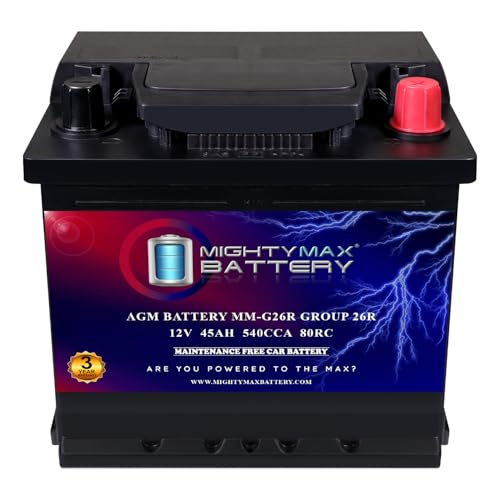
Best for Group 26R Vehicles: Mighty Max Battery MM-G26R BCI Group 26R 12V 45AH
The Mighty Max Battery MM-G26R BCI Group 26R 12V 45AH is a compact Group 26R AGM starting battery with 540 CCA and 80-minute reserve capacity listed. It is the lowest-CCA battery among the selected battery replacements, so it is a fit-based choice for vehicles that specify Group 26R, not a universal cold-weather upgrade. The stated dimensions are 8.25 x 6.87 x 7.43 inches, with positive terminal on the right.
Reasons to buy:
- Group 26R designation gives buyers a specific size to compare with the vehicle manual.
- 80-minute reserve capacity and 45 Ah capacity are listed.
- AGM construction is described as sealed, spill-proof, and suitable for multiple mounting positions except upside down.
Reasons to avoid:
- 540 CCA is lower than the other selected replacement batteries.
- Verify its dimensions and right-positive polarity against the existing battery and cable layout.
Skip it if your vehicle manual calls for a different group size or higher starting rating.
Product: Mighty Max Battery MM-G26R BCI Group 26R 12V 45AH
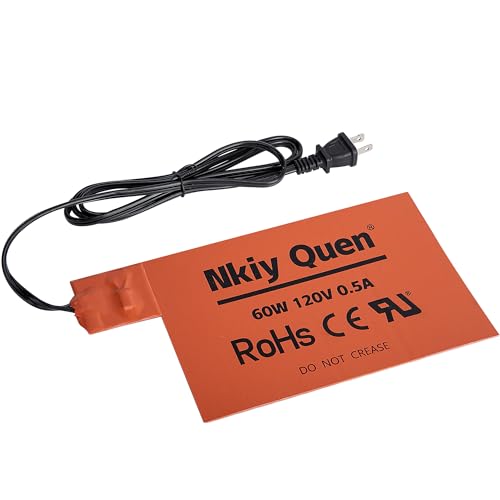
Best for Plug-In Battery Warming: 8.2 x 5.5 Inches Automotive Silicone Battery Pad
The 8.2 x 5.5 Inches Automotive Silicone Battery Pad warms a battery from below and uses a thermostat that the listing says cuts power at approximately 122°F. It is an accessory, not a replacement battery, and needs a 120V AC outlet. Its stated restrictions matter: the listing says it is unsuitable for lithium-ion and nickel-cadmium batteries, ABS battery cases, and insulated battery boxes.
Reasons to buy:
- Thermostatic control is specified, unlike the selected heated wrap.
- Thin 8.2 x 5.5-inch pad is intended to sit beneath the battery.
- The listing describes a silicone outer layer and resistance to battery acid corrosion.
Reasons to avoid:
Reasons to avoid:
- It requires a 120V AC supply and must be unplugged after use.
- It is not suitable for several battery and enclosure types named in the listing.
Skip it if you park away from an outlet or cannot confirm battery-case compatibility. For any vehicle electrical accessory, follow its instructions and your vehicle guidance, keep cables clear of terminals and moving parts, and do not use damaged wiring.
Product: 8.2 x 5.5 Inches Automotive Silicone Battery Pad
Also Considered
The 40"x7" Universal Car Battery Insulation Kit may suit buyers wanting a non-electric wrap, but its universal-fit claim still needs to be checked against battery dimensions: 40"x7" Universal Car Battery Insulation Kit.
The Car Battery Insulation Blanket from Haldane offers 5mm material and self-adhesive backing, but buyers should take care to keep the wrap away from terminals and cables: Car Battery Insulation Blanket.
The 1PC 39x7In Car Battery Thermal Heater Blanket suits drivers with an outlet who want a wrap-style warmer, but its listing explicitly says it has no thermostat and should not remain plugged in continuously: 1PC 39x7In Car Battery Thermal Heater Blanket.
The 2PCS 40"X7" Car Battery Insulation Kit includes two wraps for larger-vehicle use, though its listing warns that the material contains some fiberglass and advises avoiding direct skin contact: 2PCS 40"X7" Car Battery Insulation Kit.
How to Choose the Best Car Battery for Cold Weather
1. Match group size, dimensions, and terminals
Battery group size is a physical fit requirement, not a rough suggestion. A battery that cannot sit securely in the tray or connect to the existing cables is not a suitable replacement, even if its CCA rating looks appealing. Check your owner’s manual or the label on the current battery, then compare the listed group, dimensions, and terminal orientation. The Group 26R, Group 35, Group 48, and Group 25 products above are not interchangeable by name alone.
2. Compare CCA with the vehicle requirement
Cold-cranking amps describe a battery’s listed starting-current rating under cold conditions. A higher number can be useful in a cold climate, but it does not override the vehicle’s size and battery-type requirements. Compare the manual’s required rating with the listing: the selected batteries range from 540 CCA for the MM-G26R to 760 CCA for the MM-H6. Do not assume the highest figure makes an incompatible battery a good choice.
3. Read capacity and reserve capacity separately
Amp-hour capacity and reserve capacity describe different specifications from CCA. The products here list 44 to 70 Ah and reserve capacities from 80 to 120 minutes, but those numbers alone do not establish how a battery will perform in a particular vehicle. Use them to compare candidates that already meet the required fit and type. If your car has a start-stop system or specific charging requirements, verify the correct battery type in the manual rather than relying only on a product’s title.
4. Decide whether you need a replacement or a warming accessory
An insulation wrap or heater does not replace a failing or incorrectly sized battery. A passive wrap can provide a layer around a battery, while electric warmers need an outlet and must be used according to their instructions. The silicone pad lists thermostat control; the QincLing heated blanket does not, and its listing says to unplug it after warming. Choose an accessory only if its size, installation method, power supply, and battery restrictions suit your parking setup.
5. Check installation and safety details
Battery terminals can create a short circuit if they contact conductive material or tools. Follow the vehicle and product instructions when replacing or wrapping a battery, and keep insulation clear of terminals, cables, and areas where it could interfere with secure mounting. Some listed wrap instructions call for protective gloves and eye protection; the QincLing insulation listing also warns about fiberglass. If installation steps or electrical compatibility are unclear, ask a qualified automotive service provider.
How We Compared
This comparison uses the supplied product listings, including battery group sizes, dimensions, CCA, capacity, reserve capacity, materials, power requirements, installation details, and stated restrictions. We separated replacement batteries from passive insulation and plug-in warming accessories because they serve different needs. Product descriptions are manufacturer-provided claims, not independent performance findings, and the supplied rating data did not include written customer feedback.
Frequently Asked Questions
Can I choose a battery only by its CCA rating?
No. CCA is one comparison point, but the battery must also match the vehicle’s group size, dimensions, terminal layout, and specified battery type. Start with the owner’s manual, then compare CCA among batteries that meet those requirements.
Will an insulation blanket fix a weak battery?
No. A wrap is a temperature-protection accessory, not a battery replacement or repair. If a battery struggles to start, confirm its condition and charging system with an appropriate service provider, and replace it if needed with a compatible model.
What is the difference between a battery pad and a heated blanket?
The silicone pad sits beneath the battery and lists a thermostat that cuts power at approximately 122°F. The QincLing heated blanket wraps around the battery, runs on 120V, and its listing says it has no thermostat. Both need household power, so access to an outlet and adherence to instructions are essential.
Can I install a battery warmer on any battery?
No. The silicone pad listing excludes lithium-ion and nickel-cadmium batteries, ABS battery cases, and insulated battery boxes. Check the exact product restrictions and the vehicle maker’s guidance before installation; do not assume compatibility based on battery size alone.
Does a higher reserve-capacity figure mean a better cold-start battery?
Not by itself. Reserve capacity and CCA are separate listed specifications. Compare both only after confirming the correct group, terminal arrangement, and battery type for your vehicle, then prioritize the rating your vehicle and driving needs call for.





Write Your Review
No reviews yet. Be the first to share your experience!