

When the power goes out, an emergency radio needs to do more than pick up a station: it may also need to run without an outlet, provide useful light, or keep a phone charged. The right choice depends on whether you want automatic weather alerts, replaceable batteries, a hand crank, or a portable radio for a go-bag.
This Best Emergency Radio for Power Outage guide compares options from RunningSnail, FosPower, Raynic and more by their listed reception, power sources, lighting, alerts, and portability. Use it to match a radio to your household plan, then confirm local NOAA coverage and the exact alert behavior before relying on any model.

Pros
- Multiple charging options, including solar and hand crank
- NOAA alerts and AM/FM/SW reception
- Built-in flashlight, reading lamp, and SOS alarm
- Headphone jack for private listening
Cons
- Battery runtime and phone-charging capacity are not specified
- Who should skip it: buyers needing documented alert coverage or runtime

Pros
- Three battery charging methods
- 20,000mAh battery capacity
- Multiple radio bands
- Separate spotlight and reading lamp
Cons
- USB charging output not specified

Pros
- Access to seven NOAA weather bands
- Runs on two AA batteries
- Compact, lightweight design
- Simple physical controls
Cons
- Does not provide automatic NOAA alerts
- Who should skip it: buyers needing automatic NOAA alerts

Pros
- NOAA, AM, and FM bands
- 12,000mAh battery
- Solar and hand-crank charging
- Flashlight and reading light
Cons
- Radio runtime and phone-charging output unspecified
- Who should skip it: Buyers needing documented runtime or charging-output figures
Pros
- 10,000 mAh power bank
- Solar and hand-crank charging
- NOAA weather scan and alerts
- Bluetooth audio streaming
Cons
- USB charging output not specified
- Skip if you need specified device-charging speeds

Pros
- Three power options
- NOAA, AM, and FM reception
- Built-in LED flashlight
- Compact, lightweight design
Cons
- 2,000 mAh capacity limits its role as a phone charger
- Skip it if you need a larger-capacity emergency power source

Pros
- Receives AM, FM, and shortwave
- Large, straightforward analog controls
- AC or battery power
- Backlit time and station display
Cons
- Four AA alkaline batteries not included
- Who should skip it: listeners who need included portable-use batteries

Pros
- NOAA, AM, and FM reception
- Crank, solar, and AAA power options
- Built-in reading light and flashlight
- 2,000mAh emergency power bank
Cons
- Who should skip it: users needing higher-capacity device charging

Pros
- 12,000mAh battery capacity
- AM/FM and NOAA bands
- Solar and hand-crank charging
- Separate flashlight and reading lamp
Cons
- Phone-charging runtime not specified
- Skip it if you need specified phone-charging runtime

Pros
- Receives AM, FM, and NOAA weather broadcasts
- Runs on two AA batteries
- Includes speaker and earphone jack
- Compact 4.65-inch-long body
Cons
- Two AA batteries not included
- Skip it if you need included batteries
The Best Emergency Radios by Use Case
Best for Automatic Alerts: Raynic Emergency Weather Radio
The Raynic Emergency Weather Radio stands out for households that want an alert-capable radio with several backup functions. Its listing specifies AM, FM, shortwave, and NOAA reception, plus an automatic weather-alert feature that scans for alerts when the radio is on or in standby. It also combines a 5000mAh battery, solar and hand-crank charging, a flashlight, reading lamp, and SOS alarm.
Reasons to buy:
- Automatic NOAA alert scanning is listed for on and standby modes.
- AM, FM, shortwave, and weather-band reception give you several broadcast options.
- Its LCD shows battery level and tuning frequency, with a dimmer function for the backlight.
Reasons to avoid:
- The listing does not give a runtime for radio or light use, so battery capacity alone cannot predict outage endurance.
- IPX3 water resistance is not a claim of protection against immersion or heavy water exposure.
Skip it if you want a radio powered by standard replaceable batteries, or need a stated runtime for planning.
Best for a Large Rechargeable Battery: Aivica Hand Crank Emergency Radio with 20000mah
The Aivica Hand Crank Emergency Radio with 20000mah is aimed at people who want a high-capacity rechargeable battery alongside weather reception and emergency signaling. Its listing specifies a 20,000mAh battery, solar, hand-crank, and USB-C charging, plus AM, FM, NOAA, and shortwave reception. It also includes a spotlight, reading lamp, and SOS alarm, making it a multi-function option for a home kit or camping bag.
Reasons to buy:
- The listed 20,000mAh capacity is the largest stated battery in this guide.
- Three listed charging routes include USB-C, solar, and hand crank.
- The detachable carabiner and stated 1 lb weight suit pack attachment and portable use.
Reasons to avoid:
- The listing’s runtime and phone-charge figures are manufacturer claims, not a guarantee for every device or use pattern.
- Its 120dB alarm claim is not independently established by the supplied product information.
Skip it if you prefer a simple AA-powered radio or do not need a large rechargeable battery.
Best Budget Battery Radio: NOAA Weather Radio AM FM
The NOAA Weather Radio AM FM is a compact PRUNUS model for buyers who want basic weather and broadcast reception without a rechargeable power system. It runs on two AA batteries and receives seven NOAA weather bands, as well as AM and FM. Its controls use separate power and volume, tuning, and band-selection functions, which may suit anyone who would rather turn a dial than navigate a digital menu.
Reasons to buy:
- Two AA batteries are easy to store as spares and replace when depleted.
- Its stated 0.24 lb weight, excluding batteries, and compact dimensions suit a small emergency kit.
- A headphone jack supports private listening.
Reasons to avoid:
The listing explicitly says it does not support automatic NOAA notifications. You also need to supply AA batteries and keep spares available.
Skip it if you want an alert that sounds while the radio is unattended, or need a flashlight and phone-charging function.
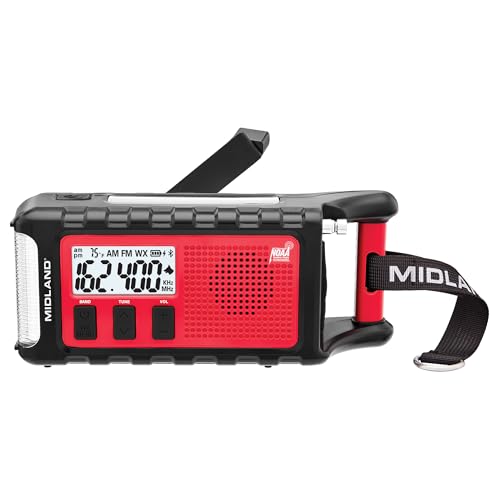
Best for Bluetooth and Long Listed Runtime: Midland – ER310PRO, Portable Emergency Bluetooth
The Midland – ER310PRO, Portable Emergency Bluetooth combines NOAA weather scanning with Bluetooth streaming, solar charging, hand-crank charging, and a listed 10,000mAh battery. The product information states up to 200 hours of radio use, a figure to treat as a manufacturer claim because actual runtime depends on use. It suits someone who wants a weather radio that can also play audio from a phone during ordinary outdoor use.
Reasons to buy:
- Bluetooth streaming adds a listening option beyond AM and FM broadcasts.
- NOAA Weather Scan is listed to scan seven weather channels and lock onto the strongest channel.
- The SOS flashlight beacon and rescue dog siren provide distinct signaling features.
Reasons to avoid:
- Bluetooth depends on a compatible paired device and uses that device’s audio library or services.
- The listing describes a 10,000mAh battery and a 200-hour radio-use claim, but does not give a charging time or usage conditions for that runtime.
Skip it if you want a low-cost, basic radio or do not need Bluetooth audio and its extra features.
Best for AAA Backup Batteries: FosPower NOAA Emergency Weather Radio A1 7400mWh
The FosPower NOAA Emergency Weather Radio A1 7400mWh offers a different backup plan: alongside solar and hand-crank charging, its listing specifies AAA batteries as another power source. That option can help if you have stored disposable batteries but cannot recharge the radio. The A1 also provides AM, FM, and NOAA broadcasts, a 1W flashlight, four-LED reading light, SOS alarm, and a 2000mAh power bank.
Reasons to buy:
The AAA option adds a replaceable-battery route alongside its built-in rechargeable power. A flashlight and separate reading light cover different lighting needs. The product listing also specifies a limited lifetime warranty, with details available from FosPower.
Reasons to avoid:
- The listed 2000mAh power bank is modest compared with the larger battery capacities in this guide.
- Check the listing for the AAA battery quantity and whether batteries are included; the supplied details do not specify either.
Skip it if phone charging capacity is your main priority and you want a larger stated battery.
Also Considered
The Mesqool Emergency Weather Radio NOAA Alert may suit buyers who want a listed 12,000mAh battery and a large solar panel, but it misses the main list because its supplied details do not establish alert behavior as clearly as the Raynic or Midland listings.
The Emergency Weather Radio with Large Solar Panel lists a 12,000mAh battery, IPX6 rating, and multiple charging methods, but its supplied information does not identify a brand in the short name, making exact model verification especially important.
The RunningSnail Hand Crank Radio with Flashlight could suit a lightweight kit with solar and crank charging; its listed 2000mAh battery is smaller than options aimed at longer device backup.
The DreamSky AM FM Radio Portable Shortwave Radio may work for everyday listening at home or outdoors, but it does not list NOAA weather-band reception, a key need for an emergency weather radio.
The Greadio NOAA Weather Radio is another simple two-AA option with NOAA, AM, and FM reception. Its supplied details do not establish automatic alert notifications, so confirm alert behavior if that feature matters.
How to Choose the Best Emergency Radio for Power Outage
Decide whether you need automatic alerts
A radio that receives NOAA broadcasts is not necessarily an alert radio. Some models need you to tune in and listen, while others scan for weather alerts and sound an alarm. The PRUNUS listing explicitly says it does not provide automatic notification, while Raynic lists automatic alert scanning and Midland lists NOAA Weather Scan with an alert function. Check whether the alert works in standby, whether the radio must remain on, and whether it locks to a local channel.
Match the power system to your outage plan
Rechargeable batteries reduce dependence on disposable cells, but hand-crank and solar charging are backup methods, not a promise of a particular runtime. AA or AAA models can be practical if you keep spare batteries stored and know their type. Compare the listed battery capacity, charging inputs, and any stated runtime, then plan for radio, light, and phone charging to draw from the same supply. Do not assume a radio can recharge a phone quickly or fully unless the listing provides compatible output details.
Check the radio bands and local coverage
NOAA weather-band reception is useful only when the radio can receive a broadcast available in your area. AM and FM add news and general broadcasts; shortwave can add stations, but it is not a replacement for local official alerts. Look for the listed bands and antenna details, then check NOAA’s local transmitter coverage and identify the channel before an emergency. A feature list cannot establish reception quality in your home, which can vary with location and building conditions.
Choose lights and signaling for your actual use
A flashlight helps with focused tasks, while a reading lamp can illuminate a table or tent. SOS alarms, flashing beacons, and sirens serve signaling rather than ordinary lighting. Compare the type of light and alarm, not just the number of features. If you need weather protection, check the exact rating: IPX3, IPX4, and IPX6 are not interchangeable, and no water-resistance rating means the radio is safe to submerge.
Prioritize controls, size, and phone connection
For a family emergency kit, a clear display and simple tuning controls may matter more than a compact shell. For a go-bag, stated weight and dimensions help you judge portability. Bluetooth, such as on the Midland, is for receiving audio from a paired phone; a USB charging port is a separate feature for supplying power to a device. Confirm the connection type and charging details on the listing rather than treating all USB or USB-C ports as equivalent.
How We Compared
This comparison uses the supplied product listings, including stated radio bands, alert functions, battery capacities, charging methods, lighting, controls, dimensions, and water-resistance claims. We considered how those features fit distinct needs, such as automatic weather alerts, replaceable batteries, phone backup, and portable use. Manufacturer runtime, charging-efficiency, reception, and alarm claims remain listing claims, not independently verified results. Customer review information was not supplied in a form that supports conclusions about recurring owner experiences.
Frequently Asked Questions
Does every NOAA radio alert you automatically?
No. Some radios receive NOAA broadcasts only when you tune to a weather channel. The PRUNUS listing says it does not support automatic notification, while Raynic and Midland describe alert or scan functions. Check whether alerts operate in standby and whether the radio needs to be switched on.
Is a hand-crank radio enough to keep a phone charged?
Not necessarily. A crank can help replenish a radio’s power, but the supplied listings do not establish that a short cranking session will fully charge a phone. Treat phone charging as an emergency backup, and check the radio’s output details and your phone’s charging needs before buying.
Should I choose rechargeable power or replaceable batteries?
Rechargeable models with solar or hand-crank options offer ways to replenish power when outlets are unavailable. AA- or AAA-powered radios depend on stored spare batteries, but those cells can be replaced without waiting for sunlight or turning a crank. Choose based on which backup source you can reliably keep ready.
Can a weather radio replace phone alerts?
A weather radio offers a separate way to receive broadcasts when mobile service or internet access is unavailable, but it should not be treated as a guaranteed replacement for every alert channel. A radio also needs suitable local reception and, for automatic alerts, the correct alert mode. Check your local NOAA channel and keep other available emergency-information methods in your household plan.
Do these radios all charge with USB-C?
No. The Aivica listing specifies Type-C charging, while the RunningSnail listing identifies USB-C. Other product details may mention USB charging without specifying the connector or charging protocol. Verify the exact port and included cable information on the individual listing.



Write Your Review
No reviews yet. Be the first to share your experience!