

Evaporative coolers can move a lot of air, but their cooling method adds moisture, which makes them a less dependable choice as humidity rises. This guide to the best evaporative cooler for a humid climate compares six models and explains when their listed features may suit a patio, garage, or indoor room, and when a fan or air conditioner may be a better fit.
Start with your space and local conditions rather than airflow alone. The VEVOR listing, for example, describes its cooling effect for areas below 60% humidity, while several other listings emphasize dry climates or outdoor use. Those details matter more than a large tank or a high airflow figure if your air is already humid.

Pros
- Large 10-gallon water tank
- Hose hookup for continuous refill
- Wheels and oscillating airflow
Cons
- Evaporative cooling is intended for dry climates
- Who should skip it: shoppers needing conventional indoor air conditioning

Pros
- Large 10.6-gallon water tank
- Hose connection supports automatic filling
- Four wheels, two with brakes
- Three fan speeds
Cons
- Skip it if you need conventional air conditioning
- Evaporative cooling may be less suitable in humid conditions

Pros
- Large 12.7-gallon tank
- Top-fill and garden hose options
- Remote control and 12-hour timer
- Four included ice boxes
Cons
- Designed for environments below 60% humidity
- Who should skip it: shoppers needing a compact, lightweight cooler
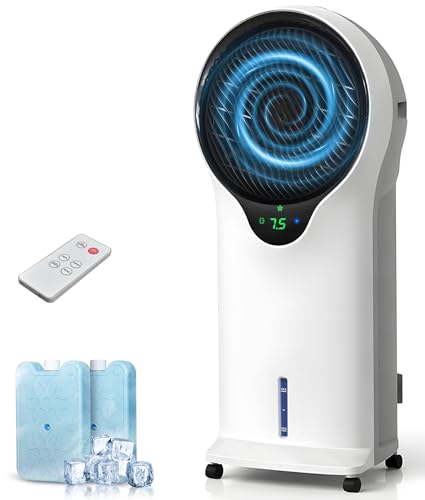
Pros
- Three speeds and three airflow modes
- Remote control and adjustable timer
- Wheels and built-in handle
- Low-water alert and fan-only fallback
Cons
- Who should skip it: people in humid climates

Pros
- Remote control and touch panel
- Detachable 5L tank with top and bottom filling
- Three speeds and 60° oscillation
- Washable dust filter
Cons
- Requires water refills for evaporative cooling
- Who should skip it: shoppers seeking conventional air conditioning

Pros
- 3,100 CFM capacity
- 10.3-gallon water tank
- Simple operating controls
- 39-pound listed weight
Cons
- Skip it if you need longer cooling without refills
The Best Evaporative Coolers by Use Case
Best for Large Outdoor Areas: Uthfy 41" Swamp Cooler, 4800 CFM Evaporative Air
The Uthfy 41" Swamp Cooler, 4800 CFM Evaporative Air is the most airflow-focused choice here, with a listed 4,800 CFM and a stated coverage claim of up to 1,200 square feet. Its 10.6-gallon tank, hose connection, and 120-degree side-to-side oscillation suit a large garage, patio, or workshop where you can direct moving air across an open area. The listing presents it for indoor and outdoor use, but evaporative cooling still depends on suitably dry air.
Reasons to buy:
- Highest listed airflow among these models, useful for moving air through a large open space.
- Hose hookup offers an automatic refill option, alongside manual tank filling.
- Three fan speeds and oscillation let you adjust airflow across a broader area.
Reasons to avoid:
- The listing’s coverage figure is a manufacturer claim, not a guarantee of results in every layout or climate.
- Its large tank and outdoor-oriented design may be more than needed for personal, close-range cooling.
Skip it if your room is small, your air is humid, or you need cooling that does not add moisture.
Best for Hose-Fed Outdoor Use: Arctic Air Outdoor Pro Swamp Cooler Evaporative
The Arctic Air Outdoor Pro Swamp Cooler Evaporative is designed for patios, garages, backyards, and outdoor work areas. Its listed 3,100 CFM airflow, 10-gallon tank, hose hookup, and oscillation make it a practical candidate when you want to move it between semi-open spaces and reduce manual refills. The product description specifically frames it as an outdoor cooler for dry climates, so it is not a strong match for a closed, humid room.
Reasons to buy:
- A 10-gallon tank supports longer operation between manual refills than the smaller indoor models in this guide.
- A hose hookup is listed for continuous refill.
- Wheels and oscillating airflow support moving and directing the cooler around open spaces.
Reasons to avoid:
- The listing does not provide a coverage-area figure, so confirm that its airflow suits your particular space.
- Its stated use is outdoor and dry-climate cooling, not humidity control or sealed-room air conditioning.
Skip it if you need a compact bedroom unit, a published room-coverage estimate, or reliable cooling in humid conditions.
Best for Remote-Controlled Open Spaces: VEVOR Evaporative Air Cooler
The VEVOR Evaporative Air Cooler combines listed airflow of up to 4,129 CFM with a 12.7-gallon tank, remote control, timer, and four ice boxes. Its listing is unusually clear about a climate boundary: it describes significant cooling or humidifying effects below 60% humidity and says the unit increases relative humidity. That makes it easier to assess for dry outdoor or open indoor areas, but it is a warning sign for already humid spaces.
Reasons to buy:
- The listed 12-hour timer and remote control offer convenient operation from across a room.
- A 12.7-gallon tank and garden-hose connection reduce the need for frequent manual refills.
- Horizontal and vertical oscillation are listed for directing airflow over a wide angle.
Reasons to avoid:
- The manufacturer specifies its cooling and humidifying effects for humidity below 60%, so verify local conditions before choosing it.
- The listing reports operation within a 65 dB range, which may be noticeable in a quiet room.
Skip it if you need moisture-free cooling or plan to use it in a humid, enclosed room.
Best for a Bedroom or Office: SereneLife Evaporative Air Cooler Tower
The SereneLife Evaporative Air Cooler Tower is a compact, standing option for personal airflow in a bedroom, office, or dorm. Its listing specifies an 80-watt power draw, 1,000 m³/h airflow, a 5-liter detachable tank, remote control, and 60-degree oscillation. The washable dust filter and three modes add everyday convenience, although the small tank and indoor format point to spot cooling rather than broad outdoor coverage.
Reasons to buy:
- The tower footprint and remote suit a personal indoor cooling setup.
- Three speeds, three modes, and 60-degree oscillation provide several airflow choices.
- The listing specifies 80 watts and a washable dust filter.
Reasons to avoid:
- The 5-liter tank is smaller than tanks on the outdoor-focused models, so refilling may be more frequent.
- The listing describes it for dry, warm climates and does not claim humidity removal.
Skip it if you need high-volume airflow for a patio or a cooler that dehumidifies the room.
Best for Timer-Based Room Cooling: EXNOS 35" 3-in-1 Evaporative Air Cooler
The EXNOS 35" 3-in-1 Evaporative Air Cooler targets home and office use, with three speeds, three modes, a remote, and a 7.5-hour timer. Its listing specifies a 5.5-liter tank and 110-watt power draw, plus low-water protection that switches the unit to fan-only mode. These features can suit someone who wants scheduled, adjustable airflow in a dry indoor space, but the product description does not provide a CFM figure or humidity threshold.
Reasons to buy:
- The timer adjusts in half-hour increments, allowing a more specific shutoff time than a simple on-off control.
- Low-water protection changes operation to fan-only mode when water runs low, according to the listing.
- The removable tank and cooling pad are described as easy to clean.
Reasons to avoid:
- No airflow rate or room-coverage figure is supplied, so compare the listing carefully if you need a specific coverage level.
- Its evaporative function adds moisture and may be a poor match for humid rooms.
Skip it if you need documented high airflow, a hose connection, or cooling that does not raise indoor humidity.
Also Considered
The Hessaire MC37M 3100CFM Evaporative Cooler may suit buyers who value a simple control layout and a listed 10.3-gallon tank, but its stated 3-to-4-hour continuous water flow and lack of remote or timer details make it less flexible than the main picks.
How to Choose the Best Evaporative Cooler for a Humid Climate
Check humidity and ventilation first
Evaporative coolers work by passing air over wet cooling media. That process adds water vapor to the outgoing air, so it generally suits dry conditions better than humid ones. If your local humidity is high, adding more moisture may make a room feel less comfortable rather than solving the problem. The VEVOR listing explicitly places its significant cooling or humidifying effects below 60% humidity; other published listings describe use in dry climates without giving a precise threshold.
Use these units where air can move through the space, such as an open garage or patio, rather than treating them as sealed-room air conditioners. Before buying, check typical humidity where and when you plan to run the cooler. If you need to lower humidity or cool a closed room regardless of outdoor moisture, compare conventional air conditioning options in the Air Conditioners & Fans category.
Match airflow to the space, not just the largest number
CFM describes airflow volume, but it does not guarantee that every corner of a room will feel cooler. Walls, furniture, open doors, and the direction of the air stream all affect how a portable cooler works in practice. The Uthfy listing gives the highest airflow figure here and claims coverage up to 1,200 square feet; treat that area as the manufacturer’s claim, not a promise for every room shape or climate.
For a large, open work area, compare the Uthfy, VEVOR, and Arctic Air models by their listed CFM and oscillation. For a bedroom or desk area, the SereneLife tower is described as a personal indoor option, while the EXNOS listing focuses on adjustable room airflow but does not state a CFM figure. When a listing does not give a coverage figure, avoid assuming one based on the product’s height or appearance.
Choose tank size and refill method for your routine
A larger tank can mean fewer manual refills, but actual runtime depends on operating conditions and water use. The listed models range from the SereneLife’s 5-liter tank and EXNOS’s 5.5-liter tank to the VEVOR’s 12.7-gallon tank. Do not compare capacity alone as a guaranteed measure of hours: product data do not provide matching runtime figures for all six units.
If the cooler will stay near a garden hose, check whether its listing includes a hose connection and whether the connection fits your setup. Uthfy, Arctic Air, VEVOR, and Hessaire list hose or continuous-water features, but the precise connection details are not equally complete. For room-to-room use without a hose, a smaller tank can be easier to manage, though it may call for more frequent filling.
Prioritize controls and movement you will use
Oscillation spreads airflow across a wider area, while a remote or timer can make a unit easier to operate from a bed or desk. The VEVOR lists a remote and 12-hour timer; EXNOS lists a remote and 7.5-hour timer; SereneLife lists a remote, display, and 60-degree oscillation. Compare the stated controls with how you use the space instead of paying attention to feature counts alone.
For frequent moves between rooms or work areas, check the listing for wheels, handles, and tank access. The outdoor models describe wheels or portable designs, while the SereneLife tower is presented as lightweight and compact. Confirm the product’s dimensions and weight on its listing if doorways, storage, or lifting matter; those details are not supplied for every model here.
Read the listing for missing practical details
Useful comparison points include airflow, humidity guidance, tank capacity, noise information, controls, and refill method. This product data does not provide a humidity threshold for most models, and only some listings specify noise or power figures. If a detail affects your decision, such as a specific room size, sound level, or connection fit, confirm it on the current product listing rather than inferring it from another model.
Evaporative coolers are not air purifiers, even when a listing mentions a filter. For a separate look at air-cleaning products, see our Air Purifiers category or comparison of Levoit and Coway air purifiers. Keep the jobs distinct: a cooler moves air and can add moisture, while an air purifier is intended to filter airborne particles.
How We Compared
This guide compares the published product specifications, listed design details, and available customer-rating information. We focused on airflow, tank capacity, stated climate suitability, refill options, controls, mobility, and any published noise or power details. The published rating data shows no customer review text for these models, so the recommendations rely on listing information and are conditional on the space and humidity where you plan to use a cooler.
Frequently Asked Questions
Do evaporative coolers work in humid climates?
They generally work less effectively as humidity rises because evaporation slows when the air already contains more moisture. They also add moisture to the air. The VEVOR listing specifies significant cooling or humidifying effects below 60% humidity; check the climate guidance for any model you consider and assess your local conditions.
Can I run an evaporative cooler in a closed room?
These products are not described as conventional air conditioners, and their evaporative process adds moisture. An open or ventilated space is generally a more suitable use than a sealed room, particularly when humidity is already high. Check the manufacturer’s room-use guidance and provide airflow appropriate to the product’s instructions.
Does a larger water tank mean longer cooling time?
A larger tank holds more water and may reduce refill frequency, but it does not establish a precise runtime. Conditions and water consumption affect how long a tank lasts, and the published listings do not provide comparable operating-time figures for every model. Choose tank size for convenience, and verify any runtime claim on the specific listing.
Are ice packs necessary for evaporative coolers?
Some models in this guide include ice packs or ice boxes, such as the VEVOR and SereneLife units. Their listings present these as an option for enhancing cooling, not as a substitute for suitable humidity or airflow. Check the included accessories for the exact model, and do not assume one unit’s ice packs fit another.
Is an evaporative cooler the same as a portable air conditioner?
No. Evaporative coolers use water evaporation and add moisture to the air, while portable air conditioners use a different cooling method. The published product descriptions call these models evaporative or swamp coolers, not portable air conditioners in the conventional sense. If you need cooling in humid weather without adding moisture, compare air-conditioning products instead.


Write Your Review
No reviews yet. Be the first to share your experience!