

Audio glasses can make calls and play music without covering your ears, but they also have to work as eyewear. This guide examines the listed aviator-style pair’s open-ear audio, photochromic lenses, battery claim, and controls, and explains what to check before choosing this type of device.

Pros
- Lightweight 30-gram build ensures comfortable all-day wear
- Fast photochromic tint transition under direct sunlight
- Automatic wear-sensing power control saves battery life
- IP54 rating protects against sweat and minor splashes
Cons
- Temple arms charge independently and both require charging
- Open-ear speakers naturally leak audio in quiet settings
- Who should skip: buyers wanting noise isolation or bass
The Best Audio Glasses by Use Case
Only one product was supplied for this guide, so there is no evidence-based way to compare several distinct models or assign multiple products to different use cases. The same glasses may suit different routines, but those scenarios do not make it a multi-product roundup.
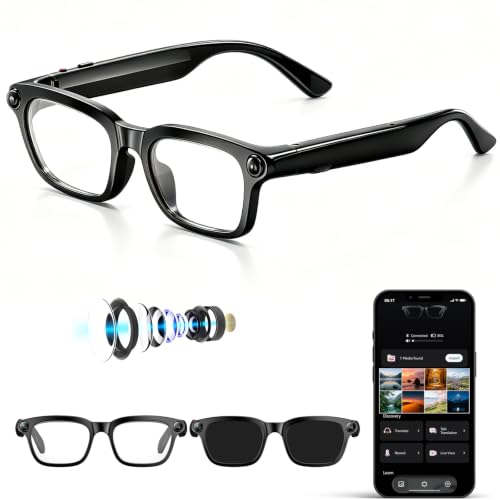
Best for Everyday Open-Ear Listening: Giwbeiv Aviator Smart Glasses, Photochromic Lens
The Giwbeiv Aviator Smart Glasses, Photochromic Lens combine Bluetooth 5.3 audio with sunglasses-style lenses and touch controls. The listing specifies wear-sensing power on and off, hands-free calling, and up to 7–8 hours of continuous use. That feature mix could suit someone who wants music or calls while keeping their ears uncovered, rather than someone seeking sealed headphones or a standalone camera-equipped pair.
Reasons to buy:
- Open-ear speakers let you listen without wearing earbuds over or in your ears.
- The listing claims photochromic lenses darken under direct UV and become clear again after resting indoors.
- Touch controls are listed for calls, playback, track changes, and access to a phone’s voice assistant.
Reasons to avoid:
- The listing does not identify supported phone operating systems, so confirm compatibility with your device before ordering.
- Open-ear audio does not isolate you from nearby sound, and people close by may hear some playback. No independent sound or leakage measurements are provided.
Skip it if you need noise isolation, verified prescription-lens support, or confirmed phone compatibility before purchase.
How to Choose Audio Glasses
Decide whether open-ear sound fits your routine
Audio glasses place speakers near your ears rather than sealing your ear canals. That can be convenient for brief calls, podcasts, or music during everyday activities when you prefer not to wear earbuds. It also means they are not a substitute for noise-isolating headphones: outside sound remains audible, and listening in a quiet room may be less private.
Check the listing for explicit open-ear design details and call controls, then consider where you plan to listen. The Giwbeiv pair is described as open-ear and includes touch controls for calls and playback. The published information does not establish how clearly calls sound in wind or busy surroundings, so avoid treating “crystal-clear” as a verified performance result.
Check phone compatibility and Bluetooth details
Bluetooth 5.3 identifies the connection version stated in this listing, but it does not name compatible operating systems, supported audio codecs, multipoint pairing, or app requirements. Those details matter if you want to use voice assistants, switch between a phone and computer, or keep glasses connected to several devices.
Before buying, check the product page or ask the seller whether your phone supports pairing and voice-assistant access. Do not assume that Bluetooth compatibility alone confirms every feature works with every phone. The published information says the glasses connect to a compatible smartphone, but does not list specific phone models or operating systems.
Understand battery claims and charging
Battery life affects whether glasses can cover a commute or a day of calls without an extra charging stop. The listing claims up to 7–8 hours of continuous use and says the magnetic charger can fully charge the glasses in one hour. These are manufacturer-stated figures, not guaranteed results for every volume level, call pattern, or battery condition.
The listing also says sound plays on only one side if only one temple arm is fully charged, and advises charging both arms. That makes charging routine worth checking if you rely on stereo playback. Confirm what charging equipment is included and how the magnetic connector attaches, since the published product details do not specify included accessories.
Evaluate lens behavior and eyewear fit
Photochromic lenses change tint in response to UV exposure, which can reduce the need to switch between clear glasses and sunglasses in some settings. Giwbeiv’s listing says these lenses darken in direct UV and clear after a one-minute rest. The speed and degree of tint can depend on conditions; the listing does not provide a tint range, a standardized UV-transmission value, or a prescription option.
Look for lens measurements, frame sizing, prescription support, and details about how the lenses behave in the environments where you will wear them. None of those specifics appears in the published information. The listing also claims UV and blue-light protection, but provides no stated test method or numerical protection rating to compare with other eyewear.
Match controls and splash resistance to your activities
Touch controls can reduce the need to take out your phone, but their usefulness depends on the available gestures and whether they are easy to use while wearing the glasses. This listing names calls, music playback, track changes, and voice-assistant access. It does not explain the exact tap patterns or whether controls can be customized, so check the manual or seller information if those details matter to you.
The product is listed as IP54 splash resistant and sweat resistant. That rating is not a promise that the glasses can be submerged or exposed to every kind of water. The listing’s stated use suggests everyday splashes and sweat, but buyers should follow the manufacturer’s care instructions and avoid assuming they are suitable for swimming or heavy rain.
How We Compared
This guide draws on the published product listing, including its stated Bluetooth version, open-ear design, touch controls, lens description, charging claim, and IP54 rating. The supplied material includes no customer reviews and no independent performance evidence. Because only one product was provided, the guide describes its potential fit and points out missing details instead of presenting an unsupported ranking against alternatives.
Frequently Asked Questions
Do audio glasses work with every smartphone?
Not necessarily. The listed glasses use Bluetooth 5.3 and are described as connecting to a compatible smartphone, but the published details do not identify supported operating systems or phone models. Confirm compatibility with the seller before buying, especially if voice-assistant access is important.
Can people nearby hear audio from open-ear glasses?
They may. Open-ear speakers do not seal the ear, so some sound can be audible to people nearby, particularly in quiet settings or at higher volume. The published listing provides no sound-leakage measurements, so treat privacy as a possible limitation.
Are photochromic lenses the same as polarized lenses?
No. Photochromic describes lenses that change tint in response to light conditions, while polarization is a separate lens feature. The published listing describes photochromic lenses but does not state that they are polarized. Verify polarization separately if glare reduction from reflected light is a priority.
Can these glasses replace prescription eyewear?
The published product information does not say whether prescription lenses can be fitted. If you need vision correction, ask the seller or an eyewear professional about frame measurements and prescription-lens support before purchasing.
Does IP54 mean the glasses are waterproof?
No. The listing describes IP54 splash resistance, not submersion protection. Follow the manufacturer’s care guidance, and do not assume the glasses are safe for swimming or prolonged exposure to water.



Write Your Review
No reviews yet. Be the first to share your experience!