

A pump that can move water quickly may still be a poor fit if its float switch cannot move freely in your sump pit. The best sump pump for your home depends on whether you need an automatic primary pump, a higher listed flow rate, or a portable pump for occasional draining.
This guide compares listed motor ratings, flow figures, switch and sensor designs, materials, and discharge connections. Check pump suitability against your pit, discharge line, expected water conditions, and the manufacturer’s installation instructions before buying.

Pros
- High stated pumping capacity
- Automatic vertical float switch
- No weep hole needed, per product description
- Five-year warranty
Cons
- Skip if listed pumping height matters; none is provided

Pros
- High stated flow rate
- Removes water down to 1/5 inch
- Multiple discharge adapters included
- Thermal overload protection
Cons
- 10-foot cord may limit placement
- Who should skip it: buyers needing documented noise or runtime details

Pros
- Up to 5,100 GPH capacity
- Automatic vertical float switch
- Top-suction design
- Three-year warranty
Cons
- Who should skip it: Buyers needing more than 5,100 GPH.

Pros
- Automatic float-switch operation
- Top-suction design helps limit clogging
- Three-year warranty
Cons
- Indoor use only
- Who should skip it: anyone needing outdoor water removal
Pros
- Automatic float-activated switch
- Non-clogging vortex impeller design
- Cast iron motor and pump housing
Cons
- Pump capacity not listed
- Who should skip it: buyers needing confirmed performance specifications

Pros
- Automatic float-switch operation
- LED power indicator
- Cast-iron housing
- Vortex impeller design
Cons
- Who should skip it: buyers needing other than 115V

Pros
- Automatic and manual operating modes
- Handles solids up to 1/8 inch
- Includes garden-hose adapters
- 10-foot power cord
Cons
- Maximum flow may differ at higher lift heights
- Who should skip it: buyers needing a specified flow rate at their lift height

Pros
- 23-foot hose and adapters included
- 36-foot lift height
- 25-foot power cord
Cons
- Limited to clean and lightly dirty water
- Who should skip it: users moving heavily debris-filled water

Pros
- Automatic float-switch operation
- Stainless steel casing
- Multiple discharge adapters included
- 16-foot power cord
Cons
- Automatic start requires at least 5.3 inches of water
- Who should skip it: users needing automatic low-water pumping
The Best Sump Pumps by Use Case
Best for Higher Listed Capacity: WAYNE CDU980E 3/4 HP Submersible Sump Pump
The WAYNE CDU980E 3/4 HP Submersible Sump Pump is a basement pump for buyers who want a higher listed flow figure and automatic operation. Its listing specifies a 3/4 HP motor and capacity of up to 5,490 gallons per hour, plus a vertical float switch and top-suction design. The vertical switch may suit a narrow pit, but you still need to check the pump’s fit and the switch’s clearance against your pit dimensions.
Reasons to buy:
- The listed flow rate is the highest among the automatic basement pumps selected here.
- Cast iron and stainless steel construction, plus a 5-year warranty listed by the manufacturer.
- Top-suction design is specified to help prevent clogging and air lock without a weep hole.
Reasons to avoid:
- The listing does not provide a flow curve showing output at different lift heights, so compare its performance at your actual discharge height.
- Its higher motor rating does not establish that it is the right size for every pit or drainage system.
Skip it if you need a portable pump for pools or general water transfer rather than an installed sump-pit pump.
See the Home Safety category for related home-protection guides.
Best for a 1/2 HP Basement Pump: WAYNE CDU800 1/2 HP Submersible Sump Pump
The WAYNE CDU800 1/2 HP Submersible Sump Pump suits buyers seeking an automatic basement pump with a listed capacity between the selected Wayne 1/3 HP and 3/4 HP models. Its listing specifies up to 5,100 gallons per hour, a vertical float switch, and cast iron and stainless steel construction. The top-suction design is intended to reduce clogging and air lock, which may simplify installation by removing the need for a weep hole.
Reasons to buy:
- Listed 1/2 HP motor and flow capacity provide an intermediate option within this selection.
- Vertical float switch supports automatic operation.
- The listing specifies a 1-1/2-inch NPT discharge and a 3-year warranty.
Reasons to avoid:
- The listing does not state its flow at a particular discharge height.
- Confirm that the 1-1/2-inch discharge matches your existing plumbing or planned fittings.
Skip it if your pit needs a pump with a smaller listed motor or you need an included hose for temporary drainage.
Product link: WAYNE CDU800 1/2 HP Submersible Sump Pump.
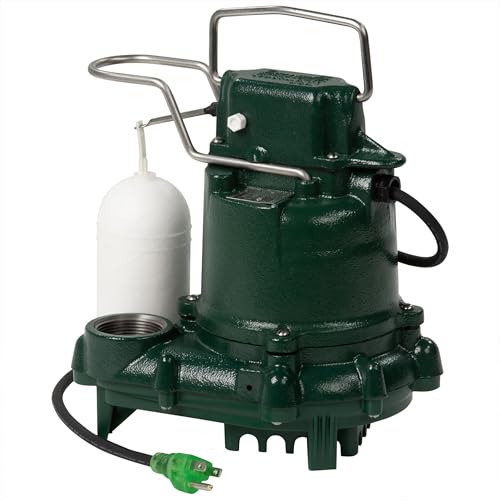
Best for a Vortex Impeller: Zoeller M53 Mighty-mate Submersible Sump Pump
The Zoeller M53 Mighty-mate Submersible Sump Pump is an automatic 1/3 HP basement pump with a float-activated switch. Its listed vortex impeller design is described as non-clogging, while the pump housing, motor, and switch case are cast iron; the base is plastic. This is a straightforward option for buyers who prioritize the specified impeller design and cast-iron components over a published high flow figure.
Reasons to buy:
- Float-activated switch provides automatic operation.
- Vortex impeller is specified as non-clogging.
- Cast iron is used for the housing, motor, and switch case.
Reasons to avoid:
- The published specifications do not give a flow rate, discharge size, or warranty, so verify these details for your installation.
- The listing identifies a plastic base, not an all-metal pump.
Skip it if you need to compare pumps by listed gallons per hour or require a stated discharge connection before purchase.
Product link: Zoeller M53 Mighty-mate Submersible Sump Pump.
Best for Automatic and Manual Modes: Cleartide 1/3 HP Submersible Utility Pump
The Cleartide 1/3 HP Submersible Utility Pump is a portable pump for buyers who want sensor-controlled operation for water removal and a manual mode for other tasks. Its listing specifies automatic start at 1-1/5 inches and stop at 1/5 inch, up to 2,790 gallons per hour, and a maximum lift of 30 feet. The listing also describes shutoff protections, but sensor behavior and suitability for a fixed sump installation should be checked against your needs.
Reasons to buy:
- Dual automatic and manual modes support more than one kind of draining task.
- The listing specifies the water levels at which auto mode starts and stops.
- Includes a 10-foot power cord, elbow, and adapters for a garden hose connection.
Reasons to avoid:
- Its listed flow rate is lower than those of the selected Wayne basement pumps.
- It handles solids up to 1/8 inch, so avoid assuming it can pump water containing larger debris.
Skip it if you need a dedicated installed pump with a specified vertical float switch rather than a portable sensor-based model.
Product link: Cleartide 1/3 HP Submersible Utility Pump.
Best Value for Portable Water Removal: AQUASTRONG 1 HP Sump Pump 4500 GPH Submersible
The AQUASTRONG 1 HP Sump Pump 4500 GPH Submersible is a portable, plug-in pump for buyers who need to drain a flooded area, pool, or garden feature. The listing specifies up to 4,500 gallons per hour at a 5-foot lift, a maximum vertical lift of 30 feet, and bottom suction that can remove water down to 1/5 inch from a surface. It starts and stops by plugging in or unplugging, so it does not offer the listed automatic float control found on the basement models.
Reasons to buy:
- Listed 1/5-inch residual water level may help with shallow water removal.
- Includes adapters for several discharge connections, including a 1-1/4-inch NPT outlet.
- Thermoplastic casing and a 10-foot power cord are specified.
Reasons to avoid:
- Manual plug-in operation means it is not described as an unattended automatic sump pump.
- The 4,500-gallon-per-hour figure is specified at a 5-foot lift; actual flow at other heights is not given.
Skip it if you need a pump that switches itself on and off as sump water rises and falls.
Product link: AQUASTRONG 1 HP Sump Pump 4500 GPH Submersible.
Also Considered
The WAYNE CDU790 1/3 HP Submersible Water Pump may suit buyers who want an automatic 1/3 HP basement pump with a specified capacity of up to 4,600 gallons per hour, though the CDU800 has a higher listed flow figure.
The Zoeller M98 Flow-Mate Sump Pump – 1/2 HP offers an LED power plug and vortex impeller, but its flow figure is lower than the selected Wayne 1/2 HP and 3/4 HP models.
The SEESII 1HP Submersible Water Pump includes a 23-foot hose and lists a 36-foot lift, making it worth considering for portable drainage; its data describes a utility pump rather than a float-controlled primary sump pump.
The LANCHEZ Sump Pump, 1.6HP High Flow Submersible lists a float switch and a 6,000-gallon-per-hour maximum, but its minimum start level and large particle-passage claim call for careful verification against your pit and water conditions.
How to Choose the Best Sump Pump
Match pump type to the job
A primary sump pump sits in a pit and should start automatically when water rises. A portable utility pump is usually intended for tasks such as draining a pool, hot tub, or flooded area, and may need manual switching. The WAYNE CDU980E, CDU800, and Zoeller M53 list float-based automatic operation; the AQUASTRONG listing describes plug-in, plug-out control. Choose by the task, not by motor horsepower alone.
Compare flow at your discharge height
Gallons per hour is useful only when you know the lift height and plumbing conditions behind the figure. AQUASTRONG specifies 4,500 gallons per hour at 5 feet, while several other listings provide a maximum without stating the height for that figure. A higher vertical lift can reduce flow, so check the manufacturer’s flow information for your planned discharge height instead of treating maximum GPH as a guaranteed rate in your basement.
Check switch clearance and operating levels
A float needs room to move without hitting the pit wall, pipes, or pump. A vertical float switch, as specified for the Wayne CDU models, may be useful in a narrow pit, but confirm the exact pump and switch dimensions in the manufacturer’s information. For sensor pumps such as Cleartide, compare its listed start and stop levels with the depth and shape of the area you need to drain.
Verify discharge connections and water conditions
Outlet size determines which pipe or adapter you need. The CDU800 lists a 1-1/2-inch NPT discharge, while AQUASTRONG lists a 1-1/4-inch NPT outlet and several adapters. Also compare particle limits: Cleartide lists solids up to 1/8 inch, whereas AQUASTRONG specifies up to 1/5 inch. Do not infer that a pump can handle sewage or heavy debris unless its specifications explicitly support that use.
Consider materials, cord length, and support
Cast iron, stainless steel, and thermoplastic are specified across these products, but material alone does not establish service life. Compare the warranty and the installation details for the particular model. For example, the selected Wayne models list 3-year and 5-year warranties, while portable pumps may include a hose, adapters, or a longer cord that better fits temporary drainage. Review the Home Appliances category for related equipment guides, including our Levoit and Coway air purifier comparison and the Air Purifiers category.
For any pump, follow its installation instructions and use a suitable, properly grounded electrical outlet in accordance with local requirements. Keep electrical connections protected from water, and do not handle a plugged-in pump while standing in water. If you are unsure whether your wiring, outlet, or discharge setup is appropriate, consult a qualified professional.
How We Compared
This comparison uses the published product specifications and design details, including motor ratings, listed flow and lift figures, switch or sensor operation, materials, discharge connections, included accessories, and stated warranties. Recommendations reflect how the listed features fit different use cases, not a claim that every pump will deliver its maximum figure in every installation.
Frequently Asked Questions
Can a portable utility pump replace an automatic sump pump?
Not necessarily. Some portable models use manual plug-in controls, while an automatic basement pump uses a float switch or sensor to respond to water level. If you need ongoing protection when nobody is present, check that the model is explicitly designed for automatic sump-pit operation and that its control can move or sense water correctly in your pit.
Does a higher GPH rating mean a pump will drain my basement faster?
Not on its own. Flow depends on lift height and the discharge setup, and some listings give a maximum figure without identifying the height. Compare a flow curve or manufacturer guidance at the vertical lift and pipe arrangement you expect to use.
What is the difference between a float switch and an auto water sensor?
A float switch rises or falls with water, while a sensor-based pump detects water electronically according to its listed operating design. The selected Wayne models specify vertical float switches; Cleartide specifies sensor-controlled auto mode with particular start and stop levels. Check clearance, minimum operating depth, and whether the control is intended for a fixed pit or portable drainage.
How do I know whether a pump fits my sump pit?
Compare the pump’s dimensions and switch movement area with the pit’s inside dimensions. Also check that the discharge outlet matches your pipe or available fittings and that the pump’s start and stop levels make sense for the pit. The listing information does not give dimensions for every model, so consult the full manufacturer listing or manual before ordering.
Can these pumps handle dirty water or sewage?
Do not assume so. Product listings specify different particle limits, and those limits do not establish suitability for sewage or every kind of debris. Match the stated solids capacity and intended use to the water you need to move; choose a pump explicitly rated for sewage if that is the task.


Write Your Review
No reviews yet. Be the first to share your experience!