

Finding the best miter saw often involves balancing crosscut capacity against workshop space and jobsite portability. A compact saw handles simple trim and molding with ease, but larger framing lumber or wide composite deck boards demand sliding rails and larger blades that consume significant benchtop depth.
Power delivery and cut accuracy introduce additional considerations. Cordless models bring flexibility outside the workshop, whereas high-amperage corded motors handle continuous, heavy cuts through thick stock. This guide compares 10 leading options across different blade sizes, bevel styles, and power formats to help you match a tool to your specific building and woodworking projects.

Pros
- Miter adjustment up to ±46°
- Soft start and electronic blade brake
- Includes EVOMAX Cermet Carbide blade
- Reinforced base and dual sliding clamps
Cons
- 72.4 lb makes frequent repositioning less convenient
- Who should skip it: buyers needing a lightweight, portable saw

Pros
- Listed for multiple material types
- 45-degree bevel and 50-degree miter
- Sliding design
Cons
- Description includes details for a different metal chop saw
- Who should skip it: buyers needing verified capacity or blade specifications

Pros
- Three TCT blades included
- Two selectable speeds
- Sliding rail and extendable side tables
- Ambidextrous design
Cons
- Skip if you need clearly stated maximum cut capacity

Pros
- Compact rail system supports flush-to-wall placement
- LED shadow line marks the cut path
- Wide left and right miter range
Cons
- Single bevel cuts only to the left
- SRS0001 stand sold separately
- Who should skip it: buyers needing a dual-bevel saw

Pros
- 4.2 x 13-inch maximum cut capacity
- Nine common angle presets
- Laser guide included
- Clamp and dust bag included
Cons
- Check miter alignment before use
- Skip if you need verified alignment without pre-use adjustment

Pros
- Adjustment-free cut line indication
- Eleven positive miter stops
- Compact 30 lb design
Cons
- Tool only; battery and charger not included
- Who should skip it: buyers needing a complete kit

Pros
- LED cutting-line guide
- Sliding design for wider crosscuts
- Bevels left and right up to 45°
Cons
- 46.43 lb may be cumbersome to move
- Skip it if you need a lightweight, frequently moved saw

Pros
- XPS LED shadow line for cut alignment
- Adjustment-free cutline indication
- Manufacturer claims over 75% dust capture
Cons
- About 55 lb, which may limit portability
- Who should skip it: Buyers prioritizing a lighter saw

Pros
- 12-inch double-bevel sliding design
- Compatible with DEWALT 20V MAX and FLEXVOLT batteries
- Dust bag and vacuum adapter included
- Adjustment-free cut line indication
Cons
- Battery not included
- Vacuum sold separately
- Who should skip it: buyers needing a complete cordless kit
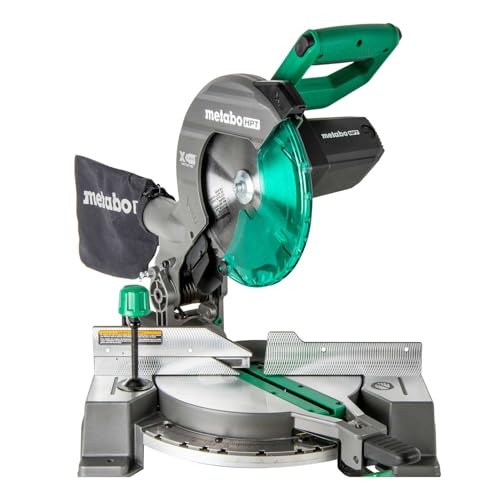
Pros
- Lightweight 24.2-pound design
- Miter adjustment left and right
- Large work table
- Vice clamping system included
Cons
- Left-only bevel; skip if you need right-tilting bevel cuts
Key Factors in Choosing the Best Miter Saw
Blade Diameter and Cutting Capacity
Blade size determines the baseline depth and height of your cuts. A standard 7-1/4-inch blade easily cuts nominal two-by-fours and small baseboards, making it suitable for basic household trim. Stepping up to 10-inch or 12-inch blades increases vertical clearance for standing baseboards and nested crown molding. For wider boards, sliding rails expand horizontal reach, allowing a 12-inch model to slice through boards up to 14 inches wide in a single pass. However, larger blades require more motor power and introduce a small risk of blade deflection when cutting dense hardwoods.
Single Bevel vs. Dual Bevel Adjustments
Bevel capabilities dictate how you tilt the saw head to make angled cuts through the thickness of the board. Single-bevel saws tilt in one direction, typically to the left, which means you must flip long boards around to cut opposite angles. Dual-bevel saws tilt both left and right, allowing you to keep material flat against the table while adjusting the saw arm. This design saves considerable time during crown molding installation, though dual-bevel mechanisms add weight and mechanical complexity to the tool head.
Corded Power vs. Cordless Mobility
Power source affects where and how long you can cut. A 15-amp corded motor provides consistent rotational speed under heavy resistance, avoiding the drop in performance that can occur as battery cells drain. Battery-powered saws allow you to work in yards, unpowered framing sites, or remote corners without dragging extension cords. The trade-off comes down to continuous runtime, as high-draw tasks like cutting framing lumber or thick composite materials will deplete batteries faster than light trim work.
Cut Alignment Systems: Shadows vs. Lasers
Accurate cut alignment reduces measurement mistakes and wasted material. Traditional laser guides project a line along the workpiece, but bright sunlight can wash them out, and physical impacts can knock them out of calibration. Modern LED shadow lines cast a direct shadow of the actual blade kerf onto the lumber. Because the shadow uses the real blade teeth, it never requires recalibration after blade swaps, providing dependable visual alignment across varied lighting conditions.
Workshop Footprint and Rail Design
Traditional sliding miter saws feature rear rails that extend several inches behind the tool during a stroke, requiring substantial clearance away from garage or shop walls. Saws with fixed forward rails or axial gliding designs allow you to set the machine nearly flush against a workbench wall. If you work in a tight single-car garage or a compact utility shed, choosing a saw engineered with space-saving slide mechanisms keeps walkways clear and maximizes your available bench surface.
How We Compared These Products
Our editorial team analyzed the 10 models by reviewing manufacturer technical specifications, published dimensional limits, motor designs, and reported buyer experiences. We evaluated structural factors such as base rigidity, sliding mechanism style, detent accuracy, bevel range, and stated material compatibility across wood, composite, and metals to provide balanced recommendations.
Which Option Fits Your Needs?
For large-scale woodworking and heavy trim jobs, the DEWALT 12-inch Double Bevel Miter Saw (DWS780) offers substantial capacity. Its 15-amp motor turns at 3,800 RPM, and the XPS LED shadow system delivers precise cut alignment without recalibration. Dual-bevel capability keeps boards stationary during compound cuts, and the integrated dust management collects up to 75% of debris.
Pros: High crosscut capacity, accurate LED shadow system, sturdy base design.
Cons: Heavy frame takes up significant bench space.
Who should skip it: Woodworkers with small bench surfaces or buyers needing a lightweight saw to haul between job sites.
When portability and remote operation matter most, the DEWALT 20V MAX 7-1/4-Inch Miter Saw, Tool Only provides practical cordless performance. Weighing roughly 30 pounds, it features an integrated shadow cutline indicator, an 11-stop detent plate, and vertical clearance for 3-1/2-inch baseboards. It runs on existing 20V MAX battery packs, eliminating tangled cords on quick trim jobs.
Pros: Highly portable, adjustment-free shadow line, easy to transport up stairs.
Cons: Smaller blade restricts wide lumber crosscuts; requires separate batteries and charger.
Who should skip it: Builders regularly cutting thick framing timber or wide deck planks who need continuous corded power.
For DIY woodworkers seeking a basic, dedicated shop tool for standard lumber, the Metabo HPT 10-Inch Compound Miter Saw, 15-Amp delivers reliable utility. Weighing only 24 pounds, it combines a 15-amp, 5,000 RPM motor with a 0-to-52-degree miter angle range and positive stops for clean framing cuts and basic joinery.
Pros: Lightweight frame, high motor speed, generous miter angle range.
Cons: Single-bevel design requires flipping material for opposite angle cuts; non-sliding arm limits wide board capacity.
Who should skip it: Remodelers working with wide shelving boards, wide composite decking, or intricate crown molding.
Frequently Asked Questions
What is the difference between a compound and a sliding miter saw?
A compound miter saw tilts on a pivot to cut bevels and swivels side-to-side for miter angles, but the blade head moves strictly up and down. A sliding miter saw adds horizontal rails, allowing the motor and blade assembly to slide forward and back. This sliding movement significantly widens the crosscut capacity, enabling you to cut wide planks and shelving that stationary compound saws cannot handle in one stroke.
Can I use a wood miter saw to cut metal?
Standard wood miter saws spin at higher speeds than dedicated cold-cut metal saws, which can overheat metal-cutting blades and create safety hazards. Dedicated metal chop saws or multi-material models operate at adjusted speeds and utilize reinforced gearboxes and spark guards. Always ensure the tool rating and blade specifications explicitly list metal cutting before attempting to cut iron, steel, or aluminum.
Why are LED shadow lines often preferred over laser guides?
LED shadow systems shine light from both sides of the blade, casting a sharp shadow of the blade teeth directly onto the workpiece. Because the shadow matches the exact physical width of the kerf, it remains accurate even after swapping blade thicknesses. Laser lines, in contrast, project along one edge of the blade and can become misaligned through jobsite vibration or temperature shifts.
How much dust does a miter saw dust bag actually collect?
Passive cloth dust bags capture only a portion of the sawdust generated by high-speed spinning blades, often missing fine airborne particles. Saws connected to a dedicated shop vacuum or dust extraction system capture significantly more debris. For enclosed workshops, hooking the dust port to an active extractor improves air quality and keeps your cut markings visible.
What safety gear should I wear when operating a miter saw?
Always wear ANSI-approved eye protection to shield against flying wood chips, along with hearing protection to reduce motor and blade noise exposure. Avoid wearing gloves, loose sleeves, or dangling jewelry near the rotating blade, as loose items can catch in moving parts. Always clamp down smaller workpieces instead of holding them close to the blade pathway by hand.




Write Your Review
No reviews yet. Be the first to share your experience!