

Breaking new ground takes more than a compact cultivator, while a wide, corded tiller can feel awkward in a small raised bed. The right choice depends on garden size, soil condition, access to an outlet, and whether you already own a compatible battery platform.
This guide compares the best electric cultivator options by listed working width, depth, power source, and useful design details. Use those specifications to narrow the field, then check the manufacturer’s listing for current compatibility and operating instructions before buying.

Pros
- Uses compatible Milwaukee M18 batteries
- Built-in battery level indicator
- Dual-action safety switch
Cons
- Skip it if you lack compatible M18 batteries; charger excluded

Pros
- Two batteries and charger included
- Detachable tines simplify cleanup
- Compact 9-inch tilling width
Cons
- Six-inch listed depth limits deeper cultivation
- Who should skip it: gardeners needing wider coverage or deeper tilling

Pros
- 16-inch tilling width
- Three-position wheel adjustment
- Folding handle
- No gas or oil
Cons
- Corded design limits mobility
- Skip it if you need cordless operation

Pros
- Cordless operation
- Compatible with listed DeWalt 20V MAX batteries
- Battery charge indicator on handle
- Lightweight 9.4 lb design
Cons
- Battery and charger not included
- Not intended for dense grass
- Who should skip it: gardeners needing wider or deeper tilling

Pros
- 16-inch maximum cutting width
- 9-inch cutting depth
- Adjustable three-position transit wheel
Cons
- Who should skip it: buyers needing documented weight or runtime

Pros
- Adjustable 18-inch or 12.6-inch tilling width
- Foldable handles
- Operates without gas or oil
Cons
- Who should skip it: buyers who need a gas-powered tiller
Pros
- Wide 18-inch working width
- Cultivates up to 9 inches deep
- Folding handles for storage
- Lifetime technical support
Cons
- Corded design limits mobility
- Who should skip it: gardeners needing cordless mobility

Pros
- Four durable steel tines
- Lightweight 8.8-pound design
- Suitable for small gardens and flower beds
Cons
- Corded power limits mobility
- Who should skip it: gardeners needing a wider working path

Pros
- Compact path for small garden areas
- Four durable steel tines
- No gas or oil required
- Adjustable shaft and ergonomic handle
Cons
- Cord placement needs attention while working
- Narrow path is less suited to large areas
- Skip it if you need to cultivate large spaces quickly

Pros
- Compact cultivating width
- Light 9.9-pound weight
- Four steel blades
- Lifetime technical support
Cons
- Corded design limits working range
- Who should skip it: gardeners cultivating large areas
The Best Electric Cultivators by Use Case
Best for Wider Corded Coverage: Sun Joe Corded Electric Garden Tiller & Cultivator
The Sun Joe Corded Electric Garden Tiller & Cultivator suits gardeners preparing broader beds who can work near an outlet. Its listing specifies a 12-amp motor, a working width of up to 16 inches, and tilling depth of up to 8 inches. Six steel tines and three-position wheel adjustment make it a practical option when you want a full-width pass and adjustable transport support. Compare other corded lawn and garden equipment if you are building out a powered-tool setup.
Reasons to buy:
- 16-inch maximum working width covers more ground per pass than compact cultivators in this guide.
- Three-position wheel adjustment gives you options for moving and controlling the tiller.
- Folding handle supports more compact storage and transport.
Reasons to avoid:
- The cord limits movement and requires access to a suitable outdoor power source.
- Its listed maximum depth is 8 inches, less than some wider alternatives that specify 9 inches.
Skip it if you need to move freely around a yard without managing a cord or mainly cultivate narrow beds.
Best for Battery Freedom with Included Batteries: GARDTECH 20V Cordless Tiller Cultivator,330 RPM
The GARDTECH 20V Cordless Tiller Cultivator,330 RPM is a cordless choice for gardeners who want to avoid an extension cord and do not already have a compatible battery. Its listing includes two 20V 4.0Ah batteries and a charger, and claims up to 40 minutes of continuous runtime using both batteries. The tiller works up to 9 inches wide and 6 inches deep, so it fits smaller plots and raised beds better than broad garden rows.
Reasons to buy:
- Two batteries and a charger are listed as included, so buyers do not need to supply a battery separately.
- The listing claims up to 40 minutes of continuous runtime with both batteries.
- Detachable tines can be removed to clear soil and weeds after use.
Reasons to avoid:
- The 9-inch width and 6-inch depth suit smaller cultivation jobs, not rapid coverage of large plots.
- The stated runtime is a manufacturer claim; actual working time may vary with soil and use.
Skip it if you prefer the continuous power of a corded machine or need a wider working path.
Best for Milwaukee M18 Owners: GELIDALITE Cordless Tiller Cultivator
The GELIDALITE Cordless Tiller Cultivator is a bare tool designed for users with compatible Milwaukee M18 batteries. The listing names M18 battery models, a 9-inch working width, and a maximum depth of 7 inches. It also specifies a 300W peak motor and 360 RPM, plus a battery-level indicator, so existing M18 owners can consider it for focused bed preparation without buying another listed charger and battery set.
Reasons to buy:
- Compatibility is specified for standard Milwaukee M18 cordless platforms, with example battery model numbers in the listing.
- A battery status indicator helps you monitor charge while working.
- The listed 9.4 lb weight and soft-grip handle are aimed at manageable operation.
Reasons to avoid:
- Battery and charger are not included; confirm that your exact battery is supported before purchase.
- The 9-inch path is narrow compared with corded tillers designed for wider garden rows.
Skip it if you do not own a compatible M18 battery and do not want to purchase one separately.
Best for DeWalt 20V MAX Owners: HEINPRO Cordless Tiller Cultivator Compatible
The HEINPRO Cordless Tiller Cultivator Compatible is another bare-tool option, this time for gardeners who already use supported DeWalt 20V MAX batteries. Its listing names compatible battery models, a 9-inch working width, and a 7-inch maximum depth. A dual safety switch, battery charge indicator, adjustable handle, and listed 9.4 lb weight add practical details for cultivating smaller flower beds and vegetable patches. Check the specific battery model against the listing because the battery and charger are not included.
Reasons to buy:
- The listing identifies a range of DeWalt 20V MAX battery models for compatibility checking.
- The charge indicator provides a visible battery-level reference during work.
- The dual safety mechanism requires pressing the safety lock and trigger together to operate.
Reasons to avoid:
- Battery and charger are not included, which adds a separate compatibility and purchase consideration.
- A 9-inch working width covers less ground per pass than the 16- and 18-inch corded models.
Skip it if you lack a compatible DeWalt battery or want a cultivator that arrives with its own battery system.
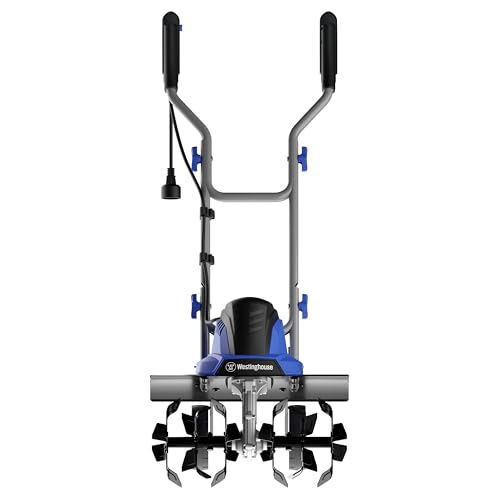
Best for Medium to Large Beds: LawnMaster 13.5 Amp 18” Electric Tiller – TE1318M
The LawnMaster 13.5 Amp 18” Electric Tiller – TE1318M is a corded model for gardeners who prioritize a wide path and want the option to narrow it. The listing specifies an 18-inch maximum width, a 9-inch depth, and detachable tines that switch the working width to 12.6 inches. Mechanical overload protection shuts the cultivator off if a foreign object blocks it, while foldable handles and three-position transit wheels address storage and movement.
Reasons to buy:
- Detachable tines let you choose between 18-inch and 12.6-inch working widths.
- The listed 9-inch maximum depth supports deeper bed preparation than several compact models.
- Mechanical overload protection is specified to shut the unit off when a foreign object blocks it.
Reasons to avoid:
- The cord restricts range and can be inconvenient in gardens far from an outlet.
- The wider cutting setup may be more machine than needed for small raised beds.
Skip it if you need cordless access or a compact cultivator for narrow planting spaces.
Also Considered
The Westinghouse 18-Inch, 15 Amp Corded Electric may suit gardeners who want an 18-inch path, a listed 9-inch depth, and a 2-year limited warranty, but its cord still limits reach. The LawnMaster TE1216M Electric Tiller 12-Amp, 16-Inch could fit medium beds where a 16-inch path and adjustable transit wheel matter, though its listing provides fewer operating and storage details than the selected options. For small plots, the Earthwise TC70025 7.5” 2.5-Amp Corded Electric specifies a narrow 7.5-inch path and 6-inch depth, while the Sun Joe Corded Electric Garden Cultivator specifies a 6.3-inch path and telescoping shaft. The Westinghouse 6-Inch, 2.5 Amp Corded Electric Mini is another compact choice, with a listed 6.3-inch width, 6-inch depth, and 2-year limited warranty. Each smaller model covers less ground per pass than a full-width tiller.
For other powered outdoor jobs, browse weed eaters for trimming and edging or compare mulching mower parts for lawn care.
How to Choose the Best Electric Cultivator
Match the working width to your beds
Width affects how many passes you need. Models in this group range from compact paths of about 6 to 9 inches to corded tillers with maximum widths of 16 or 18 inches. A narrow machine can be easier to position in a raised bed or between established planting areas, but it takes more passes across an open plot. A wider tiller can cover ground faster, although it needs room to maneuver.
Check whether the listed width is fixed or adjustable. The LawnMaster TE1318M, for example, lists two working widths using six or four tines. Do not assume that another model offers the same adjustment simply because its listing mentions steel tines.
Consider depth alongside your soil and task
Listed maximum depth varies across these cultivators, from 6 inches on several compact options to 9 inches on some wider machines. Greater listed depth may suit deeper bed preparation, while a shallow pass can be more appropriate for surface cultivation or weed control. Soil condition also matters: a specification does not establish how easily a machine will work in your particular ground.
Compare width and depth together rather than using one number as a shortcut for capability. If your soil is compacted or hard, review the manufacturer’s guidance and consider whether a small cultivator is intended for the job. The GELIDALITE listing recommends a back-and-forth motion in hard-packed soil, but that guidance applies to that product, not every tiller.
Choose corded power or a battery platform
A corded cultivator avoids battery runtime limits, but you need access to power and must manage the cord as you work. The Sun Joe and LawnMaster corded models provide wider listed paths, making them candidates for larger beds near an outlet. Follow the product manual’s electrical and operating instructions, and keep the cord positioned safely away from the tines.
Cordless models allow movement without an extension cord, but battery inclusion and compatibility vary. GARDTECH lists two batteries and a charger; GELIDALITE and HEINPRO are bare tools, with battery systems tied to Milwaukee M18 and DeWalt 20V MAX, respectively. Confirm the exact battery model, what the package includes, and any stated runtime before choosing.
Check controls, handling, and storage details
Weight, handle design, wheels, and folding parts affect how a cultivator fits your routine. The listings describe the HEINPRO and GELIDALITE models as 9.4 lb, while the Westinghouse 18-inch model is listed at 24 lb. Those figures can help you compare stated weights, but they do not replace considering how you will move, turn, and store the machine.
Look for features that address your particular task. Adjustable or transit wheels can help with positioning; folding handles can reduce storage footprint; detachable tines can change working width or make cleanup easier. Safety controls also differ: HEINPRO specifies a dual safety switch, while LawnMaster lists mechanical overload protection on the TE1318M. Verify each feature on the exact model listing rather than transferring it to another cultivator from the same brand.
How We Compared
We compared the published product listings by power source, stated motor details, working width and depth, battery inclusion or compatibility, and practical features such as adjustable wheels, folding handles, tine options, and safety controls. Customer rating information was also supplied, but the provided data contains no review text to assess. Manufacturer runtime and capability statements are treated as listing claims, not independently verified results. When a detail such as battery inclusion or compatibility affects the choice, check the current listing and product manual before purchase.
Frequently Asked Questions
Is a corded or cordless cultivator better for a home garden?
Neither power source suits every garden. A corded model can make sense when beds are near an outlet and you want a wider listed working path. A cordless model suits areas where a cord would restrict movement, provided its battery system and runtime fit your needs.
Can a cordless cultivator use batteries I already own?
Only when the product specifically supports your battery platform and model. The GELIDALITE listing names Milwaukee M18 compatibility, while HEINPRO names DeWalt 20V MAX models. Both are listed as bare tools without a battery or charger, so confirm the exact model and fit before ordering.
Do these cultivators include batteries and chargers?
Package contents vary. GARDTECH lists two 20V 4.0Ah batteries and a charger. GELIDALITE and HEINPRO explicitly describe their products as tool-only or say that the battery and charger are not included. Check the exact listing because accessories should not be assumed from another model.
What working width should I choose for raised beds?
Measure the space between bed edges and any established plants, then compare it with the cultivator’s listed width. Compact models with paths around 6 to 9 inches may be easier to place in tighter areas. Wider models can reduce passes in open beds but may be cumbersome where turning room is limited.
Can a small electric cultivator break hard or compacted soil?
Product listings describe different capabilities, but they do not establish results for every soil type or condition. Check the manufacturer’s instructions for your model and soil, and consider a machine’s listed depth, width, and motor details as selection information rather than a guarantee. The GELIDALITE listing specifically advises a back-and-forth motion for hard-packed soil.
What is the difference between a mini cultivator and a wider tiller?
A mini cultivator generally has a narrower listed path, which can help with small beds and limited spaces but means more passes over a larger plot. Wider tillers cover more ground per pass and may suit larger planting areas. Compare the actual width and depth figures, along with storage space and power access, rather than relying on the product name alone.




Write Your Review
No reviews yet. Be the first to share your experience!