

Cold outdoor shifts create competing needs: you want dependable warmth, but a bulky coat can restrict movement, and ordinary outerwear may not provide the visibility your job calls for. This guide compares heated jackets for work by heating zones, battery claims, weather protection, care instructions, and high-visibility features.
Start with your job’s safety requirements, then compare warmth and battery details. A high-visibility jacket is not automatically suitable for every worksite, and advertised runtime depends on the selected heat setting. Check the listing and your employer’s requirements before choosing.

Pros
- Rechargeable battery included
- Flexible fabric intended for mobility
Cons
- Skip if you need a stated runtime or waterproof rating

Pros
- Five heating zones
- Three adjustable heat settings
- 15,000mAh battery included
- Machine-washable construction
Cons
- Only yellow, X-Large variant specified
- Skip it if you need another size or color

Pros
- Battery pack included
- Graphene heating technology
- Flexible, soft fabric
Cons
- Runtime and heating settings are not specified
- Who should skip it: buyers who need a stated runtime

Pros
- Battery included
- Three heat settings
- 15 heating zones
- Machine washable shell
Cons
- Battery must be removed before washing
- No tumble drying or ironing
- Skip it if you need warmth without battery care

Pros
- 15 heating zones
- Independent front and back heat controls
- Three temperature settings
- Battery pack doubles as a power bank
Cons
- Battery must be removed before washing
- Skip it if you need warmth beyond the stated up-to-12-hour heating time

Pros
- Heating across six body areas
- Dedicated hand-heating feature
- Four heat modes
- Removable-battery machine-wash instructions
Cons
- Advertised runtime varies by description
- Who should skip it: workers whose site requires a different safety class
Pros
- Six heating zones plus hand heating
- Four heat modes
- ANSI Class 3 high-visibility claim
- Machine washable with battery removed
Cons
- Runtime claims vary from 11-plus to 16 hours
- Skip it if you do not need heated high-visibility workwear

Pros
- 10,000 mAh power bank included
- Waterproof, windproof shell
- 3M reflective tape
Cons
- Manual sizing may have measurement error
- Who should skip it: buyers unwilling to size up for a loose fit

Pros
- Battery pack included
- Water-repellent soft shell
- High abdominal pockets
Cons
- No heating runtime listed
- No electrical safety certification listed
- Who should skip it: buyers needing specified runtime or certification
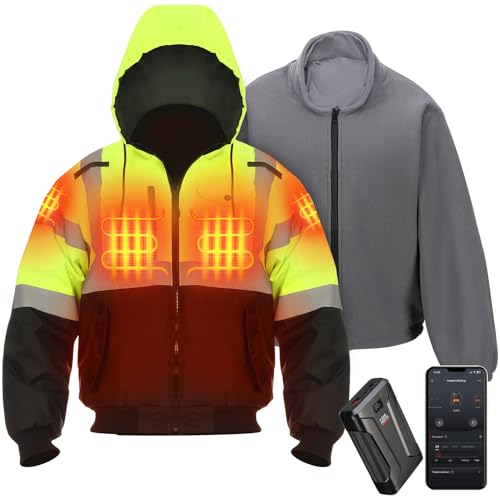
Pros
- Seven heating elements across four zones
- Detachable fleece liner and outer shell
- App and manual heat controls
- 77Wh battery included
Cons
- IPX4 rating indicates limited water resistance
- High setting runtime stated at 5.5 hours
- Who should skip it: workers needing stronger water protection
The Best Heated Jackets by Use Case
Best for Roadside Visibility: Heated Safety Jacket for Men, Class 3, Waterproof
The INNOWARM Heated Safety Jacket for Men, Class 3, Waterproof is the clearest fit here for workers who need a high-visibility layer. Its listing specifies ANSI/ISEA 107-2020 Class 3 reflective tape, five heating zones, and a 15,000mAh, 53 Wh battery, with up to eight hours of warmth claimed. That combination makes it worth considering for roadside work and low-light shifts, subject to your employer’s safety rules. Browse more outdoor tech guides for related gear comparisons.
Reasons to buy:
- Listing specifies ANSI/ISEA 107-2020 Class 3 visibility and reflective tape.
- Five heating zones and three heat settings offer adjustable coverage.
- Waterproof, windproof, machine-washable construction is specified.
Reasons to avoid:
- Claimed runtime reaches up to eight hours, which may not cover every long shift.
- Confirm the jacket’s exact compliance and fit meet your worksite rules.
Skip it if you need a longer stated runtime or do not need high-visibility clothing. View the INNOWARM jacket.
Best for Separate Front and Back Control: HOOHEAT Heated Jacket for Men with 16000mAh
The HOOHEAT Heated Jacket for Men with 16000mAh suits workers who want to adjust front and back heating separately rather than run all zones as one setting. Its listing describes 15 carbon-fiber heating zones, three heat levels, a hood, and a 16,000mAh battery, with up to 12 hours of heating claimed. It is a general outdoor-work option, not a listed high-visibility safety jacket.
Reasons to buy:
- Separate front and back controls allow more specific heat adjustment.
- Fleece lining and hood add coverage without relying on a separate hooded layer.
- Battery includes USB and Type-C ports and is described as a power bank.
Reasons to avoid:
- Up to 12 hours is a listing claim, not a guarantee for every setting or workday.
- No high-visibility class or certification is specified in the published details.
Skip it if your job requires certified high-visibility apparel or you need a jacket listing that specifies a waterproof rating.
Best for a Detachable-Layer Design: KEMIMOTO 149°F Heated Safety Jacket Men with 77WH
The KEMIMOTO 149°F Heated Safety Jacket Men with 77WH takes a modular approach: its detachable fleece liner and outer shell can be worn together or separately, according to the listing. It has four heat zones, app or manual control, reflective tape, and an 8000mm water-resistance specification. The listing describes an IPX4 rating, so treat it as protection against splashes rather than assuming it suits prolonged heavy rain.
Reasons to buy:
- Detachable liner and outer shell offer several layering arrangements.
- App and manual controls provide two ways to adjust the heat.
- Battery runtime claims vary by setting: up to 12 hours on low and 5.5 hours on high.
Reasons to avoid:
- Four heating zones provide less listed coverage than jackets with 15 zones.
- IPX4 and 8000mm specifications do not establish suitability for every wet-work condition.
Skip it if you need a fixed, simple coat or your work requires a particular high-visibility certification. Verify the exact safety standard with your employer.
Best for Hand Heating: Eoyekli Heated Safety Jacket for Men
The Eoyekli Heated Safety Jacket for Men is aimed at workers who want warmth that extends to their hands as well as their torso. Its listing describes six heating zones, including hand heating, four heat modes, and a 20,000mAh battery, with up to 16 hours of continuous heating claimed. It also claims ANSI Class 3 visibility and a machine-washable design when the battery is removed. Two published listings share this product name and feature set; check the selected listing and variant before ordering.
Reasons to buy:
- Hand-heating feature may suit outdoor tasks where fingers get cold.
- Four modes and a stated 20,000mAh battery offer several options for managing warmth.
- High-visibility design is described as ANSI Class 3, with reflective strips.
Reasons to avoid:
- Runtime and visibility-distance figures are manufacturer listing claims, not independently verified results.
- The published details do not state a specific water-resistance rating.
Skip it if your job needs a documented waterproof rating or your employer requires a different high-visibility standard. Review this Eoyekli listing.
Best for Broad Heating Coverage: Men’s Heated Jacket with 10000mAh Battery
The XINSONYUELL Men’s Heated Jacket with 10000mAh Battery is a non-high-visibility option for workers who prioritize coverage across the body and arms. The listing describes 15 carbon-fiber heating zones, three settings, and a 10,000mAh battery, with claimed runtimes of up to 12 hours on low, eight on medium, and four on high. It has a water-repellent nylon shell, hood, and machine-wash instructions that require removing the battery and sealing the USB cover.
Reasons to buy:
- Fifteen listed heating zones include the neck, abdomen, back, and arms.
- Runtime claims are given separately for low, medium, and high settings.
- Battery can also charge a phone over USB, according to the listing.
Reasons to avoid:
- Water-repellent is not the same as a stated waterproof rating.
- No high-visibility classification is provided in the published product details.
Skip it if you need reflective safety clothing or a jacket specified for sustained rain exposure. Follow the listed washing instructions and remove the battery before cleaning.
Also Considered
The Wulcea Men Heated Jacket Battery Pack Included comes in brown and black listings with graphene heating and a stated 12V, 18,400mAh battery, but published details do not specify heat zones, runtime, or safety classification, so it is harder to compare for worksite needs.
The Wulcea Men Heated Graphene Jacket 12v Battery Pack also lists a 12V, 18,400mAh battery and water-repellent soft-shell fabric, but gives no specific runtime or worksite visibility details.
The SKSAFETY Professional Level Heated Safety Bomber specifies ANSI 107 Type R Class 3 compliance, 3M reflective tape, and a 10,000mAh battery with a claimed four-to-eight-hour runtime; its shorter stated runtime makes it less suited to buyers prioritizing long shifts between charges.
The Eoyekli Heated Safety Jacket for Men listing with ASIN B0H6PXGQQ7 has the same published feature description as the other Eoyekli listing. Compare the exact selected listing and variant before purchase.
How to Choose the Best Heated Jacket for Work
Match visibility to the job
For road work, construction, or another low-light setting, reflective clothing may be a job requirement rather than a preference. Check the exact standard, class, and garment type shown on the product listing, then compare them with your employer’s rules. INNOWARM, Eoyekli, and SKSAFETY listings specify high-visibility classifications, but those claims do not replace workplace approval. A reflective appearance alone does not establish compliance.
Compare battery runtime by heat setting
Battery capacity is one part of the decision; the listed runtime at the setting you expect to use is more directly useful for planning a shift. The XINSONYUELL and KEMIMOTO listings separate runtime claims by heat level, while other listings give a maximum figure or a broader range. Maximum runtime usually refers to a particular setting, so check the fine print and plan for charging access or a compatible spare only if the product documentation confirms one.
Choose heating coverage for your tasks
More zones can spread warmth across more areas, but zone count alone does not tell you how warm the jacket will feel or how evenly it heats. Look at the locations named in the listing: HOOHEAT describes coverage across the shoulders, chest, abdomen, pockets, collar, and back, while Eoyekli adds hand heating. Separate front and back control can help you adjust coverage without changing every zone together. Match those details to how much you move and which areas need warmth.
Read weather and care claims precisely
Water-repellent fabric, waterproof construction, and an IPX rating are not interchangeable descriptions. Check the exact rating and construction details, and do not infer that a garment can handle prolonged rain from a general weather-ready claim. Care instructions matter too: most battery-powered jackets need the battery removed before washing. Follow the specific listing’s instructions, including any directions for covering charging ports or using a laundry bag.
Check fit, layers, and controls
A heated jacket needs enough room for the layers you wear on shift without getting in the way of movement. Use the product’s size chart rather than assuming your usual size will fit over work clothing. A detachable liner, like KEMIMOTO’s, offers more layering choices; a hood may be useful in exposed conditions, but can add coverage you do not need. Also check how the heat controls work and whether app control is acceptable under your workplace’s phone-use rules.
How We Compared
This comparison uses the published product listings, including stated battery capacities and runtime claims, heating-zone descriptions, weather and care details, and safety classifications. We considered how those features fit different work situations, such as roadside shifts, wet conditions, and jobs where hand warmth or adjustable coverage matters. The listing information includes no customer feedback, so recommendations rely on listed details and distinguish manufacturer claims from verified requirements buyers should confirm.
Frequently Asked Questions
Can a heated jacket replace required high-visibility workwear?
Do not assume it can. Check your employer’s requirements and the jacket’s exact listed standard, class, and garment type. A product description that says “reflective” does not by itself prove it meets a particular workplace rule.
How long will a heated work jacket stay warm?
It depends on the model and heat setting. Listings in this guide claim runtimes ranging from several hours to as much as 16 hours, but maximum figures may apply only to a low setting. Check the runtime table or claim for each setting and plan around your actual shift.
Does a larger battery capacity guarantee longer warmth?
No. Capacity alone does not show how long a jacket will run because heating zones and selected heat levels also affect power use. Compare stated runtimes under similar conditions where the listing provides them, and treat advertised figures as manufacturer claims.
Can I wash a battery-powered heated jacket?
Some listings describe their jackets as machine washable, but the battery must be removed first. Follow the specific care directions for the model, including instructions for the USB port cover, wash cycle, and drying. Do not assume every heated jacket has the same care requirements.
Do these jackets work with any power bank?
Compatibility is not established across these models by the listing information. Several products are described as including a dedicated battery pack, and the listings may specify particular voltage or connections. Use the included or manufacturer-approved battery and check the product documentation before connecting another power source.
Is a water-repellent jacket suitable for heavy rain?
Not necessarily. Water-repellent fabric helps resist moisture, but that description is not the same as a specified waterproof rating. For wet work, check the exact rating and construction details, then confirm that they meet the conditions and clothing rules for your job.



Write Your Review
No reviews yet. Be the first to share your experience!