

Cold garages pose a practical heating challenge: a portable heater can move with your work, while a mounted model can keep floor space clear. This guide to the best space heater for cold garage use compares two infrared options and explains how power, installation, and exposure to outdoor conditions affect fit.

Pros
- Dual infrared quartz and PTC heating
- Adjustable thermostat from 50 to 85°F
- Remote control and 12-hour timer
- Caster wheels for moving between rooms
Cons
- Skip if you need a lightweight heater for frequent carrying
Pros
- Three power settings
- Remote controlled
- Wall and ceiling brackets included
- Listed for indoor and outdoor use
Cons
- No thermostat; skip if automatic temperature control matters
The Best Space Heaters by Use Case
Best for Portable Garage Use: Dr Infrared Heater DR-968 Portable Space Heater
The Dr Infrared Heater DR-968 Portable Space Heater suits someone who wants a movable, plug-in heater for an enclosed garage workspace. Its listing specifies 1,500 watts, a dual infrared quartz and PTC heating system, caster wheels, and a remote. A thermostat adjustable from 50 to 85°F and a 12-hour shut-off timer give you control over operation, though the listing does not establish how quickly it can warm a particular garage.
Reasons to buy:
- Caster wheels make it easier to reposition the 19 lb heater around a work area.
- High and low settings, an adjustable thermostat, and remote control offer several ways to manage heat.
- The listing specifies tip-over and overheat protection, plus a 12-hour automatic shut-off timer.
Reasons to avoid:
- It draws 12.5 amps at 1,500 watts, so check the garage circuit and other devices sharing it before use.
- The listing describes it for a large room but gives no specific garage size or insulation conditions. Treat coverage as dependent on your space.
Skip it if you need a heater specified for outdoor exposure or want a wall- or ceiling-mounted installation.
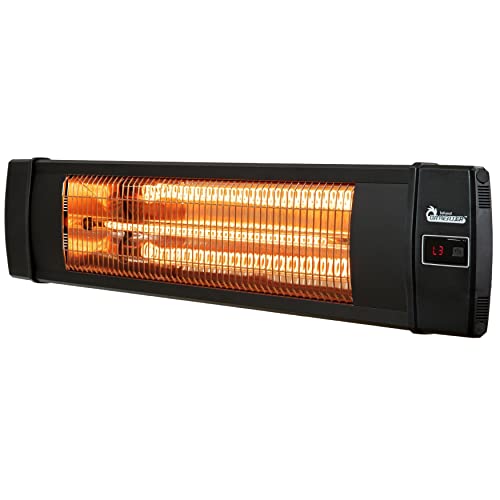
Best for Fixed Installation: DR. INFRARED HEATER Portable Infrared Indoor
The DR. INFRARED HEATER Portable Infrared Indoor fits buyers who want an infrared heater with mounting options rather than a wheeled floor unit. Its listing specifies IP55 approval for indoor and outdoor use, three power settings at 900, 1,200, and 1,500 watts, and included wall and ceiling mounting brackets. The listing also specifies standard 120V power and a remote, but says this model has no thermostat.
Reasons to buy:
- The three wattage settings give you lower-power options when full output is not needed.
- Included wall and ceiling brackets support a fixed setup that can leave garage floor space open.
- The listing specifies IP55 approval and describes the heater for indoor and outdoor use.
Reasons to avoid:
- It has no thermostat, so it does not offer the DR-968’s listed temperature range.
- Confirm mounting location, clearances, and installation directions in the product manual before attaching it to a wall or ceiling.
Skip it if you want a portable heater with caster wheels or thermostat-based temperature control.
How to Choose the Best Space Heater for Cold Garage Use
Match the heater to the garage and your work area
A garage is not necessarily comparable to an enclosed living room. Drafts, open doors, ceiling height, insulation, and the size of the area you occupy all affect comfort. The DR-968 listing describes large-room heating, but does not specify garage coverage or a tested temperature rise. Do not treat that phrase as a guarantee for a particular space.
Think about where you spend time. If you work at one bench, a fixed infrared heater may suit a defined area; if you move between tasks, a portable heater can be repositioned. Neither listing provides a measured heating radius, so check the manual for placement guidance and consider whether the heater can be aimed or positioned appropriately.
Check wattage, outlet, and circuit capacity
Both listings specify a maximum of 1,500 watts and 120V power. The DR-968 listing gives its current draw as 12.5 amps. The other model offers 900W, 1,200W, and 1,500W settings, which can give you a lower-power operating choice. A lower setting also produces less heat output, so it may not be enough for your needs.
Before buying, check the heater’s electrical requirements and your garage circuit. Avoid assuming that an outlet can support a heater plus other high-draw equipment. Follow the manufacturer’s instructions for power connections, and do not use an extension cord unless the manual explicitly permits a suitable one. If your circuit or outlet condition is uncertain, consult a qualified electrician.
Choose portable or mounted placement
The DR-968 has caster wheels and weighs 19 lb, making it the portable choice in this pair. Its 72-inch power cord limits where it can be placed relative to an outlet. Keep the unit positioned according to the manual, and make sure its cord does not create a trip hazard or pass through a doorway where it could be damaged.
The second model includes wall and ceiling mounting brackets, which may help preserve floor space. Fixed mounting limits easy repositioning, and the listing does not provide installation dimensions or detailed clearance information. Verify that the intended mounting surface, location, and clearances meet the manual’s requirements before installation.
Decide which controls matter
The DR-968 lists an electronic thermostat from 50 to 85°F, high and low settings, a remote, and a 12-hour automatic shut-off timer. These controls may suit someone who wants temperature adjustment and timed operation. The product listing does not explain how thermostat accuracy or room temperature behavior varies in a drafty garage.
The mounted model includes a remote and three power settings, but no thermostat. That can suit buyers who prefer simple output selection and do not need a set-temperature control. Read the listing and manual closely if timer functions or thermostat control are requirements; do not assume features from one model carry over to the other.
Consider indoor and outdoor exposure carefully
The second heater’s listing specifies IP55 approval for indoor and outdoor use. That stated rating distinguishes it from the DR-968 listing, which does not identify an outdoor-use rating. Still, an outdoor-use claim does not mean the heater can be exposed in every location or weather condition. Check the manual for permitted placement and exposure limits.
For either model, follow manufacturer safety instructions, keep the heater away from combustible materials, and do not block airflow or heating elements. Use tip-over and overheat protection as additional safeguards, not as a substitute for correct placement. The DR-968 listing specifies those protections; the listing information for the mounted model does not specify them.
How We Compared
This comparison uses published product listings, including stated power, controls, portability, mounting details, and the outdoor-use claim. The available product information does not provide garage-specific coverage measurements, installation clearances, or customer feedback that can establish consistent real-world performance. We therefore connect each heater to a use case supported by its listed features and identify details buyers should verify in the manual.
Frequently Asked Questions
Can either heater warm an uninsulated garage?
The published listings do not establish performance in an uninsulated garage. Both models specify up to 1,500 watts, but drafts, open doors, and garage size affect results. Check the manufacturer’s coverage guidance, and consider whether you need warmth across the whole room or only near a work area.
Which model is better if I move around the garage?
The DR-968 is the more mobile option because its listing specifies caster wheels and a 19 lb weight. Its 72-inch cord still limits placement to locations within safe reach of an outlet. The second model includes wall and ceiling brackets and is better suited to buyers considering a fixed location.
Does the outdoor-use model work in a garage?
Its listing describes indoor and outdoor use, including garages, and specifies IP55 approval. Follow the product manual for permitted locations, mounting, and exposure limits. The listing information does not establish that every garage or outdoor setup is suitable.
Is a thermostat worth choosing over multiple power settings?
Choose based on the control you will use. The DR-968 lists a 50 to 85°F thermostat and high and low settings. The other model lists 900W, 1,200W, and 1,500W settings but no thermostat. Power steps adjust output; a thermostat provides a target temperature control.
What should I check before mounting a garage heater?
Confirm that the intended mounting surface and position comply with the manual. Check required clearances, outlet access, and the route of the power cord before installing. The second model includes wall and ceiling brackets, but the published listing does not provide installation dimensions or clearance requirements.
Can I run a heater on the same circuit as garage tools?
Check the heater’s electrical requirements and the circuit’s capacity before combining loads. The DR-968 listing specifies 12.5 amps, and both listings specify 1,500 watts at maximum output. Other tools or appliances on the same circuit can add demand. Ask a qualified electrician if you are unsure whether the circuit is suitable.
For more room-heating comparisons, see our guide to space heaters for large rooms. Browse the wider Space Heaters category for related options, or explore other Home Appliances guides.


Write Your Review
No reviews yet. Be the first to share your experience!