

Cleaning high, wide, or hard-to-reach windows can mean awkward ladder work, while a robot still needs setup, clean pads, and a secure power connection. This guide to the best window cleaning robot options compares navigation, spray systems, safety features, and maintenance so you can match a model to your windows and cleaning routine.
The published listings cover models with different strengths, from an automatic pad-washing station to lighter machines with remote controls and backup power claims. Check each unit’s glass-size requirements, safety instructions, and cleaning method before buying, especially for exterior or overhead surfaces.

Pros
- Four-nozzle spray system
- Three listed cleaning modes
- Backup battery during power loss
- Remote-controlled spray settings
Cons
- Requires AC power connection
- Skip if unwilling to anchor safety rope overhead

Pros
- Wet-lift and dry-polish cleaning stages
- Automatic window mapping
- Multiple glass-surface uses
- UPS backup and safety rope included
Cons
- Cleaning liquid not included
- Purified water recommended to reduce nozzle clogging
- Skip if your glass surfaces are smaller than 30 × 30 cm
Pros
- Automatic navigation
- Remote control with manual operation
- Replaceable spray nozzle and water tank cap
- Built-in backup battery
Cons
- Requires power connection during normal operation
- Who should skip it: shoppers seeking a cordless cleaner

Pros
- Station automatically washes wiping pads
- Multiple cleaning modes
- Three-nozzle spray system
Cons
- Listed weight is 26.9 lb
- Who should skip it: shoppers prioritizing a lightweight cleaner

Pros
- Remote control
- Edge and corner detection
- Three cleaning modes
- Ten replacement pads included
Cons
- Requires dampening pads and applying solution to glass
- Skip if you want cleaning setup without manual preparation

Pros
- Dual-spray cleaning
- Edge detection and smart navigation
- 30-minute stated UPS backup
- Safety cable rated for at least 150 lb
Cons
- Dirty glass may need two cleaning passes
- Needs clean pads and careful water amounts to limit smears
- Skip it if heavily soiled windows need one-pass cleaning
The Best Window Cleaning Robots by Use Case
Best for a Lower-Cost Entry: Curalk Window Cleaning Robot
The Curalk Window Cleaning Robot suits shoppers who want automatic spraying, remote control, and a supplied set of replacement pads in one package. Its listing specifies up to 6400Pa variable-frequency suction, three cleaning modes, edge and corner detection, and an 85ml tank, although another feature description calls the tank 90ml. Treat capacity as something to confirm with the seller rather than relying on either figure.
The listed 178-inch safety rope and built-in backup battery are useful features for buyers considering high glass, but the listing does not state a backup runtime. Follow the maker’s instructions and anchor the rope to a secure object. Its lower entry cost among these picks makes it a practical feature set to consider, not proof of cleaning results.
Reasons to buy:
- Remote control and three modes provide options for quick, deep, and spot cleaning.
- The package lists 10 replacement mop pads, which gives you spares for routine pad changes.
- Dual-direction spraying and edge detection are specified for cleaning glass surfaces.
Reasons to avoid:
- The tank capacity conflicts across the published listing, and no backup runtime is stated.
- The listing advises moistening pads and applying cleaning solution to glass, not pouring it into the machine.
Skip it if you need a clearly documented tank capacity or a stated backup-battery runtime before purchase.
Best for a Lightweight Kit: HUTT H10 Window Cleaning Robot, 6500Pa
The HUTT H10 Window Cleaning Robot, 6500Pa stands out for its listed 1.3kg weight and a two-stage cleaning design. A round pad lifts dirt while a square pad handles dry wiping and polishing, which may appeal if streak reduction and edge coverage matter more than having a self-cleaning base station. Its NAVI 7.0 mapping and 14 sensors are specified for route planning, edge detection, and pressure monitoring.
The listing gives a 30-minute power-off protection claim and a safety rope rated up to 220kg. It also specifies an 80ml tank for up to 60 square meters per refill, and says purified water with minimal impurities can help limit mineral buildup and clogged nozzles. No cleaning liquid is included, so check what cleaning method the manufacturer permits for your glass.
Reasons to buy:
- The dual-stage wet-lift and dry-polish process targets both dirt removal and streak reduction.
- The listing specifies a 30-minute backup adhesion period during a power interruption.
- Included accessories include a remote, safety rope, spray bottle, six nozzles, and three pairs of pads.
Reasons to avoid:
- The minimum listed glass dimensions are 30 × 30cm, so measure smaller panes first.
- Its 80ml tank and water guidance call for attention to refilling and water quality.
Skip it if your panes are smaller than the stated minimum or you want an included station to wash the pads.
Best for Automatic Pad Washing: ECOVACS WINBOT W3 Omni Robot Window Cleaner
The ECOVACS WINBOT W3 Omni Robot Window Cleaner is the clearest fit for buyers who want less manual pad cleanup. Its station is described as washing wiping pads with 16 high-pressure nozzles in about one minute, and it includes an optional station self-cleaning function. That setup adds a separate station to manage, but it addresses a chore that the other listed models leave to the owner.
WIN-SLAM 5.0 navigation offers Fast, Intensive, and Zone modes, while the listing says TruEdge technology lowers a scrubber along edges and into corners at 200 RPM. A three-nozzle spray system is intended to cover glass and loosen dirt. These are manufacturer-listed capabilities; the published information does not state tank capacity, runtime, minimum glass size, or detailed safety-rope specifications, so verify those points for your windows.
Reasons to buy:
- The station’s pad-washing feature can reduce direct handling of dirty pads after cleaning.
- Fast, Intensive, and Zone modes offer choices for different cleaning jobs.
- The listing describes edge-focused scrubbing and a triple-nozzle spray system.
Reasons to avoid:
- The station adds another item to place, maintain, and store.
- The published details omit tank capacity, backup runtime, and minimum window dimensions.
Skip it if you prefer a compact robot-only kit or need safety and size specifications confirmed before deciding.
Best for Frameless-Glass Features: Tosima W5 Window Cleaning Robot
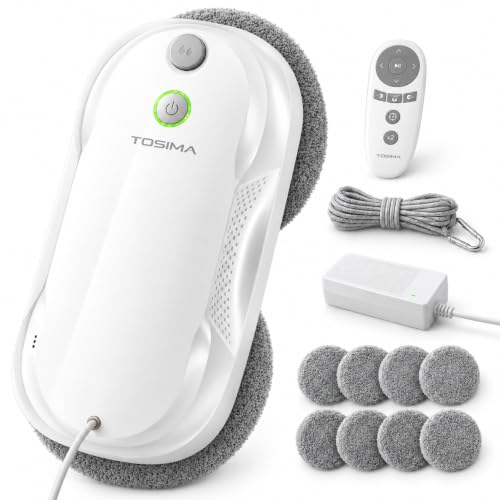
The Tosima W5 Window Cleaning Robot is a compact option for apartments, condos, or smaller homes where storage space matters. Its listing specifies adaptive suction up to 6400Pa, dual-spiral cleaning, dual spray, and navigation with remote control. An air-pressure sensor detects edges, and the maker describes the model as suitable for frameless glass; confirm that your particular surface and window layout meet the instructions.
For elevated windows, the listing describes a triple safety system with suction, a safety rope rated up to 220kg, and an emergency backup battery providing up to 25 minutes of power during an outage. It also highlights replaceable parts such as the spray nozzle and water-tank cap. The published description does not specify tank volume or minimum glass dimensions, so those details may matter if you have many large panes or small sections.
Reasons to buy:
- The compact design is presented as easier to handle and store in smaller homes.
- Remote control supports mode selection and manual control.
- The listing specifies a backup battery runtime and a rated safety rope.
Reasons to avoid:
- No tank capacity or minimum pane size appears in the published product details.
- Compact storage does not remove the need to connect power and secure the safety rope during use.
Skip it if your decision depends on a documented tank volume or a stated glass-size range.
Best for a Longer Listed Backup Period: X6 Window Cleaning Robot for High Windows
The X6 Window Cleaning Robot for High Windows may suit people prioritizing a documented backup period and a round body for narrow frames. Its listing specifies 6400Pa variable suction, dual spray, edge detection, and up to 30 minutes of adhesion during a power interruption. It also claims that the round body covers 95% of the area, but the published information does not provide an independent measurement method, so treat that as a manufacturer claim rather than a guaranteed result.
The listing says a 3.3-square-meter window takes seven minutes and recommends replacing dirty pads or making a second pass for heavy grime. Those figures describe the manufacturer’s claim, not a promised result on every surface. It also specifies a one-year warranty; confirm warranty terms, covered parts, and return conditions with the seller before purchase.
Reasons to buy:
- The listing states a 30-minute backup adhesion period during a power cut.
- The round profile is described as suitable for narrow window frames.
- A one-year warranty is listed, subject to checking its terms.
Reasons to avoid:
- The 95% coverage and cleaning-time figures are listing claims, not universal outcomes.
- The published details do not give a tank capacity or replacement-pad quantity.
Skip it if you need the manufacturer to document tank volume or included pad count before you compare kits.
Also Considered
The Floor Cleaners category covers the wider cleaning-product section. The WA9C is another option for remote-guided cleaning, but its listed suction is lower than several picks above, and the published description gives fewer details about tank capacity and navigation features.
The Home Appliances category can help you browse adjacent household equipment. The portable air conditioner guide is relevant if you are also comparing options for a hot room, though it is a separate purchase decision.
How to Choose the Best Window Cleaning Robot
Match the robot to your glass and frame
Start with pane size, frame shape, and surface type. The HUTT H10 listing specifies minimum glass dimensions of 30 × 30cm, while several other published listings do not state a minimum. If you have small panes, narrow frames, frameless sections, mirrors, or shower doors, confirm that the manufacturer supports those surfaces and dimensions rather than assuming every robot fits every window.
Round and square designs can differ in how they reach edges and corners, but shape alone does not establish coverage quality. The HUTT uses round and square pads in separate stages; the X6 listing describes a round body for narrow frames. Compare the cleaning path, edge-detection details, and stated surface restrictions to your actual windows.
Understand suction, sensors, and backup protection
Listed suction figures can help compare the specifications, but they do not by themselves show how a robot will behave on every pane. Look for edge sensors, pressure monitoring, a backup battery, and a safety rope, then read the operating instructions. The HUTT H10 lists 14 sensors and up to 30 minutes of power-off protection; the Tosima W5 lists up to 25 minutes. Those are maker-stated features, not a reason to skip the rope or use a product on an unsupported surface.
For elevated exterior glass, plan where the safety rope will anchor before starting. Keep the power cable arranged according to the instructions and supervise the robot. If the product’s rope, battery, or surface guidance is unclear, ask the seller or manufacturer before using it at height.
Compare spraying, pads, and cleaning stages
Automatic spray can reduce the need to wet glass by hand, but tank capacity and water guidance affect how convenient refills are. The HUTT listing specifies an 80ml tank and recommends purified water with minimal impurities, while Curalk’s published description gives conflicting tank figures. Check capacity, approved liquids, and nozzle-care directions in the current listing and manual.
Pad design matters too. The HUTT combines wet lifting and dry polishing, while the ECOVACS includes a station that washes pads after use. For heavily soiled windows, the X6 listing recommends a second pass and changing dirty pads. A robot cannot compensate for a saturated or dirty pad, so consider how often you are willing to pause and clean or replace it.
Check navigation and the amount of control you want
Automatic mapping is useful when panes are large or repeated, while a remote can help with manual positioning or spot cleaning. The ECOVACS lists Fast, Intensive, and Zone modes; the WA9C lists N-shaped, Z-shaped, and manual modes. Compare the named modes with your cleaning tasks, and check whether a remote is included if manual control matters to you.
Navigation claims do not mean every frame, handle, or obstacle will be handled in the same way. Review the stated edge-detection limits and window compatibility. For complex window layouts, the ability to select a zone or steer manually may matter more than a larger number in a suction specification.
Account for storage and ongoing upkeep
A robot, power adapter, rope, pads, and any station all need a place between cleaning sessions. The Tosima W5 is described as compact for smaller homes, while the ECOVACS kit includes a separate pad-washing station. Consider your storage space and whether you prefer a simpler kit or less hands-on pad washing.
Also check the availability and cost of replacement pads and consumable parts directly with the seller, since those details are not consistently supplied here. Follow the manufacturer’s cleaning instructions, keep pads and tracks in suitable condition, and use only recommended liquids. Care requirements can affect convenience as much as the robot’s advertised modes.
How We Compared
This guide compares the published product listings, including their stated suction, navigation, spray and pad designs, tank details, backup-power claims, safety-rope information, controls, and included accessories. We also considered which features address distinct household needs, such as automatic pad washing, compact storage, or a stated minimum pane size. Customer-review evidence was not supplied, so the recommendations rely on listed specifications and design details rather than reported owner experiences.
Frequently Asked Questions
Can a window-cleaning robot work on frameless glass?
Some listings describe edge sensors or suitability for frameless glass, including the Tosima W5. That does not establish compatibility with every frameless window. Check the manual for permitted surfaces, edge-detection limits, minimum dimensions, and required safety precautions before use.
Do these robots need to stay plugged in while cleaning?
The published product details identify AC power adapters or power connections for several models, while backup batteries are described as protection during an interruption. They do not establish cordless cleaning. Confirm the specific model’s power requirements and cable setup in its current instructions.
Is a higher suction rating always better?
A higher listed suction figure is one specification, not a complete measure of cleaning performance or suitability. Sensors, pad contact, spray control, surface compatibility, and window dimensions also matter. Compare those details and follow the maker’s operating guidance.
Can I use household glass cleaner in the water tank?
Do not assume that every cleaning liquid is safe for every tank or nozzle. Curalk’s listing specifically says to apply cleaning solution to the glass rather than pour it into the machine, and HUTT recommends purified water with minimal impurities. Check each model’s manual for approved liquids and fill instructions.
Are these robots suitable for outdoor, high-rise windows?
Several listings describe exterior or high-window use and include safety ropes, but that does not remove fall risks. Anchor the rope securely, follow the product instructions, and verify that the window surface and layout are supported. Do not use a robot at height if its safety requirements cannot be met.
How often should I replace or wash the cleaning pads?
Pad care depends on how dirty the glass is and the manufacturer’s directions. The X6 listing advises replacing dirty pads, while the ECOVACS station is designed to wash pads after use. Inspect pads between passes and use clean ones when needed to avoid spreading dirt or leaving smears.





Write Your Review
No reviews yet. Be the first to share your experience!