

Choosing a generator means balancing the power you need against portability, fuel availability, and the outlets your equipment requires. This guide compares the best dual fuel generator options for quiet RV use, essential home backup, and higher-output emergency power, while also explaining where a tri-fuel model may fit.
Check running watts, not only peak watts, before planning which appliances can run together. Also confirm voltage and outlet type before connecting a generator to a home circuit. The Generators category includes more options for comparing portable power equipment.

Pros
- Gasoline and propane fuel options
- Inverter output rated below 3% THD
- Three outlet types listed
- Parallel ready
Cons
- Gasoline tank holds 1.6 gallons
- Skip if you need over 3,600 running watts on gas

Pros
- Gasoline and propane operation
- RV-ready and transfer-switch-ready 30A outlets
- Wheel kit included
- Three-year limited service, labor, and parts coverage
Cons
- 135.6 lb makes lifting and moving difficult
- Who should skip it: buyers needing a lightweight generator

Pros
- Dual-fuel operation
- Three starting methods
- Multiple household, transfer-switch, and RV outlets
- Includes remote-start key fob and battery charger
Cons
- 212.1 pounds limits easy solo transport
- Skip it if you need a lightweight generator

Pros
- Runs on three fuel types
- Remote and push-button start
- CO sensor shutdown
- Three-year limited residential warranty
Cons
- 230 lb makes relocation difficult
- Transfer switch sold separately
- Who should skip it: buyers needing an included transfer switch

Pros
- Gasoline and propane operation
- 120V/240V selectable output
- Electric start
- Wheel and handle kit included
Cons
- Propane output is lower than gasoline output
- Weighs 105.8 pounds
- Skip it if you need a lightweight generator

Pros
- Runs on gasoline or propane
- Clean power for sensitive electronics
- Includes TT-30R RV receptacle
- CO shutdown sensor
Cons
- Lower rated output on propane
- Who should skip it: buyers needing over 2,600 rated watts on propane
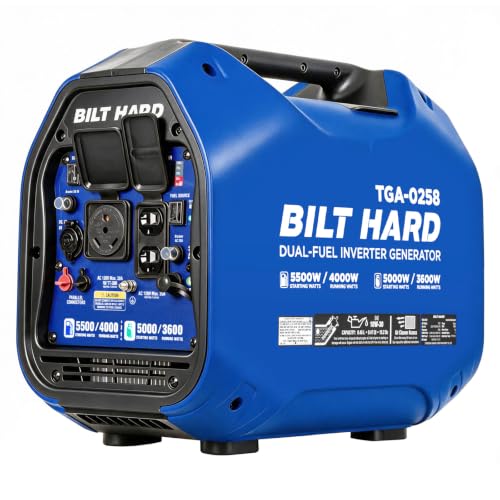
Pros
- Dual-fuel operation
- Up to 4,000 gasoline running watts
- 120V 30A RV outlet
- Digital operating readouts
Cons
- 1.14-gallon fuel tank
- Skip if required output exceeds 4,000 watts on gasoline or 3,600 watts on LPG
- Use outdoors; CO shutoff does not replace safe placement

Pros
- Gasoline or propane operation
- Push-button electric start
- 50-amp outlet
- CO Alert feature
Cons
- 245-pound weight makes moving it a consideration
- Skip it if you need a lightweight generator

Pros
- Gas and propane fuel options
- Electric start
- 50-amp transfer-switch-ready outlet
- No-flat tires
Cons
- 234 pounds, less convenient to move
- Skip it if you need a lightweight generator

Pros
- Dual-fuel operation
- Remote electric start
- Low-oil and CO shutdown features
- Three-year limited residential warranty
Cons
- Weighs 230 pounds
- Automatic transfer switch sold separately
- Skip it if you need a lightweight generator
The Best Generators by Use Case
Best for Quiet RV Use: WEN Quiet and Lightweight 3600-Watt Dual Fuel
The WEN Quiet and Lightweight 3600-Watt Dual Fuel is an inverter generator for campers and users powering smaller loads. Its listed output is 2,900 running watts on gasoline or 2,600 on propane, and the product description characterizes operation as comparable to normal conversation. Clean power is specified for sensitive electronics, while a TT-30R outlet supports RV connections. WEN Quiet and Lightweight 3600-Watt Dual Fuel also has a CO shutdown sensor and fuel shutoff.
Reasons to buy:
- Inverter output is specified for sensitive electronics.
- Includes TT-30R RV outlet, USB ports, and LPG quick-connector.
- CO sensor and fuel shutoff add useful safety and maintenance features.
Reasons to avoid:
- Lower running output than the larger home-backup models in this guide.
- The listing does not provide a fuel-tank runtime figure.
Who should skip it: Choose a higher-output model if you need 240V power or plan to run several high-draw household appliances.
Best Value: PowerSmart 4400 Watt Dual Fuel Portable Generator
The PowerSmart 4400 Watt Dual Fuel Portable Generator offers inverter power and parallel readiness in a compact-output category. The listing specifies 3,600 running watts on gasoline and 3,300 on propane, with less than 3% THD for electronics such as phones and cameras. It lists up to eight hours on gasoline at 25% load and up to 24 hours on a standard 20-lb propane tank at the same load. PowerSmart 4400 Watt Dual Fuel Portable Generator has a 120V 30A twist-lock outlet, household duplex outlet, and 12V DC port.
Reasons to buy:
- Inverter output with a listed THD below 3%.
- Propane runtime claim gives buyers a useful fuel-planning reference at 25% load.
- Parallel-ready design and 30A twist-lock outlet offer connection flexibility.
Reasons to avoid:
- Its 120V outlets do not provide the 120/240V output listed for several larger backup models.
- Runtime figures are tied to a 25% load, not full output.
Who should skip it: Look elsewhere if your transfer switch or equipment needs 240V.
Best for 120/240V Backup on a Smaller Budget: WEN 4,750-Watt 120V/240V Dual Fuel
The WEN 4,750-Watt 120V/240V Dual Fuel suits buyers who need a transfer-switch-ready connection but do not need the output of a 13,000-watt-class generator. It supplies 3,800 running watts on gasoline or 3,500 on propane, and its voltage switches between 120V and 240V. The listing specifies electric start, a four-gallon tank, and up to 11 hours at half load. WEN 4,750-Watt 120V/240V Dual Fuel includes an L14-30R outlet and wheel and handle kit.
Reasons to buy:
- Selectable 120V/240V output and L14-30R outlet suit compatible transfer-switch setups.
- Electric start avoids relying on recoil starting alone.
- Listed runtime reaches 11 hours at half load on its four-gallon tank.
Reasons to avoid:
- Running output is far below the large home-backup picks.
- Confirm transfer-switch and appliance requirements before purchase.
Who should skip it: Choose a higher-output generator if you need to support many circuits or large loads at once.
Best for High-Output Home Backup: Westinghouse 12500 Peak Watt Dual Fuel Home Backup
The Westinghouse 12500 Peak Watt Dual Fuel Home Backup is aimed at buyers seeking substantial output and several connection options. It lists 9,500 running watts on gasoline and 8,500 on propane, plus a 120/240V 50A RV-ready outlet and a 30A transfer-switch-ready outlet. Remote, electric, and recoil starting give you multiple starting methods. Westinghouse 12500 Peak Watt Dual Fuel Home Backup also includes a CO shutdown sensor and digital hour meter.
Reasons to buy:
- High listed running output on both gasoline and propane.
- 50A and 30A outlets support different compatible power setups.
- Remote start, low-oil shutdown, and CO shutdown are specified.
Reasons to avoid:
- Large output and home-backup connections make it less suited to buyers prioritizing compact RV portability.
- Up to 12 hours is specified on gasoline, but the listing does not state the load for that runtime figure.
Who should skip it: Choose an inverter model if low-noise operation and sensitive-electronics power are your main priorities.
Also Considered
The Westinghouse 6500 Watt Dual Fuel Home Backup could suit buyers who want 120/240V selection and a 30A transfer-switch-ready outlet, but its listed running output is below the larger backup picks.
The Westinghouse 14500 Peak Watt Tri-Fuel Home Backup adds natural gas as a fuel option and lists 11,500 running watts on gasoline, but its tri-fuel design is a different fit for buyers who specifically want two fuels.
The DuroMax XP13000HX 13,000-Watt Dual Fuel offers push-button start, CO Alert, and a 50A outlet, but the provided listing does not specify running watts by fuel.
The BILT HARD 5500W Dual Fuel Inverter Generator could work for RV or lighter backup loads, with parallel connectors and a digital display, but its listing gives less runtime detail than the selected inverter pick.
How to Choose the Best Dual Fuel Generator
Calculate running watts and starting demand
Running watts describe the continuous output listed for a generator. Peak or surge watts describe a higher short-term figure, so do not use peak wattage as the amount available for every appliance. Add the running requirements of the equipment you plan to operate together, then account for appliances that need extra power when starting. Compare that total with the model’s running-watt rating on your chosen fuel. For example, the PowerSmart listing gives separate gasoline and propane ratings, so the fuel choice changes the available output.
Match voltage and outlet to the connection
Outlet shape and amperage matter as much as total wattage. RV users may need a TT-30R outlet, while a home transfer-switch setup may call for a compatible L14-30R or 50A connection. The WEN 4,750-Watt model lists 120V/240V output and an L14-30R outlet; the Westinghouse 12500 lists both 30A transfer-switch-ready and 50A outlets. Confirm the generator, cable, transfer switch, and connected equipment all match. For home wiring, use a correctly installed transfer switch or interlock and follow applicable electrical and generator safety instructions. Never connect a generator directly to a wall outlet.
Choose fuel based on storage and availability
Dual-fuel models let you choose gasoline or propane, but output and runtime can differ between fuels. Propane may be useful when it is already part of your emergency fuel plan; gasoline may be more accessible for some households. Check the listing for running watts on each fuel, included hose or connector, and runtime conditions. Do not assume an advertised runtime applies at full load. The Westinghouse tri-fuel model also accepts natural gas, but that option is useful only if its connection and installation suit your home.
Decide whether inverter power matters
Inverter models in this guide emphasize cleaner power for electronics and, in some cases, quieter operation. The PowerSmart listing specifies less than 3% THD; WEN describes its inverter output as suitable for sensitive electronics but does not provide a THD number in the published details. Larger conventional backup models offer higher stated output and 120/240V connections, which may suit more demanding loads. Compare the exact output and use case rather than assuming every inverter or conventional generator meets the same needs.
Read runtime and safety details carefully
Runtime figures only help when their load and fuel conditions are clear. PowerSmart specifies its gasoline and propane figures at 25% load, while the WEN 4,750-Watt listing states up to 11 hours at half load. Other listings provide runtime without a matching load detail, so treat those figures as less directly comparable. CO sensors and automatic shutdown features appear on several picks, but they do not make indoor operation safe. Operate portable generators outdoors, away from doors, windows, and vents, and follow the manual’s placement and maintenance directions.
For broader equipment research, visit the site’s Power Tools category.
How We Compared
We compared the published product specifications, listed fuel-specific running and peak output, outlet types, voltage options, starting methods, runtime conditions, inverter details, safety features, and stated support. We used customer-feedback ratings only as listed product-page data and did not treat them as proof of long-term reliability or typical ownership experience. Where a listing omitted a detail or gave runtime without a stated load, we called out that limitation rather than filling the gap with an estimate.
Frequently Asked Questions
Can a dual-fuel generator run on gasoline and propane at the same time?
No. Dual-fuel describes a choice between two fuel sources, not simultaneous use. Switch fuels according to the owner’s instructions, and verify any required hose or connection before relying on propane.
Will a generator with a 30A outlet connect to my home?
Only if the outlet, voltage, cable, and transfer equipment match your home’s setup. A generator labeled transfer-switch-ready still needs compatible, correctly installed equipment. Ask a qualified electrician to assess home connection requirements.
Is an inverter generator necessary for phones and computers?
An inverter model can be a suitable choice when cleaner power for electronics is a priority. Check the listing for a stated THD figure or explicit clean-power claim, and follow the device and generator manuals. The published details specify less than 3% THD for the PowerSmart model.
How much generator output do I need for home backup?
List the appliances and circuits you intend to use, add their running-watt needs, and account for motor starting demand. Then compare that load with the generator’s running watts on the fuel you expect to use. A transfer-switch connection does not mean the generator can power every household circuit at once.
Can I operate a portable generator in a garage or shed?
No. Carbon monoxide can build up quickly in enclosed or partly enclosed spaces. Keep the generator outdoors, away from openings, and follow the manual and local safety guidance. A CO shutdown sensor is an added safeguard, not permission to operate it indoors.



Write Your Review
No reviews yet. Be the first to share your experience!