

A generator that can run a few essentials may not have enough capacity for larger home loads, while a high-output model can add cost, fuel use, and setup demands. This guide to choosing the best generator for home backup compares five portable Westinghouse models by running watts, fuel options, starting methods, runtime claims, and transfer-switch connections.
Pros
- Gasoline and propane operation
- RV-ready and transfer-switch-ready 30A outlets
- Wheel kit included
- Three-year limited service, labor, and parts coverage
Cons
- 135.6 lb makes lifting and moving difficult
- Who should skip it: buyers needing a lightweight generator

Pros
- Runs on three fuel types
- Remote and push-button start
- CO sensor shutdown
- Three-year limited residential warranty
Cons
- 230 lb makes relocation difficult
- Transfer switch sold separately
- Who should skip it: buyers needing an included transfer switch

Pros
- Dual-fuel operation
- Remote electric start
- Low-oil and CO shutdown features
- Three-year limited residential warranty
Cons
- Weighs 230 pounds
- Automatic transfer switch sold separately
- Skip it if you need a lightweight generator

Pros
- Runs on gasoline or propane
- Three starting methods
- Transfer-switch-ready and RV-ready outlets
- Included battery charger, oil, and tool kit
Cons
- Propane running output is lower than gasoline output
- Skip it if you need equal output on propane

Pros
- Gasoline and propane fuel options
- Remote, electric, and recoil starting
- Low-oil shutdown and CO sensor
Cons
- Weighs 230 pounds
- WATS200 automatic transfer switch sold separately
- Who should skip it: buyers needing easy one-person portability
The Best Generators by Use Case
Best for Flexible Fuel Access: Westinghouse 14500 Peak Watt Tri-Fuel Home Backup
The Westinghouse 14500 Peak Watt Tri-Fuel Home Backup supports gasoline, propane, and natural gas, giving households more fuel choices during an outage. On gasoline, the listing specifies 11,500 running watts and 14,500 peak watts, plus less than 5% total harmonic distortion (THD). That combination may suit households planning to power multiple circuits and sensitive electronics, provided an electrician confirms the connection and load plan. Browse more generators for additional category options.
Reasons to buy:
- Three supported fuel types can help when one fuel source is unavailable.
- 50A and 30A outlets support connection options such as an interlock kit or manual transfer switch; the WATS200 automatic transfer switch is sold separately.
- Remote and push-button starting, plus a listed runtime of up to 19 hours at 25% load on gasoline.
Reasons to avoid:
- The automatic transfer switch is an additional purchase, and home connection setup needs professional planning.
- The runtime figure applies at 25% load, not at full output.
Skip it if you do not need natural-gas compatibility or want a smaller, lower-output generator.
Best for Automatic-Transfer-Switch Pairing: Westinghouse 14500 Peak Watt Dual Fuel Home Backup
The Westinghouse 14500 Peak Watt Dual Fuel Home Backup shares the listed gasoline output of 11,500 running watts and 14,500 peak watts with the tri-fuel model, but supports gasoline and propane rather than natural gas. It is specified for less than 5% THD and can pair with the Westinghouse WATS200 automatic transfer switch, which is sold separately. This makes it a relevant option for buyers who want substantial output and a planned automatic-switch setup without needing a third fuel type. See the Power Tools category for related equipment.
Reasons to buy:
- Gasoline and propane offer two fuel options.
- Listed 50A and 30A outlets can work with a compatible interlock kit or manual transfer switch.
- The listing specifies remote and push-button starting, a CO sensor, and automatic low-oil shutdown.
Reasons to avoid:
- It does not support natural gas, unlike the tri-fuel alternative.
- The WATS200 switch is not included, so confirm all components and installation costs before choosing an automatic setup.
Skip it if you need natural-gas operation or have no plan to connect a generator to home circuits.
Best for Remote Starting at Lower Listed Output: Westinghouse 13500 Peak Watt Dual Fuel Home Backup
The Westinghouse 13500 Peak Watt Dual Fuel Home Backup provides 10,500 running watts and 13,500 peak watts on gasoline, with gasoline and propane as fuel choices. Its listing specifies remote key-fob, push-button, and recoil starting, along with up to 19 hours of runtime at 25% load on a 9.5-gallon gasoline tank. It offers less listed gasoline output than either 14,500-peak-watt model, so compare the running watts with the appliances and circuits you intend to use.
Reasons to buy:
- Three starting methods give you alternatives if remote or electric starting is not convenient.
- Gasoline and propane provide fuel flexibility.
- Listed 50A and 30A outlets support compatible home-backup connection plans, with the required equipment selected separately.
Reasons to avoid:
- Its gasoline running and peak output are below those of the two 14,500-peak-watt models.
- The listed 19-hour runtime is at 25% load, and the listing does not give the same runtime figure for propane.
Skip it if your calculated loads call for the higher listed gasoline output of the 14,500-peak-watt options.
Best for a Lower-Output Essentials Plan: Westinghouse 6500 Watt Dual Fuel Home Backup
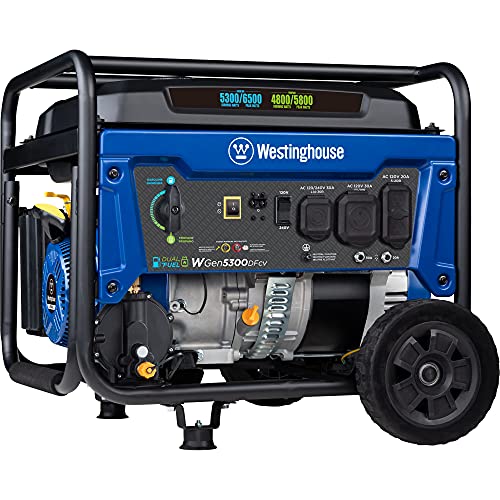
The Westinghouse 6500 Watt Dual Fuel Home Backup is the lowest-output option in this comparison. It supplies 5,300 running watts and 6,500 peak watts on gasoline, or 4,800 running watts and 5,800 peak watts on propane. Its 120/240V selector and L14-30R transfer-switch-ready outlet may suit a smaller, carefully planned backup circuit setup, while the RV-ready TT-30R outlet adds a separate connection option. The listing specifies up to 14.5 hours of runtime, though it does not state the load for that figure.
Reasons to buy:
- Gasoline and propane operation provides two fuel choices.
- The listing includes oil, an oil funnel, a propane hose, a tool kit, and a wheel kit.
- A CO shutdown feature and automatic low-oil shutdown are listed.
Reasons to avoid:
- Its listed output is substantially lower than the larger models, so it may not support a large group of household loads.
- The runtime claim does not specify load; verify expected runtime for your planned use.
Skip it if your load calculation calls for more than its listed running output can supply.
Also Considered
The Westinghouse 12500 Watt Dual Fuel Home Backup could suit buyers seeking remote starting and a 50A outlet, but it missed the main list because the 13,500- and 14,500-peak-watt alternatives offer higher listed gasoline peak output, while the 6,500-watt model covers a smaller-output use case.
How to Choose the Best Generator for Home Backup
1. Size output for the loads you plan to run
Running watts describe the generator’s listed operating output, while peak watts describe its higher startup output. Make a list of the appliances and circuits you expect to use, check their running and startup requirements, and have a qualified electrician help assess the total. Do not select a model by peak watts alone. The 6,500-watt option may fit a limited essentials plan, while the larger models list higher gasoline running output, but the correct choice depends on your actual loads.
2. Match fuel options to what you can store or access
All five products support gasoline and propane; the 14,500-peak-watt tri-fuel model also supports natural gas. Fuel flexibility can help if your preferred supply is unavailable, but each fuel type has its own connection and availability requirements. Check the listing for output by fuel, not just the headline gasoline rating: the 6,500-watt model, for example, lists different running and peak watts on propane than on gasoline.
3. Confirm the home connection before buying
A transfer-switch-ready outlet does not mean the generator includes a transfer switch or that it can connect to every home’s electrical system. The larger models list 30A and 50A outlets, while the 6,500-watt model lists an L14-30R outlet. Confirm outlet type, voltage, amperage, compatible switch or interlock equipment, and installation requirements with a qualified electrician. The WATS200 automatic transfer switch is sold separately for the compatible 14,500-watt models.
4. Read runtime claims at their stated load
Runtime varies with load and fuel. The 14,500-peak-watt and 13,500-peak-watt listings give up to 19 hours at 25% load on a 9.5-gallon gasoline tank. The 6,500-watt listing gives up to 14.5 hours but does not state the load for that figure; the 12,500-watt model lists up to 12 hours on its 6.6-gallon tank. Compare claims only when their stated conditions match your likely use, and plan for refueling during extended outages.
5. Weigh starting features and electrical needs
Remote or push-button starting may make routine startup easier, while recoil starting provides another listed method on the 13,500-watt model. The 12,500-watt model also lists remote, electric, and recoil starting. If you plan to power phones, computers, or televisions, the two 14,500-watt models specify less than 5% THD. Check the specific product listing and your equipment requirements rather than assuming every generator has the same output characteristics.
How We Compared
This comparison uses the published product listings, including output by fuel, outlet types, starting methods, stated runtime conditions, safety features, and included accessories. Customer feedback supplied no usable review detail for assessing reported owner experiences, so it does not support claims about reliability or recurring satisfaction. Recommendations focus on which listed features fit different backup plans, not on independently measured performance.
Frequently Asked Questions
Can I connect a portable generator directly to my home?
Do not connect a generator to household wiring through a wall outlet. A properly selected transfer switch or interlock setup can provide a suitable connection when installed and used according to applicable requirements. Ask a qualified electrician to confirm compatibility, wiring, and equipment before purchase.
Which generator supports natural gas?
The Westinghouse 14500 Peak Watt Tri-Fuel Home Backup lists gasoline, propane, and natural-gas operation. The other four products in this comparison list gasoline and propane. Check the specific model’s instructions and connection requirements before planning to use any fuel.
What is the difference between running watts and peak watts?
Running watts are the listed output for operating loads, while peak watts are the higher listed output available for startup needs. Compare both figures with the requirements of your planned appliances. A generator’s peak rating alone does not establish that it can run your intended combination of loads.
Can I run a generator indoors or in a garage?
No. Operate a fuel-burning portable generator outdoors, away from doors, windows, and vents, and follow the manufacturer’s safety instructions and local guidance. A built-in carbon-monoxide sensor is an additional safety feature, not permission to run the unit indoors or near openings.
Does transfer-switch-ready mean the switch is included?
No. The 14,500-watt models list compatibility with the Westinghouse WATS200 automatic transfer switch, which is sold separately. Other listed outlets may work with a compatible transfer switch or interlock kit, but verify the equipment and installation plan with an electrician.





Write Your Review
No reviews yet. Be the first to share your experience!