

A smart lock can add keyless entry, but many models replace a deadbolt rather than a door handle. That difference affects what you need to remove, what hardware stays on your door, and whether a lock actually fits your setup. This guide to the Best Smart Lock Without Deadbolt compares four options by installation style, entry methods, connectivity, and access management.

Pros
- Six distinct access methods offer flexible entry
- Reversible handle fits left or right doors
- Screwdriver installation requires no extra drilling
- App creates temporary passcodes for guests
Cons
- Requires separate WiFi gateway for remote features
- Buyers wanting built-in WiFi should skip

Pros
- Fast 0.5-second fingerprint recognition
- Built-in Wi-Fi requires no separate bridge
- Four entry options including backup physical keys
- Emergency USB-C port for dead battery situations
Cons
- IP53 rating offers only light water resistance
- Requires eight AA batteries for operation
Pros
- Built-in Wi-Fi requires no extra bridge
- Includes matching door lever set
- Fast 0.3-second biometric fingerprint response
- Multiple guest access code options
Cons
- Supports 2.4GHz Wi-Fi networks only
- Alkaline batteries not included in package
- Auto-lock feature turned off by default

Pros
- Fast biometric fingerprint scanner and multiple entry options
- Local AES128 encryption protects user credentials on device
- Weather-resistant IP55 zinc alloy deadbolt housing
- Adjustable auto-lock timer up to 180 seconds
Cons
- Requires separate G1 Gateway for remote Wi-Fi control
- Four AA batteries are not included
- Shoppers wanting built-in Wi-Fi should skip it
The Best Smart Locks by Use Case
Best Handle-Style Option: Smart Door Handle Lock with Keypad
For a buyer seeking a smart handle rather than a separate deadbolt replacement, the Yamiry Smart Door Handle Lock with Keypad is the most relevant design in this group. Its listing says it can replace an existing handle, knob, or deadbolt, and specifies fingerprint, app, passcode, key fob, and mechanical-key access. Alexa voice unlocking and remote control are listed as options when paired with a separately sold Wi-Fi gateway.
Reasons to buy:
- Handle design may suit buyers replacing door-handle hardware instead of installing a standalone deadbolt keypad.
- Several entry methods include fingerprint, passcode, app, key fob, and mechanical key.
- The listing describes reversible installation for left- or right-handed doors and says it fits most standard American wooden front doors.
Reasons to avoid:
- Remote access and Alexa features require a separately sold Wi-Fi gateway.
- The listing does not specify battery life, battery type, or a detailed door-thickness range, so verify fit and power requirements before buying.
Skip it if you need a product explicitly described as a standalone deadbolt with built-in Wi-Fi, or you do not want to verify whether its handle replaces your existing door hardware.
Best for Built-In Wi-Fi Access: Philips WiFi Keypad Deadbolt with Handle
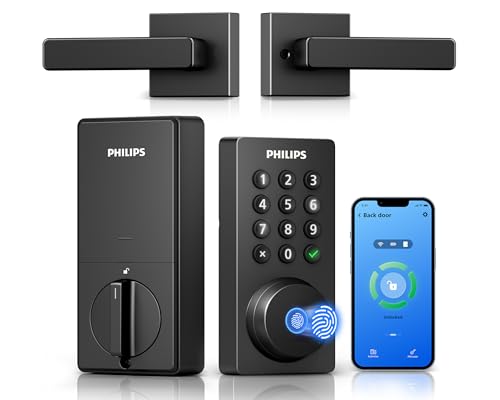
The Philips Philips WiFi Keypad Deadbolt with Handle suits buyers who want app-based remote control without purchasing a separate hub. Its listing specifies direct 2.4 GHz Wi-Fi, app controls, fingerprints, voice-assistant compatibility, and a matching handle set. This is a deadbolt-and-handle set, not a no-deadbolt conversion, so check whether that installation style matches your goal.
Reasons to buy:
- Built-in Wi-Fi connects to a 2.4 GHz network without an additional hub, with the lock kept within 33 feet of the router according to the listing.
- PIN options include permanent, one-time, periodic, and recurring codes, which can help manage household and visitor access.
- The listing specifies fingerprint unlocking, Alexa and Google Assistant support, and adjustable auto-lock timing from 0 to 180 seconds.
Reasons to avoid:
- This is a deadbolt with a handle set, so it may not suit someone who wants to replace only a knob or lever.
- Batteries are not included. The listing specifies standard 1.5 V alkaline batteries and cautions against rechargeable or high-power lithium batteries.
Skip it if your door needs a handle-only smart lock or your home network does not provide compatible 2.4 GHz Wi-Fi near the door.
Best for Fingerprint-First Deadbolt Entry: WYZE Auto-Lock Bolt v2, Wi-Fi Fingerprint
The WYZE WYZE Auto-Lock Bolt v2, Wi-Fi Fingerprint is aimed at households that want fingerprint access through a deadbolt-style lock. The listing specifies built-in Wi-Fi, app control, a keypad, physical keys, and a fingerprint scanner. It also claims up to eight months of battery life from eight AA batteries; actual life will depend on use and conditions.
Reasons to buy:
- Fingerprint, code, app, and physical-key entry offer alternatives if one access method is inconvenient.
- Built-in Wi-Fi supports remote lock management through the Wyze app, without a separately listed gateway requirement.
- The listing specifies a USB-C emergency power port and an IP53 rating.
Reasons to avoid:
- It is a deadbolt, so it does not meet a strict requirement for a handle-only lock without a deadbolt.
- Remote unlocking through a Wyze Video Doorbell is described only when paired with that doorbell, which is a separate compatibility consideration.
Skip it if you want a handle replacement or need built-in fingerprint access without a deadbolt-style installation.
Best for Managed Guest Access: Veise VE017 Fingerprint Smart Door Lock with App
The Veise Veise VE017 Fingerprint Smart Door Lock with App is a deadbolt model with app-based user management and several code types. Its listing describes remote permission changes, activity logs, local AES-128 encryption of access data, and one-time, duration, permanent, and recurring codes. Those management tools may appeal to landlords or households that regularly grant and remove access, but the model is not a handle-only solution.
Reasons to buy:
- Access permissions can be added, changed, paused, or deleted through the KK Home app, according to the listing.
- Fingerprint, app, code, fob card, and mechanical-key access provide multiple entry choices.
- The listing specifies four AA alkaline batteries, up to 12 months of battery life, and a USB-C emergency port.
Reasons to avoid:
- The product is described as a deadbolt, and its remote access, voice control, and real-time status features require a separately sold G1 Gateway.
- The listing says batteries are not included. Voice-assistant compatibility is conditional on the gateway.
Skip it if you need built-in Wi-Fi or a smart handle that replaces a knob or lever without a deadbolt.
How to Choose the Best Smart Lock Without Deadbolt
Start with the door hardware you want to replace
“Without deadbolt” can mean different things: you may want a smart knob or lever, or you may have a door that uses a handle lock rather than a separate deadbolt. The products in this comparison mostly identify as deadbolts, even when they include a handle. Yamiry’s listing is the one that explicitly describes replacing an existing handle, knob, or deadbolt, but that wording does not confirm compatibility with every door or lock preparation.
Before ordering, look at your current door and identify which piece of hardware you intend to remove. Check the product’s installation guide for door thickness, backset, bore-hole requirements, and latch details; those measurements are not supplied for these four models. If you must avoid a deadbolt entirely, confirm in writing that the product operates as a handle lock on your door, rather than relying on its title or included handle.
Decide whether remote control is worth a network accessory
App control does not always mean you can manage a lock from away from home. The Philips listing specifies built-in 2.4 GHz Wi-Fi and remote app access, while Yamiry and Veise describe remote features that need separately sold gateways. WYZE lists built-in Wi-Fi and app management. These differences affect both setup and the additional equipment you may need.
Check the exact network band, required app, gateway model, and router distance in the listing or installation documentation. Philips specifies keeping its lock within 33 feet of the router and notes that walls and other obstacles can weaken the connection. If you only need local keypad or fingerprint entry, paying attention to remote features may matter less than choosing the right physical lock type.
Match entry methods to household routines
Fingerprint access can be convenient when your hands are full, while PIN codes work for visitors who should not receive a physical key. Mechanical keys offer a backup route, and app access can help an owner manage entry remotely when the model and network support it. Compare the options you will use rather than treating a longer feature list as automatically better.
For temporary visitors, Philips and Veise list several types of PIN access, including one-time and recurring codes. Yamiry describes temporary access and one-time passcodes, while WYZE emphasizes fingerprint, app, code, and key entry. Confirm whether each feature works locally or remotely, and whether remote code creation needs a gateway or an internet connection.
Check battery details and emergency access
Battery claims are listing estimates, not guaranteed results. WYZE specifies eight AA batteries and up to eight months; Veise specifies four AA alkaline batteries and about 12 months; Philips lists up to six months and says batteries are not included. Yamiry’s published information does not provide a battery type or life estimate.
Look for the approved battery type, whether batteries are included, low-battery alerts, and a backup method for a drained battery. WYZE and Veise list USB-C emergency power ports, while all four published descriptions mention a physical key or mechanical-key access. Check the actual installation instructions to understand how emergency entry works for your door.
Review app, voice, and privacy requirements
Voice assistant support may depend on extra equipment. Philips lists Alexa and Google Assistant compatibility, while Yamiry lists Alexa voice unlocking and Veise lists Alexa and Google voice control with its separately sold G1 Gateway. Confirm the exact gateway and supported commands before assuming a lock will work with an existing smart home setup.
Access logs and stored credentials also differ. Veise says access data is locally encrypted with AES-128 and stored on the lock; Philips describes access history in its app. The published information does not explain comparable data-storage practices for every model. If privacy is a deciding factor, check the manufacturer’s current privacy policy and whether remote features transmit access records to cloud services.
How We Compared
This comparison uses the published product listings, including their descriptions of lock type, installation, entry methods, app and network requirements, battery information, access management, and stated privacy features. We considered which use cases those details support and noted missing information buyers should verify. The published product data includes no customer feedback details that support claims about owner satisfaction or recurring reliability.
Frequently Asked Questions
What does “smart lock without deadbolt” mean?
It usually means a smart knob or lever lock, or a smart lock intended to replace handle hardware without adding a separate deadbolt. Product titles can be ambiguous, so confirm which part of the door the lock replaces. Most options in this guide are explicitly described as deadbolts, while Yamiry says its model can replace a handle, knob, or deadbolt.
Can I install one of these locks on a door with no deadbolt?
Do not assume so from the product title. Check the model’s installation guide against your existing bore holes, backset, latch, door thickness, and handle arrangement. The published listings do not give all of those measurements, so ask the manufacturer or seller to confirm compatibility before ordering.
Do smart locks need Wi-Fi to unlock?
Not necessarily. These listings describe local methods such as fingerprints, PINs, fobs, and mechanical keys, while Wi-Fi or a gateway supports remote functions and some voice controls. Philips and WYZE list built-in Wi-Fi; Yamiry and Veise list gateway-dependent remote features. Check which functions remain available if your internet connection is down.
Which option suits short-term guests or rental access?
Philips and Veise list multiple code schedules, and Yamiry describes temporary access and one-time passcodes. Veise also describes user-permission management and activity logs. Compare whether creating or changing codes remotely requires a gateway, and confirm how codes are removed when a guest’s stay ends.
Are fingerprints, PINs, and physical keys all included?
The published listings describe multiple entry methods for each product, but exact enrollment steps and the number of supported users are not provided for every model. Verify those limits and setup requirements in the manufacturer’s instructions. A physical key can provide another way to enter, but confirm that the included key arrangement suits your needs.
Should I choose a handle set or a deadbolt with handle?
Choose based on the hardware your door uses and the part you want to replace. A matching handle set can be useful when you are changing both components, while a handle-only design may suit a door without a separate deadbolt. Product wording alone may not settle the distinction, so check the installation diagram and confirm compatibility with your current door.
For more connected-home context, see our guides to smart home hubs and gateways and hub versus Wi-Fi control. You can also browse our broader smart lock category and smart home guides.
Write Your Review
No reviews yet. Be the first to share your experience!