

Winter storms can knock out power when you need to keep food cold, run a sump pump, or maintain other household essentials. Choosing the best portable generator for winter storms means matching running and starting watts to your loads, then checking fuel options, outlet compatibility, and how you will connect the unit safely.
This guide compares compact inverter models with larger home-backup generators. Use the specifications below to narrow your choices, and confirm appliance requirements and connection plans before buying.

Pros
- Gasoline and propane fuel options
- Inverter output rated below 3% THD
- Three outlet types listed
- Parallel ready
Cons
- Gasoline tank holds 1.6 gallons
- Skip if you need over 3,600 running watts on gas

Pros
- Dual-fuel operation
- Three starting methods
- Multiple household, transfer-switch, and RV outlets
- Includes remote-start key fob and battery charger
Cons
- 212.1 pounds limits easy solo transport
- Skip it if you need a lightweight generator

Pros
- 3,200 running watts
- Less than 3% THD
- Multiple AC, USB, and DC outputs
Cons
- Parallel kit sold separately
- Who should skip it: buyers needing included parallel hardware

Pros
- Gasoline and propane operation
- 120V/240V selectable output
- Electric start
- Wheel and handle kit included
Cons
- Propane output is lower than gasoline output
- Weighs 105.8 pounds
- Skip it if you need a lightweight generator

Pros
- Dual-fuel operation
- Remote electric start
- Low-oil and CO shutdown features
- Three-year limited residential warranty
Cons
- Weighs 230 pounds
- Automatic transfer switch sold separately
- Skip it if you need a lightweight generator

Pros
- 2,450-watt output
- Inverter technology
- 43-pound weight
- EPA compliant, according to title
Cons
- Runtime claims conflict: 8.3 hours versus 10 hours at 25% load
- Skip if you need a clearly stated runtime

Pros
- Runs on gasoline or propane
- Three starting methods
- Transfer-switch-ready and RV-ready outlets
- Included battery charger, oil, and tool kit
Cons
- Propane running output is lower than gasoline output
- Skip it if you need equal output on propane

Pros
- Three fuel options
- Electric start with included battery
- COsense carbon monoxide shutdown
- 120/240V outlets, including 50A
Cons
- Skip if you need a lightweight unit, weighs 219 lb
The Best Portable Generators by Use Case
Best for Flexible Fuel and Clean Power: PowerSmart 4400 Watt Dual Fuel Portable Generator
The generator category includes options for different loads, but this PowerSmart model stands out for shoppers who want both gasoline and propane with inverter output. Its listing specifies 3,600 running watts on gasoline, 3,300 on propane, and less than 3% total harmonic distortion (THD), which makes it a candidate for essentials and sensitive electronics. It lists up to eight hours at 25% load on gasoline and 24 hours on a standard 20-pound propane tank at the same load.
Reasons to buy:
- Gasoline and propane provide a choice of fuel.
- Inverter output is specified at less than 3% THD.
- Includes a 120V L5-30R outlet, household duplex outlet, and 12V DC port.
Reasons to avoid:
- Running output is lower on propane than gasoline.
- Its 120V outlets do not provide the listed 120/240V connection found on larger backup models.
Skip it if you need listed 120/240V output or more running wattage for multiple large appliances. See other power tools only if your backup needs extend beyond generators.
The external monitor guide covers a different kind of power need, but electronics owners may also want to compare its requirements with the generator’s clean-power claim. Check device documentation rather than assuming every appliance can run from any generator.
Name: PowerSmart 4400 Watt Dual Fuel Portable Generator
Best for High-Power Home Backup: Westinghouse 14500 Peak Watt Dual Fuel Home Backup
For households with larger loads, the Westinghouse 14500 Peak Watt Dual Fuel Home Backup lists 11,500 running watts and 14,500 peak watts on gasoline, with propane also supported. Its 50A and 30A outlets suit buyers planning a compatible interlock or transfer-switch setup, while remote and push-button starting can reduce the effort of starting the generator outdoors in cold weather. The listing specifies up to 19 hours at 25% load on its 9.5-gallon gasoline tank.
Reasons to buy:
- High listed gasoline running output can serve larger planned loads.
- Gasoline and propane fuel choices offer flexibility.
- Remote and push-button starting are included, and the listing specifies a three-year residential warranty.
Reasons to avoid:
- The transfer switch and related connection equipment are sold separately.
- Its less-than-5% THD specification differs from the under-3% claims on the PowerSmart inverter picks.
Skip it if you need a compact, low-output generator mainly for electronics or camping. Verify household load requirements and transfer equipment compatibility before choosing this larger-output option.
Product: Westinghouse 14500 Peak Watt Dual Fuel Home Backup
Best for 120/240V and Electric Start: WEN 4,750-Watt 120V/240V Dual Fuel
The WEN 4,750-Watt 120V/240V Dual Fuel suits buyers who want a midrange output rating, two fuel options, and voltage selection. It lists 3,800 running watts on gasoline and 3,500 on propane, with an L14-30R outlet and selectable 120V or 240V output for compatible transfer-switch arrangements. Electric start, a wheel and handle kit, and a listed runtime of up to 11 hours at half load make it a practical option for planned household backup.
Reasons to buy:
- Switches between gasoline and propane using a selection dial.
- Offers 120V and 240V output plus an L14-30R twist-lock outlet.
- Includes electric start, wheel and handle kit, and a propane connection hose.
Reasons to avoid:
- Its running output is substantially below the larger Westinghouse and Generac models.
- Confirm that the intended transfer equipment matches the generator’s outlet and voltage.
Skip it if your calculated load exceeds its running watts or you need inverter output with a supplied low-THD specification.
Product: WEN 4,750-Watt 120V/240V Dual Fuel
Best for Three Fuel Sources: Generac 12,500 Starting Watt Tri-Fuel
The Generac 12,500 Starting Watt Tri-Fuel is worth considering when a household wants gasoline, propane, and natural gas choices. Its listing specifies 9,500 running watts on gasoline, automatic voltage regulation, electric start, and up to 9.5 hours at 50% load on gasoline. It also lists 120V household outlets and 120/240V 30A and 50A outlets, giving buyers several connection types to check against their backup plan.
Reasons to buy:
- Tri-fuel operation includes natural gas as an option.
- Automatic voltage regulation is specified for stabilizing output voltage.
- Electric start, COsense shutdown, and a digital hour meter are listed features.
Reasons to avoid:
- Natural-gas connection details and installation needs should be confirmed before purchase.
- The listing gives different runtime figures at 50% and 25% loads, so compare runtime at a load close to your planned use.
Skip it if you do not need three fuel options or want an inverter model with an under-3% THD specification.
Product: Generac 12,500 Starting Watt Tri-Fuel
Best for Remote Starting and Multiple Home Outlets: Westinghouse 12500 Peak Watt Dual Fuel Home Backup
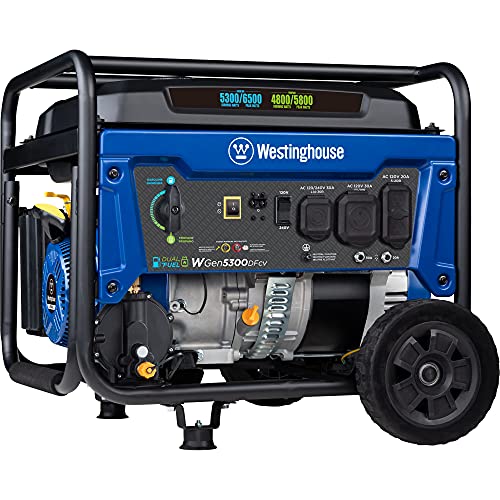
This Westinghouse model pairs dual-fuel operation with a remote-start key fob, electric start, and recoil backup. The listing specifies 9,500 running watts on gasoline and 8,500 on propane, plus a 120/240V 14-50R outlet and a transfer-switch-ready 120V L14-30R outlet. Those connections can suit a household backup plan, but you should confirm the required cord, transfer equipment, and circuit loads before connecting appliances.
Reasons to buy:
- Remote, electric, and recoil starting methods are listed.
- Offers both a 30A transfer-switch-ready outlet and a 50A RV-ready outlet.
- Includes CO shutdown, low-oil shutdown, and a three-year limited service, labor, and parts coverage claim.
Reasons to avoid:
- The listing specifies up to 12 hours on its 6.6-gallon tank but does not state the load for that runtime claim.
- Its listed gasoline running output is lower than the 14500 Peak Watt model from the same brand.
Skip it if you need a compact inverter generator or require a runtime estimate tied to a stated load.
Product: Westinghouse 12500 Peak Watt Dual Fuel Home Backup
Also Considered
The wireless thermometer guide is unrelated to generator selection, but these remaining models offer additional generator options: the PowerSmart 4000 Watt Portable Inverter Generator may suit buyers prioritizing under-3% THD and a listed 59 dBA noise level, but it uses gasoline only. The POXURIO 2450-Watt Portable Inverter Generator is a smaller gasoline inverter option, though its published details do not specify running watts. The Westinghouse 12500 Watt Dual Fuel Home Backup shares the 9,500 gasoline and 8,500 propane running-watt figures of the remote-start pick, but its published listing does not include a CO sensor.
How to Choose the Best Portable Generator for Winter Storms
Calculate running watts and startup demand
Running watts describe the power a generator can supply continuously; starting watts cover short surges when some motor-driven appliances start. A refrigerator, sump pump, or furnace blower may have a startup demand above its running draw. Check each appliance label or manual, add the loads you expect to operate at the same time, and compare that total with the generator’s running rating. Also account for the largest startup surge rather than adding peak ratings as if they were continuous output.
The larger Westinghouse and Generac picks list thousands of running watts, while the PowerSmart inverter pick lists 3,600 watts on gasoline. Higher output can support more planned loads, but it does not automatically mean every circuit can be powered at once. Keep a written priority list for essential appliances and avoid exceeding the generator’s ratings.
Choose fuel around availability and runtime
Gasoline, propane, and natural gas have different storage and connection needs. Dual-fuel models let you choose between gasoline and propane; the Generac tri-fuel model adds natural gas. A fuel option only helps if you can safely and reliably supply it during an outage. Check the listed runtime and its stated load, tank size, and connection requirements. Runtime figures at 25% load should not be treated as a promise at heavier loads.
Cold-weather outages make fuel planning especially important. Keep fuel handling and storage consistent with the generator manual and local fire codes. Never refuel a running or hot generator, and do not store gasoline or propane in living spaces.
Match outlets and transfer equipment
Outlet type and voltage decide how power can reach your equipment. Household 120V outlets can connect compatible individual devices with appropriate cords, while 120/240V outlets may support a compatible transfer-switch or interlock arrangement. The WEN lists selectable 120V and 240V output; the larger Westinghouse and Generac picks list 120/240V outlets. These features do not mean a generator connects directly to a home panel without suitable equipment.
Have a qualified electrician confirm the transfer switch or interlock, inlet, breaker arrangement, and generator connection. Never connect a portable generator to household wiring through a wall outlet. That can send power onto utility lines and create a lethal hazard for utility workers and neighbors.
Consider power quality, noise, and starting
Inverter models in this roundup specify low THD, which can matter for sensitive electronics. The PowerSmart inverter options list less than 3% THD; the Westinghouse 14500 model lists less than 5%. Do not assume all generators have the same power-quality specification. If you plan to power computers or other sensitive devices, check both the generator listing and the equipment manufacturer’s guidance.
Noise claims also need context. The PowerSmart 4000 Watt Portable Inverter Generator lists 59 dBA from 23 feet away, and the POXURIO listing claims 59 decibels without stating the same distance. These are listing specifications, not a guarantee of the sound at your property. Remote or electric start may help avoid pull-start effort, but electric-start models need their starting system maintained according to the manual.
How We Compared
This comparison uses published product specifications, design details, and listed features, including wattage, fuel types, outlets, runtime claims, starting methods, inverter or voltage-regulation details, and safety shutoffs. Customer feedback information was supplied as ratings without written comments, so it does not establish recurring owner experiences. Recommendations reflect how the stated features fit different backup-power needs; verify model details and connection requirements with the manufacturer before purchase.
Frequently Asked Questions
Can a portable generator run a whole house during a winter outage?
It depends on the home’s total load, generator output, and connection setup. A larger generator can supply more listed running watts, but the actual circuits available depend on a compatible transfer switch or interlock and the electrician’s installation. List essential appliances, include their startup demands, and compare the total with the generator’s running and peak ratings.
Should I choose an inverter generator or a conventional model?
An inverter generator may suit users who want a supplied low-THD specification for sensitive electronics and value a quieter listed operating claim. Larger conventional-style home-backup models in this guide offer substantially higher running-watt ratings and 120/240V outlets. Choose based on the loads and connection plan, not the product type alone.
Can I connect a generator directly to a home outlet?
No. Do not connect a generator to household wiring through a wall outlet. Use a properly installed transfer switch or interlock and compatible inlet, with installation confirmed by a qualified electrician. This prevents dangerous backfeed onto utility lines.
Is propane a better choice than gasoline in winter?
There is no universal answer. Dual-fuel models provide a choice, but the listed wattage can differ by fuel, and propane needs a compatible tank and connection. Compare the manufacturer’s cold-weather operating instructions, fuel availability, runtime claims, and output ratings for each fuel before deciding.
Can I run a generator in a garage or near a window?
No. Operate portable generators outdoors, well away from doors, windows, and vents, following the manual and local safety guidance. Carbon monoxide is odorless and can be fatal. A CO shutdown sensor is an added safeguard, not permission to operate a generator indoors or near openings. Keep the generator dry as directed by its manual, and never use it in snow-covered or enclosed areas where exhaust can collect.


Write Your Review
No reviews yet. Be the first to share your experience!