

Countertop air fryer ovens can combine several cooking jobs, but capacity, controls, and included accessories vary. This Best Smart Oven Air Fryer guide compares three options for different cooking routines, from large family meals to a more traditional toaster oven format.
“Smart” can describe cooking controls, not necessarily internet-connected features. The published information lists digital presets and temperature controls, but does not specify Wi-Fi, an app, or voice assistant support for these models. Check the listing for connectivity if remote control is important to you.
Pros
- Large 10-liter capacity
- Five cooking modes
- 17 touch-screen presets
- Dishwasher-safe parts
Cons
- Skip it if countertop space is limited
Pros
- Thirteen cooking functions
- Large interior capacity
- Interior oven light
- Includes two oven racks and several cooking accessories
Cons
- Weighs 30.2 pounds
- Who should skip it: shoppers with limited counter space

Pros
- Eight cooking functions
- 0.6-cubic-foot capacity
- Includes air fry basket and grill/griddle
- 60-minute timer with auto-shutoff
Cons
- Who should skip it: shoppers with limited counter space
The Best Smart Ovens by Use Case
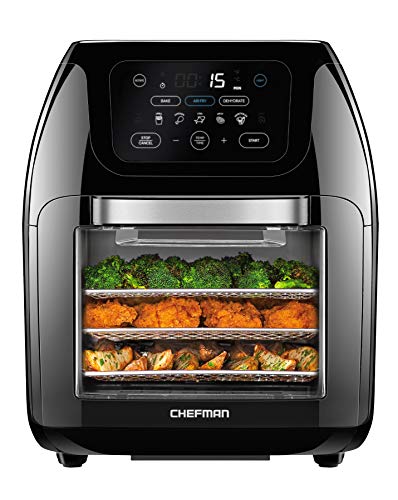
Best for Preset Variety: CHEFMAN Multifunctional Digital Air Fryer
The CHEFMAN Multifunctional Digital Air Fryer suits cooks who want several cooking modes and touch-screen presets in one appliance. Its 17 presets accompany air frying, baking, dehydrating, rotisserie cooking, and roasting. The 10-liter capacity and included racks, spit, retrieval tool, and drip tray make it a flexible option for family meals or batch cooking.
Reasons to buy:
- 17 touch-screen presets simplify choosing common cooking settings.
- Rotisserie, dehydrating, baking, roasting, and air frying cover varied meal plans.
- The listing includes three airflow racks, a rotisserie spit and retrieval tool, and a drip tray.
Reasons to avoid:
- The listing gives capacity in liters but does not provide interior dimensions, so check whether your usual cookware or food portions fit.
- Its touch-screen presets may be less appealing if you prefer simple dials.
Skip it if you want a conventional toaster-oven layout with a specified bread-slice capacity, or if you need confirmed app or voice control.
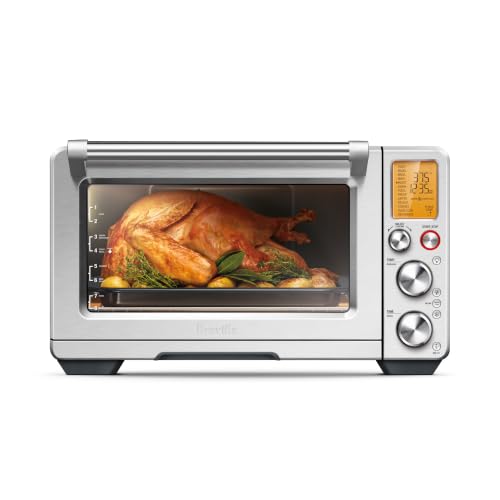
Best for Large Oven-Style Meals: Breville BOV900BSS Smart Oven Air Fryer Pro
The Breville BOV900BSS Smart Oven Air Fryer Pro is a strong fit when you want countertop cooking beyond snacks and toast. Its listed 16 x 13.5 x 7-inch interior can accommodate a 14-pound turkey, most 9 x 13-inch pans, and 12-cup muffin trays. Thirteen cooking functions include air fry, dehydrate, slow cook, proof, bake, and roast, while the LCD displays preheat status and cooking countdowns.
Reasons to buy:
- The stated interior size and cookware fit make it useful for larger oven-style dishes.
- Element iQ uses five independent quartz elements and digital PID temperature control, according to the listing.
- Super convection and regular convection provide two fan-speed settings, and the appliance can dehydrate up to four trays at once.
Reasons to avoid:
- The listing does not provide an exterior footprint, so measure your counter and clearance before choosing it.
- Its 13 modes and display offer more controls than cooks who only need basic toast and air frying may want.
Skip it if you need a compact unit or want a simple control layout with fewer cooking options.
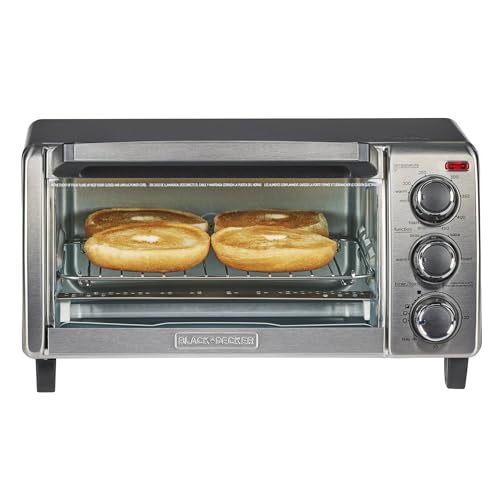
Best for Toaster-Oven Cooking: Cuisinart Air Fryer Toaster Oven, 1800W
The Cuisinart Air Fryer Toaster Oven, 1800W combines air frying with familiar toaster-oven functions and adjustable dials. Its stated 0.6-cubic-foot capacity fits six slices of bread, a 12-inch pizza, or a 4-pound chicken, according to the product information. Eight functions include toast, convection bake, convection broil, grill, and warming, and the included accessories cover several cooking styles.
Reasons to buy:
- The 60-minute timer with auto-shutoff and toast-shade selector provide direct, familiar controls.
- The listing specifies capacity for six bread slices, 3 pounds of wings, a 12-inch pizza, or a 4-pound chicken.
- Included items are an oven rack, baking pan/drip tray, air fry basket, and reversible ceramic non-stick grill/griddle.
Reasons to avoid:
- Its eight listed functions omit the dedicated dehydrating and rotisserie modes found on the other options.
- The controls use dials rather than a touch-screen preset interface.
Skip it if you specifically need rotisserie cooking, dehydrating, or a large interior for bigger oven-style dishes.
How to Choose a Smart Oven Air Fryer
Match capacity to the food you cook
Capacity labels do not tell the whole story. A 10-liter figure, a 0.6-cubic-foot figure, and interior dimensions describe space in different ways, so compare the actual foods and cookware you plan to use. If you regularly make pizza, roast poultry, or bake in a pan, look for those specific examples in the listing.
The product information says the Breville fits most 9 x 13-inch pans and 12-cup muffin trays, while the Cuisinart is listed for a 12-inch pizza and a 4-pound chicken. The Chefman listing emphasizes 10-liter capacity but does not state comparable cookware dimensions. Verify measurements and clearance before buying, especially if counter space is limited.
Choose cooking modes you will use
More modes can replace other kitchen appliances, but only if they fit your routine. The Chefman lists rotisserie and dehydration alongside baking and air frying. Breville adds proofing and slow cooking, plus dehydration for up to four trays. Cuisinart focuses on toaster-oven staples, including toast, grill, broil, and warming.
Think through a typical week rather than counting modes alone. If you want to dry ingredients in batches, check the number of trays the listing supports. If you mainly toast, reheat, and cook wings, a long list of specialty functions may add controls you rarely touch.
Compare controls and cooking guidance
Control style affects how easily you can repeat a setting. Chefman uses a capacitive touch screen with 17 presets. Breville has an LCD that indicates when preheating is complete and starts a cooking countdown. Cuisinart uses adjustable temperature and timer dials, plus a toast-shade selector.
Choose a touch screen if preset access suits your cooking habits; choose dials if you prefer direct adjustments. The published descriptions do not establish that any of these appliances connects to a phone app, Wi-Fi network, or voice assistant. If connectivity is part of your decision, confirm it in the current product listing rather than assuming “smart” means networked.
Check accessories and cleanup needs
Included accessories affect what you can cook without buying additional parts. Chefman lists three airflow racks, a rotisserie spit and retrieval tool, and a drip tray. Cuisinart includes an air fry basket and reversible grill/griddle in addition to its rack and baking pan. The Breville description focuses on functions and oven fit rather than listing a comparable accessory set.
Review the supplied parts and care instructions before choosing. Chefman specifically describes dishwasher-safe parts and a removable drip tray; the Cuisinart listing describes a stainless steel easy-clean interior. Do not assume that every rack, pan, or basket is dishwasher-safe unless the product instructions say so.
How We Compared
This comparison uses the published product specifications, listed cooking functions, control descriptions, capacity examples, included accessories, and stated design details. We matched those features to practical cooking needs, such as family portions, toaster-oven use, rotisserie cooking, and dehydrating. The published ratings are included in the product cards; no customer-review details were provided to support broader claims about owner experiences.
For other kitchen buying advice, see our guide to wireless meat thermometers or browse the wider Kitchen Tech category.
Frequently Asked Questions
Do these smart ovens connect to Wi-Fi or a phone app?
The published product information does not specify Wi-Fi, app control, or voice assistant compatibility for any of these models. Their described “smart” features relate to cooking controls, presets, temperature management, or display guidance. Check the current listing and manufacturer details if remote control is essential.
Which model includes rotisserie cooking?
The Chefman listing includes rotisserie cooking and specifies a stainless steel rotisserie spit with a retrieval tool. The supplied function lists for the Breville and Cuisinart do not include rotisserie, so choose the Chefman if that feature is a priority.
Which option is suited to dehydrating food?
Both Chefman and Breville list dehydration. Breville specifies that it can dehydrate up to four trays at once. Chefman includes three airflow racks, but the published description does not state a tray count for dehydration, so confirm the intended rack arrangement in its instructions.
Can these ovens replace a full-size oven?
The product information describes countertop cooking capacity, not a guarantee that any model can replace a full-size oven for every household. Breville lists room for a 14-pound turkey and many standard pans; Cuisinart lists smaller examples such as a 4-pound chicken and 12-inch pizza. Compare those limits with your usual meals and cookware.
Which model is easiest to operate?
That depends on the controls you prefer. Chefman offers 17 touch-screen presets, Breville provides an LCD with preheat and countdown information, and Cuisinart uses dials and a toast-shade selector. If you prefer preset choices, consider the Chefman; if you want direct dial adjustments, consider the Cuisinart.
What should I measure before buying?
Measure the counter area and check the appliance’s exterior dimensions and required clearances in the product listing or manual. Then compare interior dimensions with your baking pans, pizza, or typical portions. The published information gives interior dimensions for the Breville but not exterior footprints for these three models, so verify the full measurements before ordering.




Write Your Review
No reviews yet. Be the first to share your experience!