

A ski camera needs to capture fast runs without turning every bump into distracting shake, and it should be practical to control when you are wearing gloves. The Best Action Camera for Skiing depends on whether you prioritize cold-weather battery claims, strong stabilization, a lightweight point-of-view setup, or a lower-cost way to record your day.
This guide compares five cameras with different strengths. Check the mounting method and waterproof housing details before you head to the mountain, and consider how much control you need while moving.

Pros
- 4K video recording at up to 120fps
- Subject tracking for horizontal and vertical framing
- Dual OLED touchscreens
- 47GB built-in storage
Cons
- Curved adhesive base not included
- Skip if you need an included curved adhesive mounting base

Pros
- Waterproof case rated down to 131 feet
- Electronic image stabilization smooths shaky footage
- Compact and lightweight at 0.125 pounds
- Wrist remote enables convenient wireless capture
Cons
- Included wrist remote is not waterproof
- MicroSD memory card is not included
- Who should skip: users needing underwater remote control
Pros
- Dual displays for easy vlogging and preview framing
- Built-in electronic image stabilization for steady footage
- Includes two rechargeable 1350mAh batteries and remote
- Submersible up to 131 feet with housing
Cons
- Requires external case for water resistance
- MicroSD memory card not included

Pros
- Lightweight 35g body with magnetic mounting options
- Six-axis stabilization for smoother movement capture
- Integrated 1.5-inch preview and setup screen
- Quick wireless file transfer via WiFi and Bluetooth
Cons
- 4K recording capped at 30 frames per second
- Fast-action sports creators needing 60FPS should skip it
The Best Action Cameras by Use Case
Best Cold-Weather Battery Claim: DJI Osmo Action 5 Pro Essential Combo
The DJI Osmo Action 5 Pro Essential Combo is a strong fit if you want a conventional action camera with a stated cold-weather runtime. DJI rates its 1950mAh battery for up to 3.6 hours of recording at -4°F, and the camera has dual OLED touchscreens for framing and changing settings. Its 360-degree HorizonSteady stabilization is designed to keep footage level during movement, which can help when a run gets bumpy. Our action camera picks under $300 offer more options if you are comparing budgets.
Reasons to buy:
- DJI states up to 3.6 hours of recording at -4°F.
- Two OLED touchscreens make it easier to frame shots from the front or rear.
- 360-degree HorizonSteady and subject tracking address movement and framing needs.
Reasons to avoid:
- The cold-weather runtime is a manufacturer claim, and actual recording time can vary with settings and conditions.
- Confirm that the Essential Combo includes the mounts and other accessories you need for your helmet or chest position.
Skip it if you want the lowest-cost camera or a tiny wearable body camera rather than a touchscreen action camera.
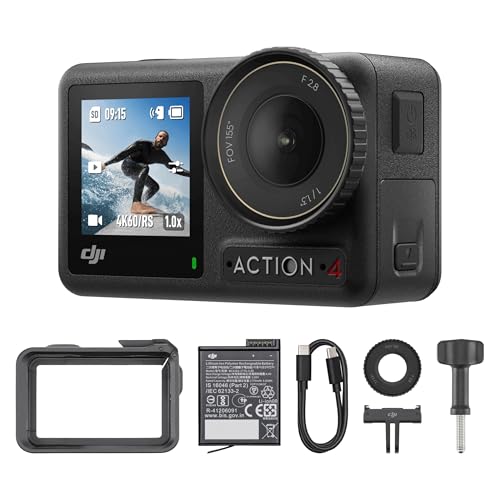
Best for High-Frame-Rate Footage: DJI Osmo Action 4 Essential Combo
The DJI Osmo Action 4 Essential Combo suits skiers who want to record fast movement and may edit footage later. It can capture 4K at 120 frames per second, has a 155-degree field of view, and supports 10-bit color and D-Log M for editing. DJI rates its battery for up to 150 minutes and says it works at temperatures down to -4°F. The camera also has front and rear color touchscreens and a magnetic quick-release mounting system.
Reasons to buy:
- 4K at 120 frames per second gives you a high-frame-rate recording option for fast action.
- 10-bit color and D-Log M offer more room for color work in a compatible editing workflow.
- DJI’s stated cold-weather capability and magnetic quick-release system suit outdoor use and mount changes.
Reasons to avoid:
- The 150-minute battery figure is an up-to claim, not a guarantee for every cold day or recording mode.
- Its advanced color formats are most useful if you plan to edit footage, rather than simply sharing clips as recorded.
Skip it if you want a simple, low-cost camera and do not expect to use high-frame-rate recording or edit color.
Best Lightweight POV Option: 4K Mini Body Camera With EIS 6-Axis
The 4K Mini Body Camera With EIS 6-Axis is a wearable alternative for skiers who prefer a compact first-person camera. Its maker lists a 35g weight, 4K recording at 30 frames per second, six-axis electronic stabilization, and up to 150 minutes of recording. The camera includes a ski mount, helmet mount, rotating clip, and waterproof case, making its mounting approach a notable advantage over a camera that needs accessories chosen separately. It has a small screen for previewing and changing settings.
Reasons to buy:
- The 35g design is intended for wearable, hands-free point-of-view recording.
- A ski mount and helmet mount are included, along with a waterproof case.
- Six-axis EIS and landscape or portrait recording give you options for moving footage and social clips.
Reasons to avoid:
- The 1.5-inch screen is much smaller than the touchscreens on the DJI cameras.
- Its stated 150-minute runtime may not cover a full day of skiing without charging or managing recording time.
Skip it if you want a larger display for framing or need a stated operating-temperature range for cold-weather use.
Best Budget Pick: AKASO EK7000 4K30FPS 20MP WiFi Action Camera
The AKASO EK7000 4K30FPS 20MP WiFi Action Camera is a lower-cost way to get 4K recording and a wrist remote for starting or controlling a shot. It offers electronic image stabilization, 20MP photos, built-in Wi-Fi, and a waterproof case rated for use up to 131 feet. For skiing, the remote may be useful when the camera is mounted out of easy reach, though the remote itself is not waterproof. The microSD card is not included, so plan to get a compatible card before your trip.
Reasons to buy:
- 4K video, EIS, and 20MP photos cover common action-camera recording needs.
- The wrist remote offers another way to control the camera while it is mounted.
- The included waterproof case is rated for depths up to 131 feet.
Reasons to avoid:
- The remote is not waterproof, so keep it protected from snow and moisture.
- A microSD card is not included, and the manufacturer does not state a cold-weather battery runtime in these specifications.
Skip it if cold-weather runtime information, a front display, or 4K recording above 30 frames per second is a priority.
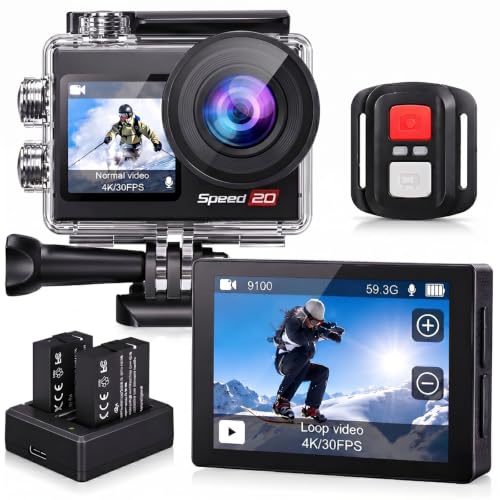
Best for Dual-Screen Framing: Hiicam 4K Action Camera 20MP Touch Screen WiFi EIS
The Hiicam 4K Action Camera 20MP Touch Screen WiFi EIS is a budget-minded option with screens on both sides, which can help when you want to check framing before a run. It records 4K at 30 frames per second, includes EIS, and comes with two rechargeable batteries. The waterproof housing is rated for depths up to 131 feet, and the camera supports cards up to 256GB, though the memory card is not included. Its remote and Wi-Fi app add control and file-sharing options.
Reasons to buy:
- Front and rear screens help with framing from different camera positions.
- Two rechargeable batteries provide a spare for swapping during a day out.
- Its included housing is rated to 131 feet, and storage support extends up to 256GB.
Reasons to avoid:
- The 4K frame rate tops out at 30 frames per second, below the 120fps option on the DJI models.
- The camera is waterproof only when installed in its housing, and a memory card must be purchased separately.
Skip it if you need high-frame-rate 4K or want to use the camera without a waterproof case in wet conditions.
How to Choose the Best Action Camera for Skiing
Stabilization and the point of view
Ski footage can include repeated jolts from turns, terrain, and the way a camera is mounted. Look for the specific stabilization feature rather than assuming that 4K recording alone will make clips look smooth. The DJI Osmo Action 5 Pro Essential Combo offers 360-degree HorizonSteady, while the DJI Osmo Action 4 Essential Combo lists three stabilization modes. The AKASO and Hiicam models specify EIS, and the mini body camera describes six-axis EIS.
Your mount also affects what the camera sees. A helmet position can show the direction you are looking, while a chest position may capture more of your arms and ski poles. Before buying, check whether the exact package includes a mount suited to your preferred position. The mini body camera expressly includes a ski mount and helmet mount; check the Essential Combo contents for the DJI models rather than assuming that every possible mount is in the box.
Cold-weather operation and battery planning
Cold can make battery planning more important on the mountain, but an advertised maximum runtime is not a promise for every setting or day. DJI gives cold-weather figures for both models here: up to 3.6 hours at -4°F for the Action 5 Pro and up to 150 minutes with operation down to -4°F for the Action 4. The mini camera states up to 150 minutes, but its listed features do not give a temperature range. The AKASO and Hiicam information in this comparison also does not establish a cold-weather runtime.
When you compare options, check the manufacturer’s stated operating temperature and whether the runtime applies to the video mode you expect to use. High-resolution or high-frame-rate recording can affect how long you can film, so consider carrying a spare battery when the camera supports one. The Hiicam package includes two batteries; do not assume that a spare battery is included with another model unless its package contents confirm it.
Resolution, frame rate, and editing plans
Resolution and frame rate address different needs. 4K describes image dimensions, while a higher frame rate provides more frames each second and can give you options for slow-motion editing. The DJI models list 4K at 120 frames per second; the AKASO, Hiicam, and mini body camera list 4K at 30 frames per second. If you mostly share short clips without editing, 4K at 30fps may be adequate. If you want to slow down a fast turn, compare the camera’s supported frame rates and resolutions together.
Editing features matter only if they fit your workflow. The Action 4 supports 10-bit color and D-Log M, which can be useful if you want to adjust color later. Those options add less value if you prefer to transfer clips and share them without additional work. Look for the exact recording mode you expect to use, not just the highest headline resolution.
Controls, displays, and remote operation
Gloves can make small controls awkward, so consider how you will start recording and check the frame. The DJI cameras have front and rear touchscreens, the Hiicam has a rear touchscreen and a front display, and the mini body camera has a 1.5-inch screen. The AKASO includes a wrist remote, but its remote is not waterproof. Check whether the control you plan to use is suitable for snow exposure and whether you can operate it with your usual gloves.
Voice control is another option on the Action 5 Pro, which supports voice commands. A remote, voice command, or screen can each be convenient in different setups, but a camera mounted on a helmet may not be easy to reach. Decide where the camera will sit before choosing based on its interface.
Water protection, mounts, and storage
Snow can melt, and wet conditions make housing details relevant. The DJI Action 5 Pro is rated IP68 and for underwater use up to 20m; the Action 4 is rated for use up to 18m. The AKASO and Hiicam describe their cameras as waterproof to 131 feet with the supplied case, while the mini camera includes a waterproof case. These claims refer to different protection approaches, so follow the maker’s instructions for the relevant case or rating rather than treating all models as equivalent.
Also check storage and package contents. The AKASO and Hiicam do not include a microSD card, and the Hiicam supports cards up to 256GB. The Action 5 Pro lists 47GB of storage. For more comparisons across the category, see our guides to action cameras under $200 and cameras under $500. You can browse the broader Action Cameras category for related guides.
How We Compared
We compared the cameras by the features that change how useful they are on a ski day: stabilization, supported video modes, screen and remote controls, stated cold-weather operation, protection details, and included mounting options. The recommendations reflect the manufacturers’ specifications and retailer information, with attention to practical differences such as whether a memory card is included or whether a waterproof case is required. Where a runtime or water-protection figure is a manufacturer claim, treat it as guidance and follow the maker’s operating instructions.
Frequently Asked Questions
Is 4K at 30 frames per second enough for skiing?
It can suit straightforward recordings and sharing, but it gives you fewer frames to work with than 4K at 120fps if you want to slow down fast action. The AKASO, Hiicam, and mini camera specify 4K at 30fps. The two DJI models list 4K at 120fps, so compare the modes you will actually use rather than choosing by resolution alone.
Which camera in this guide has the clearest cold-weather battery information?
The DJI Osmo Action 5 Pro Essential Combo has a specific claim of up to 3.6 hours of recording at -4°F. DJI also describes the Action 4 as operating down to -4°F and rates its battery for up to 150 minutes. Actual runtime can vary with conditions and settings, so keep a charging plan for a long day.
Do I need a waterproof case for skiing?
It depends on the camera’s protection design and the conditions you expect. The Hiicam is waterproof only when its case is installed, while the AKASO’s 131-foot rating applies with its waterproof case. The DJI models have their own stated water-protection ratings. Check the specific operating instructions and make sure covers and doors are properly secured before exposing a camera to snow or moisture.
Can I use the included remote with gloves?
The AKASO includes a wrist remote, but its manufacturer notes that the remote is not waterproof. Whether its buttons are easy for you to use with ski gloves depends on your gloves and setup. The DJI cameras also have touchscreens, while the Action 5 Pro supports voice control. Check the control method you plan to rely on before your trip.
Should I mount a ski camera on my helmet or chest?
Helmet mounting can capture the direction you look, while a chest position can show more of your arms and equipment. The best viewpoint depends on the footage you want and on which compatible mount is included or available for your camera. The mini body camera package lists a ski mount and helmet mount; verify mount compatibility for other choices before purchasing accessories.





Write Your Review
No reviews yet. Be the first to share your experience!