

Air purifiers can differ sharply in room coverage, filtration claims, and sleep or smart features, so a small bedroom unit may not suit an open living area. This guide to the Best Air Purifier for Asthma compares five models by their listed particle filtration, clean-air delivery details, controls, and fit for different rooms. An air purifier can reduce airborne particles, but it does not diagnose or treat asthma.
Use the room-size and cleaning-rate information carefully: some listings describe a large area receiving one air change per hour, while smaller-room figures may reflect more frequent cleaning. Choose based on the room where you spend time, and check replacement-filter availability before buying.

Pros
- Weighs only 2.2 pounds for easy desktop placement
- Sleep mode with auto-off display minimizes distractions
- Integrated fragrance sponge supports aromatherapy use
- AHAM Verifide certification for safety and efficiency
Cons
- Compact dimensions unsuitable for large open rooms
- Buyers seeking whole-house air cleaning should skip it

Pros
- Quiet 24dB sleep mode operation
- AHAM-verified CADR particle ratings
- Display shutoff prevents bedroom light disruption
Cons
- Restricted to 120V United States electrical outlets
- Requires official brand replacement filters for best performance

Pros
- Quiet 20 dB sleep mode with auto-dimming screen
- Separate HEPA and carbon filter replacements cut waste
- Tracks three particle sizes via onboard sensor
- Low 7.5W average power consumption with Energy Star
Cons
- Modest 161 CFM CADR limits fast air exchanges
- Buyers needing rapid whole-house clearing should skip it
Pros
- Washable pre-filter captures fur and reduces replacement waste
- Quiet 25-decibel sleep mode with automatic light dimming
- Delivers 4.8 air changes hourly in medium rooms
Cons
- Achieves only one air change hourly in larger rooms
- Buyers needing rapid whole-home air cleaning should skip it

Pros
- Captures 99.97 percent of 0.3-micron particles
- Automatic fan adjustment based on air quality
- Air quality indicator light turns off for sleep
- Filter alert tracks processed air volume
Cons
- Requires 60 minutes to clean 1,748 square feet
- Who should skip: buyers needing faster large-room turnover
The Best Air Purifiers by Use Case
Best for Compact Spaces: Levoit Air Purifiers for Bedroom Home Pets Dorm
The Levoit Air Purifiers for Bedroom Home Pets Dorm is the most compact-use-oriented option in this group, with a pre-filter and main filter listed for lint, hair, pet dander, fine airborne pollutants, and smoke particles. Its sleep mode and auto-off display may suit a bedside table or desk where light and noise matter. The listing identifies it as AHAM verified, but provides no CADR or room-coverage figure here, so confirm that it can clean your intended room adequately before choosing it.
Reasons to buy:
- Compact use cases include bedrooms, kitchens, and offices.
- Sleep mode and an auto-off display support nighttime use.
- Listed filtration targets include smoke particles, dust, and pet dander.
Reasons to avoid:
- The published details do not state a CADR or room-coverage rating.
- The fragrance sponge feature may not suit people who prefer to avoid added scents.
Skip it if you need a stated CADR to match a larger room or want to compare cleaning rates directly.
Best for a Quiet Bedroom: Levoit Air Purifier for Home Pets Hair Allergens
The Levoit Air Purifier for Home Pets Hair Allergens offers specific CADR figures and a defined smaller-room cleaning rate, making it easier to compare with a bedroom’s size. Its listing gives smoke, dust, and pollen CADR values of 143, 153, and 167 CFM, respectively, and says it refreshes a 222-square-foot room 4.8 times per hour. Sleep Mode is listed at 24 dB, with display lights that can be turned off. Its HEPA-grade filtration claim applies to Sleep Mode and is described as based on IEST RP C001.7.
Name it once: compare Levoit and Coway purifier options for another view of the brands.
Reasons to buy:
- Separate smoke, dust, and pollen CADR figures help with room planning.
- The listing specifies a 4.8 air changes per hour rate in a 222-square-foot room.
- Sleep Mode is specified at 24 dB, and the display can be darkened.
Reasons to avoid:
- The 1,073-square-foot figure corresponds to one air change per hour, not the faster smaller-room rate.
- The listing specifies 120V and says the unit is suitable for use only in the United States.
Skip it if you need app-based air-quality monitoring or a washable pre-filter.
Best for Air-Quality Monitoring: Levoit Air Purifier, Next Gen Fully Sealed HEPA
The Levoit Air Purifier, Next Gen Fully Sealed HEPA is the most data-rich option for buyers who want sensor readings and app controls. Its listing specifies PM1.0, PM2.5, and PM10 monitoring, a 161 CFM CADR, and capture of 99.97% of allergens down to 0.3 microns. The VeSync app supports schedules, timers, filter-life tracking, and voice-assistant connections with Alexa and Google Assistant. A 20 dB Sleep Mode and listed two-year filter life may interest people planning regular overnight use, though the filter-life claim has stated operating assumptions.
Reasons to buy:
- Three particle-size sensor readings show more detail than a basic air-quality light.
- App controls include schedules, timers, filter tracking, and the listed voice assistants.
- The listing specifies a fully sealed HEPA system and 161 CFM CADR.
Reasons to avoid:
- App and voice-control features matter less if you want a simple manual purifier.
- The stated two-year filter life is based on specified conditions, including 12 hours of daily use on maximum speed and a CADR decline criterion.
Skip it if you do not want to use an app or prioritize a washable pre-filter for pet hair.
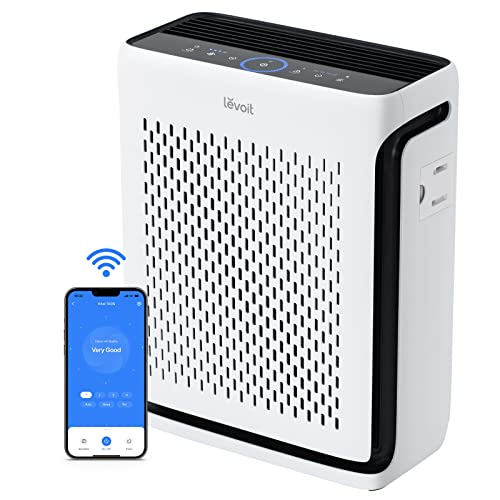
Best for Pet Hair and Dander: LEVOIT Air Purifier for Home Pets Bedroom Washable
The LEVOIT Air Purifier for Home Pets Bedroom Washable pairs a wide U-shaped air inlet with Pet Mode and a washable pre-filter, features aimed at households dealing with airborne fur and larger particles. Its listing specifies 99.97% filtration efficiency for particles sized 0.1 to 0.3 microns and describes a 4.8-times-per-hour cleaning rate in a 222-square-foot room. The VeSync app adds scheduling and filter-life checks. A washable pre-filter can reduce the need to replace that layer, but the HEPA and activated-carbon filters still need maintenance according to their condition and the manufacturer’s guidance.
Reasons to buy:
The model’s combination of a washable pre-filter, Pet Mode, and a wide inlet makes it the clearest fit here for pet households. Its Sleep Mode is listed as low as 25 dB, and the light sensor can dim the display in dark rooms.
- Washable pre-filter helps capture larger particles such as airborne fur.
- Pet Mode, schedules, and app-based filter tracking offer flexible operation.
- Activated-carbon filtration is listed for pet odors, fumes, and VOCs.
Reasons to avoid:
- The listing’s 1,073-square-foot coverage figure is at one air change per hour; the faster stated rate applies to a smaller room.
- Smart controls depend on using the VeSync app, which may be unnecessary for buyers who want basic controls.
Skip it if you do not have pets and would rather prioritize the Eleva 300X’s particle readings or the Core 300-P’s listed CADR figures.
Best for Broad Room Coverage: COWAY Air Purifier for Home Up to 1,748ft²
The COWAY Air Purifier for Home Up to 1,748ft² is designed for larger spaces, with the listing specifying coverage up to 1,748 square feet in 60 minutes. That is a slower air-change rate than the 4.8-times-per-hour figures given for smaller rooms by several Levoit models, so do not treat the largest stated area as equivalent to rapid cleaning. Its four-stage system includes a washable pre-filter, deodorization filter, Bipolar Device, and HEPA filter. The listing says the HEPA filter reduces 99.97% of 0.3-micron particles, and includes an air-quality monitor and Auto and Eco modes.
For a broader brand comparison, see our Levoit versus Coway purifier comparison. You can also browse the wider air purifier category when comparing other room-cleaning options.
Reasons to buy:
- Large-area coverage is specified, with the rate clearly stated as one cleaning cycle per hour.
- Auto Mode adjusts fan operation based on the air-quality monitor, according to the listing.
- A washable pre-filter and filter indicators support routine upkeep.
Reasons to avoid:
- The listed large-room rate is one air change per hour, which may not meet buyers’ preferred cleaning frequency.
- The listing includes a Bipolar Device but provides no separate performance details for that component.
Skip it if you need a clearly stated fast cleaning rate for a small bedroom or want app controls and voice-assistant support.
How to Choose the Best Air Purifier for Asthma
For asthma-related shopping, focus on particle filtration and the room’s cleaning rate rather than assuming a purifier will prevent symptoms. The right choice depends on the pollutants you want to reduce, how large the room is, and whether you will keep the unit running at a useful fan speed.
Match CADR and air changes to your room
CADR, or Clean Air Delivery Rate, describes the volume of filtered air delivered for a pollutant category. Higher figures can be useful when you need more cleaned air, but compare them for the same pollutant and look for the room-size rate attached to the figure. The Core 300-P lists separate smoke, dust, and pollen CADR values and a 4.8-times-per-hour rate for a 222-square-foot room. Several models also state much larger room coverage at just one air change per hour. Check the listing’s rate, not only its largest square-foot number.
Check what the filter claim actually covers
Particle capture claims include a particle-size range, so compare the wording rather than treating every “HEPA” or “HEPA-grade” label as interchangeable. The Eleva 300X listing specifies 99.97% capture down to 0.3 microns, while the Core 300-P listing describes 99.97% filtration for particles from 0.1 to 0.3 microns and identifies its filter as HEPA-grade in Sleep Mode. The Vital 100S-P listing gives a similar 0.1-to-0.3-micron range. Review the model-specific claim and its conditions on the product listing before deciding.
Plan for odors, pets, and filter upkeep
Particle filters and odor-control media serve different purposes. If you have pets, the Vital 100S-P combines a washable pre-filter with activated carbon listed for odors, fumes, and VOCs. Coway also lists a deodorization filter, while the Core Mini-P’s listing mentions help with odors and fumes. These descriptions do not establish how quickly a purifier removes a particular smell. Check which replacement filters your chosen model needs, how to clean its pre-filter, and whether the manufacturer’s replacement parts are accessible.
Choose noise and controls you will use
A purifier only helps while it is operating, so quiet modes and simple controls can matter in a bedroom. The published listings state 24 dB for the Core 300-P, 20 dB for the Eleva 300X, and as low as 25 dB for the Vital 100S-P. Treat those as product-listing specifications, not a guarantee of the sound you will hear in every room or at every fan speed. If you value automation, the Eleva 300X offers app controls and particle readings, while the Vital 100S-P offers schedules, Auto Mode, and Pet Mode.
For a basic unit, check whether the controls cover your needs without requiring app setup. The Core Mini-P lists sleep mode and an auto-off display; the Coway model lists Auto and Eco modes, a timer, and a filter indicator. Confirm the controls and operating requirements in the current listing, especially if you need a particular voltage or plan to use voice assistants.
How We Compared
We compared the published product descriptions and listed specifications, including CADR, room-cleaning rates, particle-size claims, filter designs, noise figures, controls, and maintenance features. We also considered the stated use cases, such as compact rooms, pet households, and larger spaces. The product data supplied no customer-review text, so this guide does not rely on reported owner experiences or claim that any model will improve a medical condition.
Purifiers are one part of indoor air management, not a substitute for medical care or advice from a clinician. Check current product documentation and consult a qualified health professional about asthma triggers and treatment.
Frequently Asked Questions
Can an air purifier treat asthma?
No. An air purifier may reduce some airborne particles, depending on its filter, room size, and use, but it does not treat asthma or replace medical care. Ask a qualified clinician about your health needs and indoor triggers.
How large a room can these purifiers clean?
Coverage depends on the cleaning rate you want. The Core 300-P and Vital 100S-P listings specify cleaning a 222-square-foot room 4.8 times per hour, while their 1,073-square-foot figures correspond to one air change per hour. Coway lists up to 1,748 square feet in 60 minutes. Compare the rate as well as the area, and check that your room is within the stated size.
Does a purifier need to run all night?
Operating it while you occupy the room can maintain air circulation through the filter, but the appropriate schedule depends on your needs and the product instructions. Sleep modes on the listed Levoit models reduce fan noise, and the Core 300-P and Vital 100S-P listings specify display-dimming or light-control features. Check the manual for recommended placement and operation.
Are washable pre-filters enough for pet hair and allergens?
A washable pre-filter can capture larger debris such as hair, but it is not a replacement for the main particle filter. The Vital 100S-P listing describes a washable pre-filter alongside a separate filtration system. Follow the maker’s cleaning instructions, and check whether the main filter and carbon filter need separate replacement.
Should I choose an air-quality sensor or a simpler model?
Choose a sensor if you value real-time particle readings or automatic fan adjustments. The Eleva 300X lists PM1.0, PM2.5, and PM10 readings and app-based monitoring; the Coway lists an air-quality monitor and Auto Mode. A simpler model may suit you if you prefer fewer controls, but check its CADR and room-cleaning rate before purchase.
What should I check before ordering a replacement filter?
Match the filter to the exact purifier model and confirm whether the main filter, pre-filter, and carbon layer are separate parts. Levoit recommends genuine replacement filters for the Core 300-P, and the Eleva 300X listing describes separately replaceable HEPA and activated-carbon filters. Check the current manufacturer guidance for fit, cleaning, and replacement intervals.




Write Your Review
No reviews yet. Be the first to share your experience!