

Mini fridges range from small thermoelectric coolers for a few cans to compressor refrigerators with room for groceries and a freezer compartment. The best mini fridge for your space depends on what you plan to store, how cold it needs to stay, and whether you need portability or everyday food storage.
This guide compares compact personal coolers, beverage refrigerators, and small food fridges. Check the capacity, stated temperature range, power options, and freezer details against your intended use before choosing.

Pros
- Compact 6L capacity
- Home and 12V power cords
- Lightweight with carrying handle
Cons
- Cooling depends on ambient temperature
- Skip it if you need space for more than nine cans

Pros
- Up to 126-can capacity
- Four adjustable shelves
- Wide 34°F to 64°F temperature range
- Glass door displays contents
Cons
- Weighs 50 pounds
- Who should skip it: anyone needing a smaller, lighter unit

Pros
- Cooling and warming modes
- Home and 12V car power
- Carry handle and detachable shelf
- Holds up to six 12-ounce cans
Cons
- Cooling varies with ambient temperature
- Who should skip it: shoppers needing consistent refrigerator temperatures

Pros
- Holds up to 130 standard cans
- Five adjustable wire racks
- Temperature control from 37°F to 61°F
- LED interior lighting
Cons
- Who should skip it: shoppers without space for its listed dimensions

Pros
- Four removable shelves
- Adjustable 34–64°F temperature range
- Reversible door hinge
- Digital temperature display
Cons
- 50 lb weight may make repositioning harder
- Who should skip it: shoppers seeking a lightweight, compact fridge

Pros
- Compact 18.9 x 17.2 x 32.7-inch footprint
- Reversible door
- Adjustable shelves and door bins
- ETL certified
Cons
- Small freezer is intended for short-term storage
- Manual defrost required
- Who should skip it: shoppers needing substantial freezer capacity
Pros
- AC and DC power options
- Three-pound weight with carrying handle
- Fits up to six 12-ounce cans
Cons
- Who should skip it: anyone needing more than six cans

Pros
- Compact 20-inch dimensions
- Reversible door hinge
- Slide-out, spill-proof shelf
- Adjustable thermostat
Cons
- Who should skip it: shoppers needing more storage

Pros
- Holds up to 130 standard cans
- Four adjustable shelves
- Digital temperature control
Cons
- Skip it if you need more than 3.2 cubic feet of drink storage

Pros
- Separate freezer compartment
- Adjustable mechanical temperature control
- Compact 18.63 x 17.13 x 32.5-inch dimensions
Cons
- Freezer capacity not specified
- Who should skip it: shoppers needing specified freezer capacity
The Best Mini Fridges by Use Case
Best for Everyday Food and Frozen Items: Frostorm 3.2 Cu Ft Mini Fridge with Freezer
The Frostorm 3.2 Cu Ft Mini Fridge with Freezer is a compact upright refrigerator for dorm rooms, bedrooms, and offices where food storage matters more than a dedicated drink display. Its 3.2-cubic-foot total capacity includes a separate 0.35-cubic-foot freezer compartment, adjustable shelves, door bins, and a reversible door. The listing specifies a mechanical thermostat, manual defrost, and average energy use of 0.6 kWh per day.
Reasons to buy:
- Separate freezer compartment is listed for ice cubes and short-term frozen storage.
- Reversible door can help fit different room layouts.
- Adjustable shelves and door bins offer flexible storage for groceries and drinks.
Reasons to avoid:
- The freezer is relatively small at 0.35 cubic feet, so it is not a substitute for a full-size freezer.
- Manual defrost means you will need to defrost the freezer as needed.
Who should skip it: Choose a beverage cooler instead if your main goal is holding a large collection of chilled cans.
See the Large Appliances category for more compact and full-size appliance guides.
Best for a Large Drink Collection: Feelfunn 3.2 Cu. Ft. Beverage Refrigerator
The Feelfunn 3.2 Cu. Ft. Beverage Refrigerator suits a home bar, office, or game room where cans and bottles need dedicated space. The listing gives it a 126-can capacity, four adjustable shelves, a glass door, digital temperature control from 34°F to 64°F, and compressor cooling with circulating airflow. Its stated 36 dB operating noise may appeal in quieter rooms, though actual sound can depend on placement and surroundings.
Reasons to buy:
- Four adjustable shelves accommodate different drink sizes.
- The digital control covers a broad stated range for different beverage preferences.
- Glass door lets you see the contents without opening it.
Reasons to avoid:
- This is a beverage refrigerator, not a general-purpose food fridge with a listed freezer compartment.
- Its 3.2-cubic-foot footprint needs more floor space than personal countertop coolers.
Who should skip it: Look at a small food refrigerator if you need a freezer for frozen meals or want storage for a wider range of groceries.
For broader room-appliance comparisons, browse our Home Appliances guides.
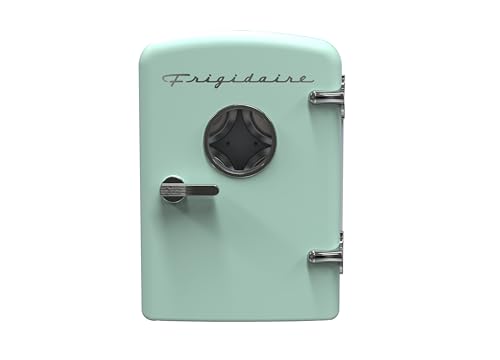
Best for Skincare and Car Trips: Frigidaire Retro Mini Personal Fridge Cooler
The Frigidaire Retro Mini Personal Fridge Cooler is a small thermoelectric cooler for a desk, bedroom, or vehicle. Its 6-liter interior is listed to hold up to nine cans, and it includes cords for a home outlet and a 12V car adapter. Frigidaire says it cools 26°F to 28°F below ambient temperature, so its final temperature depends on the surrounding air rather than a fixed refrigerator setting.
Reasons to buy:
- Dual home and 12V car power options support use in different settings.
- Listed capacity fits up to nine cans or smaller skincare items.
- Carrying handle and locking latch support portable use.
Reasons to avoid:
- Thermoelectric cooling depends on ambient temperature, unlike a compressor model with a stated set-temperature range.
- Its capacity is much smaller than full-size beverage refrigerators.
Who should skip it: Choose a compressor refrigerator for steady storage of groceries or for a larger beverage supply.
For another portable personal cooler, the Air Conditioners and Fans category covers adjacent home comfort products, though it is not a refrigerator category.
Best for Cooling and Warming: CROWNFUL Mini Fridge, 4 Liter/6 Can
The CROWNFUL Mini Fridge, 4 Liter/6 Can is a portable personal unit with both cooling and warming modes. It holds up to six 12-ounce cans, includes a detachable shelf, and comes with home and 12V car power cords. The listing says its cooling performance varies with ambient temperature and gives a warming temperature of up to 149°F, making this model more versatile than a cooling-only personal cooler.
Reasons to buy:
- Switches between cooling and warming modes.
- Includes home and 12V car power options.
- The detachable shelf and carry handle support flexible packing and transport.
Reasons to avoid:
- The four-liter interior is intended for a few items, not meal storage for several people.
- Cooling temperature changes with room or vehicle temperature, according to the listing.
Who should skip it: If you need a set temperature for everyday food storage, choose a compressor refrigerator with a stated temperature control range.
Best for a Small Desk or Nightstand: Frigidaire EFMIS171 Retro Mini Portable Personal
The Frigidaire EFMIS171 Retro Mini Portable Personal is a compact 4-liter thermoelectric cooler listed to hold six 12-ounce cans. It includes AC and DC power cords and weighs three pounds, which makes it easier to move between a desk, dorm room, and car than a larger compressor fridge. The listing also describes a flush-back design for different placement options.
Reasons to buy:
- Three-pound weight and included home and vehicle power cords suit portable personal use.
- Interior capacity accommodates six standard soda cans, according to the listing.
- Thermoelectric cooling uses semiconductors and is described as free of CFCs and refrigerants.
Reasons to avoid:
- Small interior limits it to a few cans or similarly sized items.
- The listing does not provide a fixed temperature range, so check whether ambient-dependent cooling meets your needs.
Who should skip it: Choose a larger personal cooler if you need more than six cans, or a compressor model for groceries and freezer storage.
Also Considered
The best space heater for large rooms covers a different appliance category, so compare it only if you are also choosing room heating.
Our smoke air purifier comparison may help with another room appliance purchase, but it does not address refrigerator storage.
The California air purifier guide compares a separate appliance category and is not a substitute for a compact fridge buying guide.
How to Choose the Best Mini Fridge
Decide between a personal cooler and a compressor refrigerator
Personal thermoelectric coolers are compact and often include car power, but their cooling depends on surrounding temperature. The Frigidaire Retro Mini Personal Fridge Cooler, CROWNFUL model, and Frigidaire EFMIS171 list capacities of four to six liters and rely on ambient-dependent cooling. These are better suited to a few drinks, skincare products, or snacks than to routine grocery storage.
Compressor models are the more relevant category when you need a larger interior or a stated temperature range. Beverage models in this guide list adjustable ranges, while the Frostorm and Igloo models include separate freezer compartments. Check the product type and cooling description rather than assuming every device called a mini fridge performs the same job.
Match capacity and shelves to what you store
Can capacity offers a quick comparison for drinks, but it does not tell you how easily larger bottles or food containers will fit. Beverage refrigerators here list capacities of up to 126 or 130 cans and adjustable shelves. Review shelf count and adjustability on the listing, then compare those details with the bottle shapes and containers you actually plan to store.
For groceries, total cubic feet and the interior layout matter more than a can count. The Frostorm lists 3.2 cubic feet of total space, including its freezer, while the Frigidaire Mini Fridge, Ideal for Dorm, Office lists 1.55 cubic feet. Confirm whether the listed capacity includes a freezer compartment, and check the product images or listing details for door bins and shelf arrangement.
Check temperature needs and freezer details
A digital temperature setting can make a beverage cooler easier to adjust, but the available range still matters. Feelfunn lists 34°F to 64°F, while the Electactic beverage listings give different lower limits. Compare the specific model’s range with what you plan to chill rather than treating similar-looking product names as identical.
If you need frozen food, check that the product explicitly lists a freezer and note its size and stated temperature information. Frostorm lists a 0.35-cubic-foot freezer and manual defrost. Igloo lists a separate freezer compartment but does not provide its capacity in the published details, so verify its layout and intended storage before buying.
Measure the space and confirm door access
Large beverage refrigerators can hold many drinks, but need more room than a countertop cooler. Measure the intended location and account for the space needed to open the door and reach shelves. The published listings do not provide dimensions for every product, so confirm the exact model’s measurements before ordering.
A reversible door can make placement easier when a hinge would otherwise open toward a wall or desk. Frostorm and the 1.55-cubic-foot Frigidaire list reversible doors. Do not assume that feature applies to other models in the same brand or product family.
Choose power options for the intended location
Personal coolers with home and 12V car cords can work in more than one setting, but the vehicle connection does not make them equal to a refrigerator for everyday food storage. Frigidaire’s two personal models and the CROWNFUL unit list home and car power options. Beverage and food refrigerators in this guide are designed for stationary room use in the published descriptions; check the exact power requirements before choosing a location.
How We Compared
This comparison uses the published product specifications, feature descriptions, and available customer feedback details. We considered listed capacity, cooling type, temperature controls, freezer compartments, shelf flexibility, portability, and stated power options to match each model to a practical use. Product descriptions are manufacturer-provided claims, and no customer review details were supplied to establish a pattern of owner experience.
Frequently Asked Questions
Can a personal mini cooler replace a regular refrigerator?
Not for most everyday food-storage needs. The small thermoelectric models here hold roughly six to nine cans, and their cooling depends on ambient temperature. For groceries or a separate freezer compartment, consider a compressor refrigerator with the relevant storage features listed.
What is the difference between a beverage fridge and a mini fridge with a freezer?
A beverage refrigerator is designed around drink storage, often with a glass door, adjustable shelves, and a stated temperature range. A compact food refrigerator may include door bins, shelves, and a small freezer compartment. Choose based on whether you primarily store cans and bottles or need space for groceries and frozen items.
Will a thermoelectric mini fridge keep drinks at a fixed temperature?
Do not assume so. The personal cooler listings describe cooling relative to the surrounding temperature, which means warmer surroundings can affect the result. If a specific set temperature matters, look for a model with a stated adjustable range and check the range for that exact product.
Can I use a mini fridge in a car?
Some small personal coolers include a 12V car adapter, including the Frigidaire personal models and CROWNFUL unit in this guide. Confirm that the exact model includes the car cord and follow its product instructions for vehicle use. Do not assume a larger beverage or food refrigerator supports a vehicle connection.
Should I choose a model with a freezer compartment?
Choose one if you need to keep ice or a small amount of frozen food close by. Check freezer capacity and temperature details, because a compact compartment may have limited room. If frozen storage is unnecessary, a beverage refrigerator or a fridge without a freezer may devote more of its space to chilled items.







Write Your Review
No reviews yet. Be the first to share your experience!