

During a blackout, a compact power station may keep phones and a router running, but it may not have enough output or stored energy for larger appliances. The best power station for home backup depends on what you need to run, for how long, and whether you need a transfer setup, quick backup switching, or room to add batteries.
This comparison covers four models with different capacities, output ratings, charging options, and backup features. Check appliance labels and the power station’s manual before connecting equipment, and plan for the limits of battery capacity rather than assuming a listed output rating tells you how long a device will run.

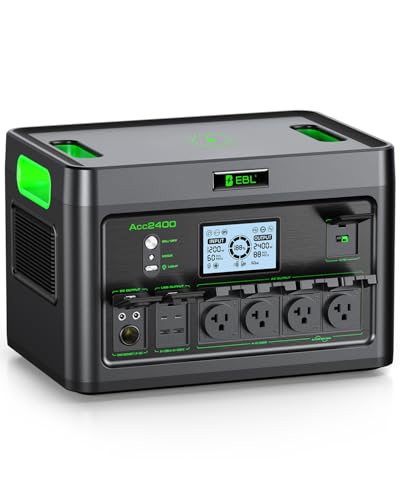
Pros
- Four AC outlets with 2400W maximum output
- Multiple charging options for up to 12 devices
- LiFePO4 battery rated for over 3,500 cycles
Cons
- 54 lb weight limits easy portability
- Skip it if you need a lightweight power station

Pros
- High 3,600W AC output
- Expandable 3,584Wh capacity
- Four charging options
- Wheels and telescopic handle
Cons
- 77.16 lb, less convenient to carry
- Skip it if you need a lightweight station

Pros
- 3,072Wh LiFePO4 battery capacity
- Six AC outlets
- 100W USB-C ports
- UPS mode with 8 to 20 ms switching
Cons
- 63.3 lb makes frequent carrying less practical
- EP3800-48V expansion requires separately sold XT120-M cable
- Skip it if you need a lightweight, easily carried station
The Best Portable Power Stations by Use Case
Best for Expandable Whole-Home Backup: Jackery HomePower 3600 Plus Power Station, 3584Wh
The Jackery HomePower 3600 Plus Power Station, 3584Wh suits households that want substantial stored energy and a path to expand it. The listing specifies 3,584Wh capacity, 3,600W output, and expansion up to 21kWh per unit or 43kWh with multiple units. It also lists 120V and 240V operation in parallel and says the unit can pair with an MTS for home use, so confirm the required equipment and installation details before planning a house connection.
Reasons to buy:
- Higher listed output than the 1,600W and 2,400W models in this comparison.
- Expandable capacity can suit longer outages or a growing backup plan.
- Wheels and a telescoping handle make it easier to move than a stationary battery system.
Reasons to avoid:
- Parallel operation and MTS pairing involve additional equipment and setup; confirm what your home needs.
- Its 3,584Wh capacity is not unlimited, and runtime depends on the appliances and their actual consumption.
Skip it if you need a lighter, smaller unit for occasional device charging, or if you do not need expansion and higher household output.
Best for High Output at a Lower Listed Price: PECRON Portable Power Station F3000LFP
The PECRON Portable Power Station F3000LFP pairs a 3,600W output rating with 3,072Wh capacity, making it a fit for buyers prioritizing strong output and a substantial battery in one unit. The listing specifies six AC outlets, 13 total ports, solar input up to 1,600W, and an 1,800W AC charging input. It also lists an 8–20ms UPS switching time and app monitoring, although you should verify whether its UPS behavior meets the needs of each device you plan to connect.
Reasons to buy:
- 3,600W listed output supports more high-demand equipment than lower-output options, subject to appliance startup and running requirements.
- Six AC outlets and multiple USB and DC ports support several connected devices.
- Expansion is available with an additional battery, but the required XT120-M cascade cable is sold separately.
Reasons to avoid:
- Expansion adds a separately sold cable and battery, so check total system requirements before buying.
- The 8–20ms UPS figure is a listing claim; confirm device compatibility and backup behavior for sensitive equipment.
Skip it if you want a simpler, smaller-capacity station or do not need its high output and expansion option.
Best Value for Multiple Devices: EBL 2400W Portable Power Station LiFePO4 Battery
The EBL 2400W Portable Power Station LiFePO4 Battery offers 1,843.2Wh capacity and 2,400W maximum output, with a particularly broad set of connection options. Its listing describes 12 device connections, including four AC outlets, two USB-C ports, USB-A, DC, a car port, and wireless charging. EBL also describes a 0.1-second emergency power mode; treat that as a manufacturer claim and verify whether it suits your equipment before relying on it for uninterrupted backup.
Reasons to buy:
- Twelve listed connection points make it useful when several people need to charge devices at once.
- Its 2,400W rating sits between the lower-output BROWEY and the 3,600W models.
- The listing specifies 55 lb and dual-side handles, giving buyers a concrete portability consideration.
Reasons to avoid:
- At 55 lb, it is not a lightweight option for frequent carrying.
- Its 1,843.2Wh capacity is lower than the Jackery and PECRON models, which may limit runtime for sustained loads.
Skip it if your backup plan depends on high-power appliances for extended periods or you need a lighter station to carry by hand.
Best for Built-In Solar Charging: BROWEY 1600W (3200W Peak)
The BROWEY 1600W (3200W Peak) stands out for its built-in solar panel, which can collect sunlight while the station charges connected devices. Its listed capacity is 1,024Wh, with 1,600W continuous pure sine wave output and 3,200W peak output. That combination favors lighter backup needs and outdoor use over running several large household appliances at once; check both continuous and startup wattage for every appliance you intend to power.
Reasons to buy:
- Built-in solar panels and an MPPT controller provide an integrated solar option.
- USB-C PD output is listed at 100W, useful for compatible laptops and other devices.
- LiFePO4 cells and a claimed 3,000 cycles to 80% capacity are specified in the product information.
Reasons to avoid:
- Its 1,024Wh capacity is the lowest among these four, so it may need recharging sooner under sustained loads.
- The listing describes solar charging at 40W, so check expected solar input and local sunlight conditions rather than assuming rapid solar replenishment.
Skip it if you need to support high-demand appliances or want a larger reserve for a long outage.
How to Choose the Best Power Station for Home Backup
Match output to appliance demand
Output, measured in watts, describes how much power the station can supply at one time. Capacity, measured in watt-hours, describes stored energy. They answer different questions: output affects whether a device can run at all, while capacity helps estimate how long it may run.
Start with the appliances you need during an outage, such as a refrigerator, router, lights, medical equipment, or a sump pump. Check each device’s rated running wattage and, where relevant, startup surge. A motor-driven appliance can demand more power when it starts than while it runs. Compare those figures with the station’s continuous and peak output, and do not treat a peak rating as a continuous rating. The BROWEY, for example, lists 1,600W output and 3,200W peak, while PECRON lists 3,600W output.
Estimate capacity from the loads you will actually use
More watt-hours can support a larger load for longer, but actual runtime depends on appliance consumption, how often it cycles, and conversion losses. Product listings do not provide a guaranteed runtime for your specific home. Make a short list of essential devices, note their wattage and expected hours of use, and estimate their energy needs before choosing capacity.
The listed capacities here range from 1,024Wh for BROWEY to 3,584Wh for Jackery. EBL lists 1,843.2Wh, while PECRON lists 3,072Wh. That makes Jackery and PECRON more suitable starting points when stored energy is a priority, while EBL and BROWEY may suit narrower backup plans. None of these capacity figures alone proves a particular number of hours for a refrigerator or other appliance.
Check outlets, charging, and solar input
Count the devices you want to connect and check the outlet types and ratings, not just the total port count. EBL lists 12 connection points, including four AC outlets and two USB-C ports. PECRON lists 13 ports, including six AC outlets and two 100W USB-C PD ports. Confirm that each port supports the voltage, connector, and power level your device needs. USB-C describes a connector type, not a guarantee that every port has the same charging capability.
Charging speed matters when outages last longer than one battery cycle. The product listings provide different methods and manufacturer-stated times: Jackery lists AC, solar, gas-generator, and hybrid AC-plus-DC charging; PECRON lists AC, solar, and car charging; BROWEY includes built-in solar panels and describes a separate 100W solar figure. Verify the input limits, compatible panels, cables, and charging conditions in each manual. Solar charging depends on available sunlight and setup, so do not plan around a best-case listing time alone.
Understand backup switching and home connection
A power station with an emergency or UPS mode may switch to battery power when grid power fails, but the listed switching time is not a universal guarantee for every connected device. EBL describes a 0.1-second emergency mode, and PECRON lists an 8–20ms UPS switching time. Confirm the device’s tolerance, required connection method, and operating instructions before relying on either feature for computers, networking equipment, or medical devices.
Powering selected devices directly from station outlets is different from connecting a station to home wiring. Jackery’s listing describes pairing with an MTS and parallel operation for 120V and 240V use. Check the manual and ask a qualified electrician about a transfer setup and local requirements. Never connect a power station to household wiring through an improvised method or an ordinary wall outlet.
Weigh portability against expansion
A home backup unit may need to move between a storage area and the appliances it powers. EBL lists a weight of 55 lb, while Jackery describes wheels and a telescoping handle. Compare the stated weight and carrying or rolling design with the route through your home, including stairs and doorways. Product descriptions do not provide dimensions for every model, so check the listing and manual if storage space is tight.
Expansion can add capacity, but it may involve extra equipment, connections, and expense. Jackery describes expansion up to 21kWh per unit and up to 43kWh with multiple units. PECRON supports an additional battery and specifies that a special XT120-M cascade cable is required and sold separately. Confirm battery compatibility, required cables, and any system limits before treating expansion as part of your backup plan.
How We Compared
This guide compares the published product information, including listed watt-hour capacity, output, port counts, charging methods, expansion details, and backup features. We also considered stated portability details and product-specific limitations, such as PECRON’s separately sold cascade cable. Manufacturer-provided claims, including charging times, cycle counts, and UPS behavior, are presented as listing information rather than independent performance findings. No customer feedback was supplied for these models.
Frequently Asked Questions
Can a portable power station run a refrigerator during an outage?
Potentially, if the station can supply the refrigerator’s running and startup wattage and has enough capacity for the desired runtime. Check the refrigerator’s label or manual for its power requirements, then compare them with the station’s continuous and peak output. Runtime will depend on the refrigerator’s energy use and cycling, so the listed watt-hour capacity cannot guarantee a specific number of hours.
Is a 3,600W power station automatically better for home backup?
No. A higher output rating can support a larger simultaneous load, but it does not necessarily mean more stored energy or longer runtime. Compare output and watt-hours separately, then match both to the appliances you intend to operate. Jackery and PECRON list 3,600W output, but their stated capacities differ.
Can I connect a power station to my home’s electrical panel?
Do not assume that a portable station can connect directly to a home panel. Jackery describes using an MTS for its home backup setup, but the published information does not establish that every installation is compatible or explain all required equipment. Consult the product manual and a qualified electrician about transfer equipment, wiring, and local electrical requirements. Avoid improvised connections.
What does UPS or emergency backup mode do?
It describes a mode intended to provide battery power when another power source fails. EBL and PECRON list switching times, but the claims do not establish compatibility with every computer or medical device. Check the device maker’s guidance and the power station manual, including whether the station should stay plugged into wall power during normal operation.
Do built-in solar panels make a station recharge quickly?
Not necessarily. BROWEY includes built-in solar panels, but its listing describes 40W solar charging. Charging time depends on solar input, sunlight, and operating conditions. Compare the station’s stated solar input limits with the panel setup you plan to use, and verify cable and panel compatibility before buying.
Should I choose a LiFePO4 model for backup?
LiFePO4 is the stated battery chemistry for BROWEY, EBL, and PECRON. Their listings also provide cycle-life or service-life claims, which vary by model and are manufacturer specifications, not a promise of a particular lifespan in your home. Compare the full product information, charging limits, operating instructions, and warranty terms before deciding; the published information does not establish that every model uses the same cells or has the same protections.
For more options in this category, browse our portable power station guides. For related charging gear, see our Power & Charging category and guide to choosing a USB-C cable.


Write Your Review
No reviews yet. Be the first to share your experience!