

Washing a car at home calls for enough water flow to lift grime, but a powerful spray can be too aggressive when used carelessly on paint, trim, or decals. This guide to the best pressure washer for cars compares electric and gas models, soap options, hose lengths, and portability so you can choose a setup that fits your washing routine and other outdoor jobs.
Specifications here come from product listings, and advertised maximum pressure does not tell the whole story. Pay attention to rated pressure, nozzle choice, and the distance you can maintain from the vehicle. For broader electric-model comparisons, see our electric pressure washer guide.

Pros
- Four quick-connect metal nozzles
- Foam cannon included
- Wheels and anti-tipping base
- Compact 16.6-pound design
Cons
- No PSI rating listed
- Who should skip it: buyers needing a specified pressure rating

Pros
- Five quick-connect nozzle options
- Onboard soap tank
- Compact, lightweight design
- Automatic pump shutoff when trigger is released
Cons
- Who should skip it: buyers needing more than 1.24 rated GPM

Pros
- Compact 19-pound design
- Five quick-connect nozzle options
- Onboard soap tank
- Three-year limited service, labor, and parts coverage
Cons
- Rated flow is 1.2 GPM, below 1.76 max GPM
- Who should skip it: buyers needing higher rated water flow
Pros
- Five quick-connect nozzles included
- Onboard soap tank
- 35-foot GFCI power cord
- Three-year limited manufacturer coverage
Cons
- Corded 120V design limits use away from outlets
- Who should skip it: buyers needing cordless operation
Pros
- Adjustable foam cannon included
- Turbo nozzle included
- 35-foot GFCI power cord
- Built-in accessory holders
Cons
- Rated output is 1800 PSI and 1.2 GPM
- Who should skip it: buyers needing higher rated pressure or flow

Pros
- Foam cannon included
- Turbo and two spray nozzles included
- 17-pound compact design
- 35-foot GFCI cord
Cons
- Who should skip it: Buyers needing higher rated flow

Pros
- Lightweight 17.6-pound design
- Built-in carry handle
- Detachable foam cannon
- Three-year limited service, labor, and parts coverage
Cons
- Skip it if you need more than 1,800 rated PSI or 1.2 rated GPM

Pros
- Five quick-connect nozzles, including soap
- Onboard half-gallon soap tank
- Includes engine oil and tools
Cons
- Gas engine requires recoil starting
- Who should skip it: shoppers avoiding gas-powered equipment
The Best Pressure Washers by Use Case
Best Budget: Westinghouse ePX3100s Electric Pressure Washer
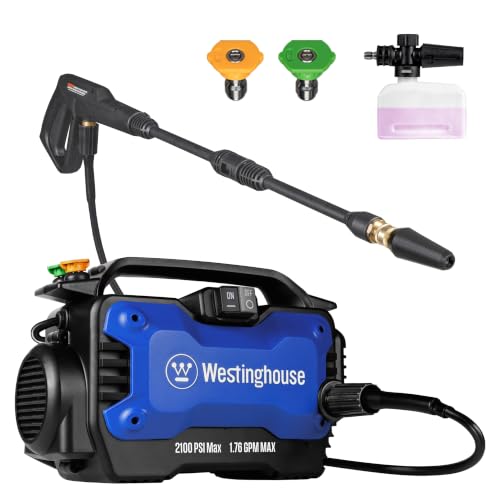
The Westinghouse ePX3100s Electric Pressure Washer suits car owners who want a compact electric unit with a dedicated foam cannon. Its listing specifies 1,800 rated PSI and 1.2 rated GPM, plus a 20-foot high-pressure hose and 35-foot GFCI power cord. At 10 pounds, it is the lightest listed model in this group, making it easier to carry and store between routine washes.
Reasons to buy:
- Adjustable foam cannon applies clinging foam.
- Low listed weight and compact design support easy storage.
- Long power cord gives room to move around a vehicle.
Reasons to avoid:
- Its 20-foot hose may limit reach around larger vehicles or distant water connections.
- The listing does not specify a rated flow above 1.2 GPM.
Skip it if you need a longer pressure hose or higher listed rated flow for frequent larger cleanup jobs.
Best for Soap Application: Westinghouse ePX3500 Electric Pressure Washer
The Westinghouse ePX3500 Electric Pressure Washer is a compact option for owners who want a soap tank and multiple spray patterns in one package. The listing gives it 2,000 rated PSI and 1.2 rated GPM, a 20-ounce onboard soap tank, and five nozzle options, including a soap applicator. Its four quick-lock wheels and anti-tipping design may help when moving it across a garage or driveway.
Reasons to buy:
- Onboard tank and soap nozzle support detergent application.
- Five included nozzle options cover different spray patterns.
- Compact body, four wheels, and a 25-foot hose support home use.
Reasons to avoid:
- Rated flow is listed at 1.2 GPM, so it is not the higher-flow option in this roundup.
- The listing specifies a 20-ounce soap tank, which may call for refilling during extended work.
Skip it if you want a larger onboard soap reservoir or a gas-powered machine for heavy outdoor chores.
Best for Larger Outdoor Jobs: Westinghouse WPX3000e Electric Pressure Washer
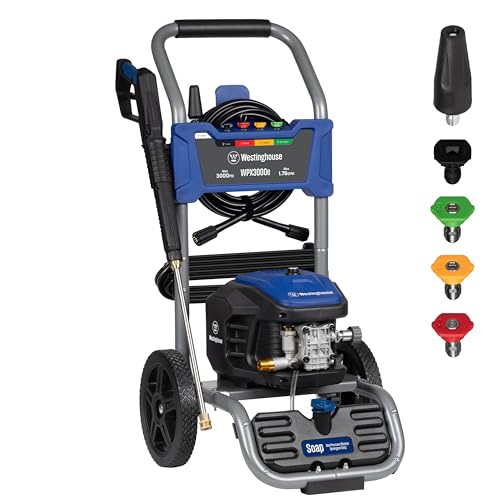
The Westinghouse WPX3000e Electric Pressure Washer fits buyers who want a wheeled electric washer for cars as well as sidewalks, fences, and patio furniture. Its listing specifies 2,600 rated PSI and 1.1 rated GPM, a 0.45-gallon soap tank, and a 25-foot abrasion-resistant hose. The 10-inch wheels and 35-foot GFCI cord favor moving around larger outdoor spaces, though car washing calls for a suitable nozzle and careful distance.
Reasons to buy:
- Larger onboard soap tank than the compact models listed here.
- Includes five nozzles and a metal spray gun and wand.
- M22 fitting compatibility is specified for listed accessory types.
Reasons to avoid:
- Its rated flow is 1.1 GPM, so the high maximum PSI figure does not mean the highest rated water flow.
- The listing does not give a lightweight carry weight.
Skip it if compact carry-and-store convenience matters more than a wheeled frame and larger soap tank.
Best for Hose Reach: Westinghouse ePX3050 Electric Pressure Washer
The Westinghouse ePX3050 Electric Pressure Washer is a wheeled electric choice for drivers who value a long power cord and a ready-to-use foam cannon. The listing specifies 1,800 rated PSI and 1.2 rated GPM, a 20-foot pressure hose, and a 35-foot GFCI cord. It includes 15-degree and 25-degree nozzles alongside a turbo nozzle, so the selection is more limited than models supplied with five nozzles.
Reasons to buy:
- Foam cannon comes with the washer.
- 35-foot GFCI cord offers useful reach from an outlet.
- Wheels and a 26-inch profile support rolling storage and transport.
Reasons to avoid:
- Three included nozzle options provide fewer choices than five-nozzle kits.
- The hose is 20 feet, shorter than the 25-foot hoses on some alternatives.
Skip it if you need a wider choice of included nozzle patterns or a longer pressure hose.
Best for Higher Listed Flow: Pressure Washer, Portable Power Washer
The Pressure Washer, Portable Power Washer may appeal to car owners who also clean patios and driveways and want the listing’s stated flow figure of up to 2.5 GPM. It includes four quick-connect nozzles, from 0 to 40 degrees, and a foam cannon. The product information does not provide a rated PSI figure, so buyers should not compare its headline flow claim directly with the rated pressure figures listed for other models.
Reasons to buy:
- Four nozzle angles provide several spray-width choices.
- Foam cannon supports soap application.
- Listing describes a faucet or bucket water collection system.
Reasons to avoid:
- Rated PSI and rated GPM are not supplied, limiting direct specification comparisons.
- The listing advises clearing air from inlet and high-pressure hoses before operation.
Skip it if you need clearly stated rated pressure and flow figures before choosing a washer.
Best Gas-Powered Option: Westinghouse WPX3400 Gas Pressure Washer
The Westinghouse WPX3400 Gas Pressure Washer is the gas-powered pick for buyers who want a single machine for vehicle washing and demanding outdoor cleaning. Its listing specifies 3,400 PSI and 2.6 GPM, a 25-foot hose, a half-gallon soap tank, and five nozzles. The 212cc four-stroke engine and recoil start bring more setup and upkeep considerations than the electric alternatives, and the high stated output calls for care around vehicle finishes.
Reasons to buy:
- Highest listed pressure and flow among these products.
- Includes five nozzle choices, including a 40-degree nozzle and soap nozzle.
- Steel frame and 12-inch wheels are specified for moving the unit.
Reasons to avoid:
- Gas engine adds fuel and engine-oil considerations absent from electric models.
- Its strong output may be excessive for routine car washing unless carefully controlled.
Skip it if you mainly wash cars and prefer an electric unit with less engine-related setup.
Also Considered
The Westinghouse ePX3100 Electric Pressure Washer could suit buyers seeking a compact wheeled design, soap tank, and five nozzles, but its specifications closely overlap with the ePX3500 pick. The Westinghouse ePX3100v Electric Pressure Washer may fit people who prioritize a built-in carry handle and detachable foam cannon, though its listing gives fewer nozzle details than several main picks.
How to Choose the Best Pressure Washer for Cars
Compare rated pressure, not only maximum PSI
Listings may show a maximum PSI alongside a lower rated PSI. The rated figure offers a more useful basis for comparing the stated working pressure across models, while maximum PSI is not a promise of constant output. For car washing, more pressure is not automatically better: use a wide spray pattern, keep the nozzle moving, and follow vehicle and washer guidance. Avoid directing a concentrated jet at paint, seals, tires, or delicate trim.
Read flow figures with their labels
GPM describes water flow, which can affect how quickly rinsing moves soap and loose dirt away. Listings may distinguish rated flow from maximum flow, so compare like with like. For example, the Westinghouse electric models list rated flow around 1.1 to 1.24 GPM, while the gas WPX3400 lists 2.6 GPM. The LWQ listing states up to 2.5 GPM but does not provide a rated PSI or rated GPM figure, making direct comparison harder.
Choose a nozzle and soap setup for the task
A wider spray angle spreads water over a larger area; a narrow angle concentrates it. Several picks include multiple quick-connect nozzles, while the ePX3050 lists three options and a foam cannon. Soap tanks and foam cannons are not interchangeable claims: check which one the specific model includes and whether its instructions identify suitable detergent. Never assume a chemical is safe for a washer, car finish, or surface because a listing mentions detergent use.
Check hose length, cord reach, and storage
Hose and cord length affect where you can position the washer while walking around a vehicle. The listed pressure hoses range from 20 to 25 feet on the models with stated lengths; some electric picks also specify a 35-foot GFCI cord. Consider outlet and water-source locations before buying. Compact carry models can be easier to store, while wheeled units may be more convenient across a larger driveway.
Decide whether gas power fits your routine
Electric washers avoid the gas engine listed on the WPX3400, while that gas model supplies substantially higher stated pressure and flow for broader heavy-duty chores. That extra output may be unnecessary for an occasional car wash. Think about your other jobs, where you will operate the machine, and whether fuel and engine oil fit your setup. Follow the manufacturer’s operating instructions, especially for gas equipment and electrical connections.
How We Compared
We compared the published product specifications and design details, including rated and maximum pressure where provided, stated water flow, nozzle sets, soap accessories, hose and cord lengths, portability features, and power type. Customer feedback information available for these listings did not provide review text to assess, so recommendations rely on published product data rather than reported owner experiences. Missing rated figures and other unspecified details are noted rather than assumed.
Frequently Asked Questions
Can I use any pressure washer to wash a car?
These listings identify the models for vehicle use, but correct operation still matters. Use a wide nozzle pattern and keep the spray moving at a safe distance; avoid concentrated spray on paint, trim, tires, and seals. Check the washer manual and your vehicle-care guidance before applying detergent or spray to sensitive areas.
Is a foam cannon included with every model?
No. The ePX3100s and ePX3050 list a foam cannon, the ePX3100v lists a detachable foam cannon, and the LWQ model lists one as well. Other products specify an onboard soap tank or soap nozzle instead. Confirm the exact accessory in the individual listing, and do not assume it comes with another model from the same brand.
What is the difference between an onboard soap tank and a foam cannon?
An onboard soap tank stores detergent on the washer, while a foam cannon is a separate attachment listed for applying foam. Product descriptions vary in how much detail they give about adjustment and detergent compatibility. Check the manual for approved cleaning products and the correct connection before use.
Should I choose an electric or gas pressure washer for a car?
An electric model may suit routine vehicle washing and home storage, especially if you want a compact unit, soap accessory, or long power cord. The gas WPX3400 lists greater pressure and flow for heavier outdoor tasks, but its engine adds fuel and oil considerations. Choose based on the full set of jobs you expect to do, not the largest PSI number alone.
Can I use a bucket instead of a faucet?
The LWQ listing describes a faucet or bucket water collection system. The other published product details do not confirm bucket-feed compatibility. Check the manual for inlet requirements before connecting a water source that differs from the listed setup.
Can I use a surface cleaner or other accessory?
The WPX3000e and WPX3400 listings specify compatibility with some pressure-washer accessories using M22 fittings, including surface cleaners. That does not establish compatibility with every attachment. Check the accessory connection and the washer manufacturer’s requirements before purchasing; an attachment intended for flat hard surfaces is not automatically suitable for vehicle paint.




Write Your Review
No reviews yet. Be the first to share your experience!