

Smart glasses now combine familiar eyewear with cameras, open-ear audio, and voice assistants, but those features vary by model. This guide to the Best Smart Glasses helps you compare camera and translation claims, lens choices, battery information, and the difference between audio-first glasses and models with extra recording features.

Pros
- Open-ear audio
- Hands-free camera and voice features
- Charging case adds up to 48 hours
Cons
- No augmented-reality display
- Who should skip it: shoppers seeking an augmented-reality display

Pros
- Hands-free 4K video recording with stabilization
- Open-ear speakers maintain situational environmental awareness
- Multi-language real-time translation features without subscription fees
- Includes both sun and anti-blue light lenses
Cons
- Video recording limited to eighty minutes per charge
- Who should skip: long-session videographers needing hours of continuous recording

Pros
- Lightweight 35g frame with three swappable lenses
- Six-axis electronic image stabilization for video
- IP65 water resistance against sweat and light rain
- Dual-microphone noise cancellation for calls
Cons
- Video recording capped at 12 minutes per session
- Limited internal storage of 4GB without card expansion
- Skip if you need continuous long-format video recording

Pros
- Open-ear audio keeps ambient sounds audible
- Hands-free camera and call features
- Clear lenses for everyday wear
Cons
- No augmented reality display
- Who should skip it: shoppers needing an AR display

Pros
- Transitions lenses adapt to changing light
- Open-ear audio keeps surroundings audible
- Hands-free camera and calling features
Cons
- No augmented reality display; skip if you want visual overlays
The Best Smart Glasses by Use Case
Best for Everyday Audio and Sunglasses: Meta Ray-Ban (Gen 2) Wayfarer, Matte Black
The Meta Ray-Ban (Gen 2) Wayfarer, Matte Black pairs the Wayfarer frame with polarized gradient graphite lenses, open-ear speakers, a camera, and Meta AI. Its listing claims up to eight hours of use with moderate activity, plus 48 additional hours from the charging case. The lenses suit buyers who want sunglasses first, with hands-free capture and audio available along the way. Travel headphone comparisons can also help clarify whether open-ear sound fits your listening habits better than headphones.
Reasons to buy:- Polarized gradient graphite lenses provide a sunglasses-oriented option.
- Open-ear audio lets you listen while remaining aware of nearby sounds.
- Meta AI supports voice interactions and listed features such as translation.
- It does not include an augmented-reality display.
- The battery figure is a manufacturer claim for moderate use, not a guarantee for every routine.
Skip it if you need prescription lenses, a display in your field of view, or a camera-free frame; verify lens and prescription options before buying.
Best for Camera Features on a Budget: iONCT AI Smart Glasses with Camera
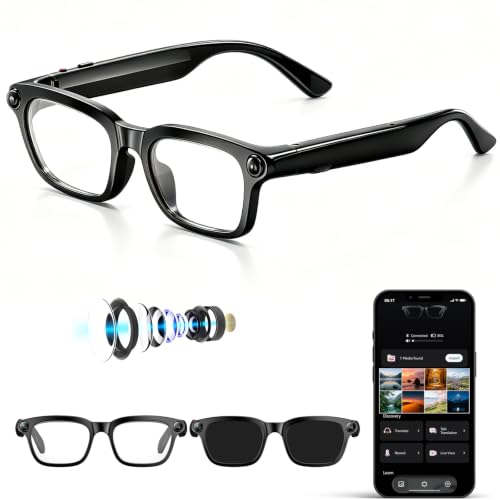
The iONCT AI Smart Glasses with Camera is a feature-heavy option for buyers interested in first-person video, calls, and translation without moving to a Ray-Ban frame. Its listing specifies an 8MP sensor, 32MP photos, 4K video, and electronic image stabilization, though those headline claims do not establish the final image quality. It also lists voice-activated AI, object recognition, and translation across more than 165 languages. The claimed battery figures are up to 10 hours of music playback or 80 minutes of total video recording, making recording intensity an important consideration.
Reasons to buy:- Listing includes camera stabilization and hands-free photo or video capture.
- Two lens types are specified: sunglass lenses and an anti-blue-light lens.
- Bluetooth 5.3 and Wi-Fi are listed for connection and file syncing.
- Video recording is listed for up to 80 minutes total, substantially less than the music-playback claim.
- Phone, app, language, and translation-mode compatibility details are not fully specified in the published information.
Skip it if you want a clearly documented phone ecosystem or need extended continuous video capture; confirm app support and recording limits first.
Best for Interchangeable Lenses: AI Smart Glasses with POV Camera for 4K Photo
The AI Smart Glasses with POV Camera for 4K Photo targets people who want a camera-equipped frame with lens choices for different settings. Haulvean lists three replaceable lenses, including blue-light, sunglasses, and brown-gradient options, alongside a stated 35 g weight. The listing specifies 4K photo capture and 1200P HD video, with 6-axis electronic stabilization and recording sessions configurable in the app up to 12 minutes. Its combination of storage, Wi-Fi transfer, calls, and voice assistance may suit travel or casual content capture, but buyers should treat these as manufacturer specifications.
Reasons to buy:- Three listed lens choices let you switch between indoor and outdoor use.
- Built-in 4GB storage is specified, so recording does not rely on an external memory card.
- The listing states IP65 protection against sweat and light rain.
- Video recording is limited to app-set sessions of up to 12 minutes, according to the listing.
- Battery capacity is listed as 290mAh, but no runtime estimate is supplied.
Skip it if you need a documented all-day runtime or longer uninterrupted recording; check the app’s recording controls and file-transfer process before purchase.
Best for Clear Indoor Wear: Ray-Ban Meta (Gen 2) Wayfarer, Matte Black
The Ray-Ban Meta (Gen 2) Wayfarer, Matte Black uses clear lenses rather than the polarized or photochromic variants in this guide. That makes this version the clearest fit for buyers who want camera, Meta AI, calls, and open-ear audio in a frame intended for indoor wear as well as everyday use. Meta lists up to eight hours of moderate-use battery life and another 48 hours from the charging case. The glasses have no augmented-reality display, so they deliver audio and camera functions rather than visual overlays.
Reasons to buy:- Clear lenses suit buyers who do not want a sunglass tint indoors.
- Open-ear speakers support music and calls without covering the ears.
- Meta AI, camera capture, and language translation are among the listed functions.
- Clear lenses do not provide the sunglass tint of the other listed lens variants.
- No display overlays or augmented-reality visuals are included.
Skip it if you need sun protection in the lens itself or want visual navigation and notifications; verify any prescription-lens needs separately.
Best for Changing Light: Ray-Ban Meta (Gen 2) Wayfarer, Matte Black
The Ray-Ban Meta (Gen 2) Wayfarer, Matte Black with Transitions Grey lenses is the lens-focused choice for people moving between outdoors and indoors. The listing describes lenses that darken in sunlight and fade clear indoors, while keeping the same core camera, open-ear audio, and Meta AI feature set as the other Gen 2 Ray-Ban options. Meta claims up to eight hours of moderate use, with up to 48 extra hours supplied by the case. This variant’s main distinction is its changing-light lens, not a different AI or camera capability.
Reasons to buy:- Transitions Grey lenses are listed to darken outdoors and fade indoors.
- Combines the adaptive lens option with Meta AI, calls, and camera capture.
- Open-ear speakers leave the ears uncovered.
- The listing does not state how quickly the lenses change or how dark they become.
- It has no augmented-reality screen, like the other Meta models here.
Skip it if you need a fixed lens tint or rely on precise lens-darkening behavior; check the lens details against your driving and indoor-use needs.
How to Choose the Best Smart Glasses
Decide whether you need a camera, audio, or both
Smart glasses in this comparison are audio-and-camera wearables, not full augmented-reality displays. That distinction matters: open-ear speakers can play music or handle calls, while a built-in camera can capture a first-person view, but neither feature creates on-lens navigation or floating app windows. If a display is essential, these products do not meet that requirement based on the published descriptions.
For calls, check the listing for microphones, noise handling, Bluetooth, and the phone app required for setup. For recording, compare video resolution claims, stabilization, recording-session limits, and the way files transfer to a phone. The iONCT listing names Wi-Fi and Bluetooth 5.3, while Haulvean lists Wi-Fi transfer and built-in storage; neither description fully establishes compatibility with every phone or app.
Match lenses to where you wear them
Lens choice can matter more than an extra voice feature if you wear the glasses for long stretches. Clear lenses suit indoor wear, polarized gradient lenses are the sunglasses-focused option here, and Transitions Grey is listed to adapt between sunlight and indoor conditions. The iONCT pair includes sunglass and anti-blue-light lenses, while the Haulvean model lists three replaceable options.
Do not assume that a lens option meets a prescription, vision-correction, or driving need simply because its tint is described. Confirm prescription availability, lens replacement rules, and the exact tint or polarization details with the seller. For adaptive lenses, consider whether you need the glasses to darken at a particular speed or to a particular level; the published listings do not quantify either.
Read battery claims by activity
A single battery estimate can hide large differences between listening, calling, using AI, and recording video. Meta lists up to eight hours with moderate use and up to 48 additional hours from its charging case. iONCT separates its claims, listing up to 10 hours for music but 80 minutes of total video recording. Haulvean provides a 290mAh battery capacity but no runtime estimate in the published description.
Use the claim that matches your intended task, not the largest number on the page. If you plan to record throughout an outing, look for a stated video runtime and session limit. If charging access matters, check whether the case’s extra capacity applies to your preferred use and what charging accessories the product includes; the published data does not specify those accessories.
Check app, phone, and AI requirements
AI features depend on more than the frame itself. The listings mention phone apps, Bluetooth or Wi-Fi connections, translation, object recognition, and voice assistants, but do not provide a complete compatibility matrix, operating-system requirements, or account and network requirements. Confirm these details for your phone before choosing a model, especially if translation or image recognition is central to the purchase.
Also separate a feature claim from a promised result. A listing that names translation across many languages does not tell you how well it handles accents, noisy surroundings, or offline use. Likewise, object recognition does not guarantee identification of every item. If you mainly need audio calls and casual capture, simpler features may matter more than a long AI feature list.
Consider privacy and recording etiquette
Camera glasses put recording controls close at hand, which can be useful for hands-free capture but can also make bystanders unsure whether they are being recorded. Check how each model signals recording, how to pause capture, where files are stored, and which app controls sharing. Those privacy details are not fully described in the published product information, so verify them in the manufacturer’s instructions before wearing camera glasses in private or sensitive settings.
Open-ear audio keeps the ears uncovered, but it does not remove the need to stay alert. Keep volume appropriate for your surroundings and follow local rules for recording and device use. If you mainly want a listening device for travel, compare open-ear glasses with conventional options in our guide to headphones for travel.
How We Compared
This comparison uses the published product listings, including lens types, listed camera and audio features, connection details, battery claims, and stated recording limits. We distinguished the three Ray-Ban Gen 2 lens variants rather than treating them as interchangeable. Where a listing makes a performance or battery statement, we describe it as a manufacturer claim; customer feedback was not supplied for these products, so no review consensus is presented.
Our recommendations focus on the tasks the listed features can support: calls and listening, casual first-person capture, changing light, or lens flexibility. Important details such as full phone compatibility, prescription support, privacy controls, and actual recording performance may vary or remain unspecified. Check those points with the seller or manufacturer before buying.
Frequently Asked Questions
Do these smart glasses show maps or notifications in the lenses?
No. The supplied Meta descriptions explicitly say these glasses are designed for audio, camera capture, and voice-enabled Meta AI, and do not include an augmented-reality display. The other published listings describe cameras, audio, AI, and translation, but do not specify a visual display either.
Can I use smart glasses with any smartphone?
The published information does not confirm universal phone compatibility. Meta, iONCT, and Haulvean list connected features or apps, but do not provide a complete set of supported phone models and operating-system versions here. Check the current compatibility requirements and app availability for your phone before purchase.
Which lens type works best indoors and outdoors?
Clear lenses are the straightforward choice for indoor wear, while the polarized gradient graphite variant is the sunglasses-oriented option. Transitions Grey is listed to darken in sunlight and fade indoors. The iONCT and Haulvean models offer multiple included lens choices according to their listings. Confirm the exact lens package and any prescription options before ordering.
Are smart glasses suitable for long video recordings?
That depends on the model and the length of recording you need. iONCT lists up to 80 minutes of total video recording, while Haulvean lists app-controlled recording sessions up to 12 minutes each. Meta’s published description gives a moderate-use battery estimate but no separate video runtime. Compare recording limits and file-transfer details rather than assuming music playback time applies to video.
Can I replace the lenses or use prescription lenses?
Haulvean lists three replaceable lenses, and iONCT lists two lens types. The Meta listings describe a wider range of lens options, but the published information does not establish that buyers can replace lenses themselves or use prescription lenses with each specific variant. Verify availability and replacement arrangements with the seller or manufacturer.


Write Your Review
No reviews yet. Be the first to share your experience!