

Smart scales can show more than weight, but their body-fat readings are estimates, and the way each model collects and shares data differs. This guide to the best smart scale for body fat compares display information, app features, user modes, connectivity, and the kind of body-composition tracking each scale offers.

Pros
- Seven metrics shown directly on the display
- 500 lb capacity
- Multiple user profiles, athlete mode, and baby mode
Cons
- FITINDEX app required for setup and detailed metrics
- Who should skip it: buyers who want app-free tracking

Pros
- Weight trends visible on the scale
- Body composition and heart-rate tracking
- Wi-Fi and Bluetooth connectivity
Cons
- Skip if you only need basic weight readings
Pros
- Tracks 14 metrics through the app
- Syncs with three named fitness platforms
- Large display shows key readings
- 400 lb capacity
Cons
- App required for 14-metric tracking; skip if avoiding app-based tracking

Pros
- Supports five named health and fitness apps
- Displays selected metrics on the scale
- Tracks weight and body composition
Cons
- App and Wi-Fi needed for connected tracking
- Who should skip it: people seeking weight-only readings
Pros
- Seven metrics visible on the scale
- Trend charts and printable reports
- Supports shared household profiles
Cons
- BIA readings are estimates, not medical analysis
- Skip if pregnant or using a pacemaker

Pros
- 50 g weight measurement increments
- On-scale color screen and app tracking
- Segmental body-composition features
Cons
- Who should skip it: shoppers wanting weight-only tracking

Pros
- Tracks 20 body metrics
- 400 lb capacity
- Seven customizable light colors
- 0.1 lb measurement increments
Cons
- Who should skip it: shoppers seeking a basic scale without connected features

Pros
- Seven metrics shown directly on scale
- App-based trends and goals
- Unlimited user profiles
- Baby and pet weighing modes
Cons
- Who should skip it: shoppers wanting weight-only tracking

Pros
- Weight trends shown on the scale
- Body composition estimates
- Apple Health compatible
Cons
- Who should skip it: shoppers who only need basic weight readings

Pros
- 500 lb capacity
- Larger 11.8-inch platform
- Seven measurements shown on display
- Unlimited user profiles
Cons
- Skip if you prefer not to use app-based tracking
The Best Smart Scales by Use Case
Best for Full-Body Composition Views: arboleaf Smart Scale for Body Weight
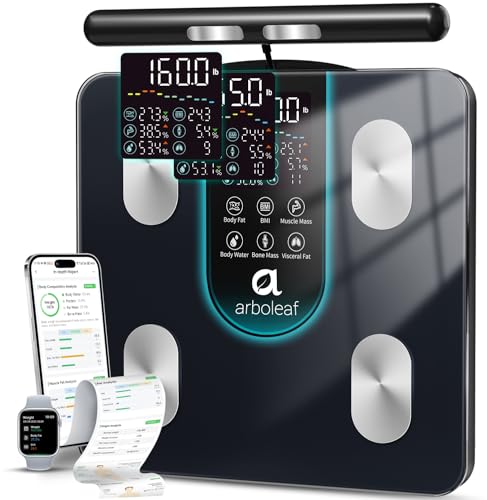
The arboleaf Smart Scale for Body Weight uses an eight-electrode, dual-frequency BIA design with a handle and foot electrodes. That makes it the clearest fit here for shoppers who want segmental body-composition estimates in addition to basic weight trends. Its app lists more than 50 metrics and printable reports, while the scale displays seven readings for quick check-ins.
Reasons to buy:
- Handle-and-foot electrodes support full-body and segmental views.
- The app offers more than 50 metrics, trend charts, and printable reports.
- Supports unlimited users, with up to eight profiles stored and auto recognition.
Reasons to avoid:
- Initial use requires pairing the scale in the app and completing a profile.
- The listing says BIA readings are estimates for long-term trends, not equivalents to DEXA or professional body-composition analysis.
Skip it if you want a simple scale without app setup, or if you need clinical body-composition measurements.
Best for Wi-Fi and Heart-Rate Tracking: WITHINGS Body Smart – Accurate Scale for Body
The WITHINGS Body Smart – Accurate Scale for Body combines body-composition tracking with a high-resolution color display, Wi-Fi and Bluetooth connectivity, and a heart-rate reading at weigh-in. The listing specifies weight measurements to within 50 g and says the scale estimates daily energy needs. It suits people who want a connected scale with more than weight and body-fat figures, though the published details do not specify which health apps it supports beyond Apple Health compatibility in the listing title.
Reasons to buy:
- Wi-Fi and Bluetooth offer two connection options.
- Displays weight trends on the scale’s color screen.
- Includes heart-rate readings at weigh-in and body-composition analysis.
Reasons to avoid:
- App details and the full list of body metrics are not specified in the published features.
- Verify phone and health-app compatibility before choosing it for a particular ecosystem.
Skip it if you want a low-cost model or need a clearly stated list of app metrics before purchase.
Best for a Detailed Display: Etekcity Smart Scale for Body Weight and Fat, BMI
The Etekcity Smart Scale for Body Weight and Fat, BMI pairs a TFT display with Wi-Fi syncing and the VeSync app. The listing says its display can show up to nine metrics, while the app provides a 14-metric analysis and syncs with Apple Health, Google Fit, Fitbit, MyFitnessPal, and Samsung Health. That combination suits people who want useful readings on the scale itself and a broader app-based record.
Reasons to buy:
- TFT screen can display up to nine body metrics without opening the phone app.
- Wi-Fi can sync health data to the cloud.
- The listing names five compatible health and fitness platforms.
Reasons to avoid:
- Some setup and tracking features depend on the VeSync app.
- The product listing describes both 14 app metrics and up to nine display metrics, so check which readings matter to you.
Skip it if you prefer Bluetooth-only tracking or do not want your data synced through an app and cloud service.
Best for a Higher Weight Limit: FITINDEX Smart Scale for Body Weight, Body Fat
The FITINDEX Smart Scale for Body Weight, Body Fat supports up to 500 lb and has an 11.8-inch-square platform. Its LED screen shows seven readings, including body fat, BMI, muscle mass, and body water, while the app tracks 13 metrics and progress reports. The larger platform and stated capacity make it a practical option for households where standard scale limits may not fit every user.
Reasons to buy:
- 500 lb maximum capacity and an 11.8-by-11.8-inch platform.
- Seven readings appear directly on the display.
- App includes multiple user profiles, athlete mode, and baby mode for infants or pets.
Reasons to avoid:
- The app is required for initial profile setup, Bluetooth pairing, syncing, and detailed metrics.
- The listing does not specify Wi-Fi connectivity.
Skip it if automatic Wi-Fi syncing is important or you do not want to use a phone app for setup.
Best for ECG and Segmental Estimates: WITHINGS Body Scan – Smart Scale
The WITHINGS Body Scan – Smart Scale is the feature-heavy choice for shoppers interested in segmental body-composition readings alongside ECG and other health estimates. Its listing also names vascular age, nerve-health checks, visceral fat, and heart rate, with Wi-Fi and Bluetooth connectivity. Those added functions make it distinct from basic weight-and-body-fat scales, but buyers should review how each feature works and what it can and cannot tell them.
Reasons to buy:
- Lists segmental body-composition readings and an ECG feature.
- Includes heart-rate readings and estimates of arterial age.
- Supports both Wi-Fi and Bluetooth, with a color screen and app.
Reasons to avoid:
- Its extensive health feature set may be unnecessary if you only want weight and broad body-fat trends.
- Health readings and estimates should not replace assessment by a qualified medical professional.
Skip it if you want a straightforward bathroom scale or have no use for its additional health features.
Also Considered
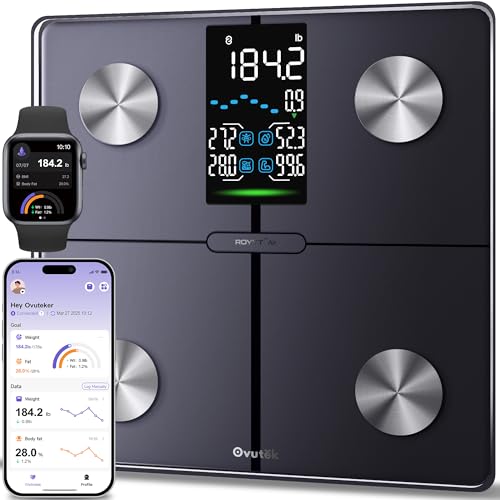
Ovutek Smart Digital Scale for Body Weight could suit families wanting unlimited users, guest mode, and a display that shows core readings, but the published details do not state the app name or phone-platform support.
Alcedo Smart Body Fat Scale, Color-Changing Scale may appeal if customizable lighting and weight-change indicators matter, though its listing gives less detail about health-app integrations.
RENPHO Smart Scale with BMI, Body Fat offers an ITO-coated surface, seven display readings, and unlimited user profiles; it may suit a household that wants a compact platform, but its stated capacity is 400 lb rather than 500 lb.
RENPHO Smart Scale for Body Weight, Body Fat, BMI is another option for families needing a 500 lb capacity and baby or pet mode. Its app is required for detailed tracking, so compare its setup needs with your preferred routine.
How to Choose the Best Smart Scale for Body Fat
Understand the body-fat measurement method
Most scales in this group estimate body composition using bioelectrical impedance analysis, or BIA. A reading is best treated as an estimate for following changes over time, not as a definitive measure of body fat. The arboleaf listing makes this distinction explicitly and notes that its figures are not equivalent to DEXA or professional analysis. Check the listing for the measurement method and any stated limitations.
Choose the display and app detail you will use
A scale that shows readings on its screen can make quick check-ins easier, while a companion app can provide longer-term charts and additional measurements. FITINDEX and RENPHO Elis 2XL display seven readings, while Etekcity lists a TFT screen with up to nine display metrics and a 14-metric app analysis. Compare the exact readings available on-screen with those hidden in the app, and decide whether app setup is acceptable for your household.
Match connectivity and app support to your phone
Bluetooth scales generally need a nearby phone for syncing, while Wi-Fi models can send readings through a home network. The published product details name Wi-Fi and Bluetooth for both Withings options and Etekcity; FITINDEX specifies Bluetooth pairing. Etekcity lists Apple Health, Google Fit, Fitbit, MyFitnessPal, and Samsung Health compatibility. Verify the current app requirements and supported services on the product listing if you rely on a specific health platform.
Check capacity, platform size, and user modes
Maximum capacity and standing area affect whether a scale fits you comfortably and safely. FITINDEX and RENPHO Elis 2XL specify a 500 lb limit and an 11.8-inch-square platform; several other listed models specify 400 lb. For shared homes, look for individual profiles, automatic recognition, guest mode, or infant and pet modes. Features differ by model, so do not assume one brand’s scale modes appear across its whole range.
Decide whether extra health features add value
Heart-rate readings, ECG features, segmental estimates, and metabolic-age calculations can make a scale more informative, but they also add complexity. The standard WITHINGS Body Smart includes heart-rate readings, while Body Scan adds ECG and other estimates. If your priority is simply tracking weight and broad composition trends, a model with fewer functions may be easier to use. Treat health-related outputs as informational, not as a diagnosis.
How We Compared
This guide compares the published product descriptions, listed specifications, design details, app features, connectivity, supported user modes, and available customer-rating information. Product-specific statements reflect the published listings; manufacturer-described accuracy and body-composition functions are not presented as independently verified results. Where app compatibility, setup, or measurement details were not provided, the guide flags what buyers should confirm before choosing.
Frequently Asked Questions
Are smart-scale body-fat readings exact?
No. These scales estimate body composition, and their readings can differ from professional assessment methods. Use them as a consistent way to observe broad trends rather than as a medical measurement. For the most useful comparisons, weigh under similar conditions and focus on changes over time.
Do I need a phone app to use a smart scale?
That depends on the model. Several scales show basic readings on their built-in displays, but FITINDEX requires its app for initial profile setup, Bluetooth pairing, syncing, and detailed metrics. Check whether the readings you want are available on the scale itself or require an app account.
What is the difference between Bluetooth and Wi-Fi scales?
Bluetooth usually connects the scale to a nearby phone, while Wi-Fi can sync data through your home network. A Wi-Fi connection may be convenient when you do not want to open an app at every weigh-in, but setup and account requirements still vary. Confirm the connection type and app process in the specific model listing.
Are scales with hand electrodes different from standard models?
Yes. A typical foot-electrode scale estimates composition from the lower body, while a model with hand and foot electrodes can collect readings across more of the body. The arboleaf model lists an eight-electrode design, dual-frequency BIA, and segmental views. More readings do not make an estimate equivalent to clinical analysis.
Can more than one person use the same smart scale?
Several listed models support multiple profiles, and some add automatic recognition, guest, baby, or pet modes. Check the exact model’s user limit and mode list, since features vary. If household privacy matters, review how its app stores and shares account data before setup.




Write Your Review
No reviews yet. Be the first to share your experience!