

A chilly garage presents a practical choice: warm the air around a workbench with a portable cabinet, or mount a radiant heater overhead to save floor space. This guide to the Best Garage Heater compares two electric models by heat delivery, controls, installation, and the kind of workspace each may suit.
Both heaters use standard 120V power, but their designs serve different routines. Review the listed features, then check your outlet, mounting location, and the space you expect to warm before choosing.

Pros
- Dual infrared quartz and PTC heating
- Adjustable thermostat from 50 to 85°F
- Remote control and 12-hour timer
- Caster wheels for moving between rooms
Cons
- Skip if you need a lightweight heater for frequent carrying
Pros
- Three power settings
- Remote controlled
- Wall and ceiling brackets included
- Listed for indoor and outdoor use
Cons
- No thermostat; skip if automatic temperature control matters
The Best Garage Heaters by Use Case
Best for Thermostat Control: Dr Infrared Heater DR-968 Portable Space Heater
The Dr Infrared Heater DR-968 Portable Space Heater pairs an infrared quartz tube with a PTC element and a fan, giving it a different approach from a directional overhead radiant heater. Its electronic thermostat is listed with a 50°F to 85°F range, so it may suit a user who wants to set a target temperature rather than operate only at a fixed power level. Caster wheels and a 19 lb weight support moving it between work areas.
Reasons to buy:- Electronic thermostat offers a listed 50°F to 85°F setting range.
- High and low settings, remote control, and a 12-hour automatic shut-off timer provide control options.
- Caster wheels make the 19 lb cabinet movable, and the listing gives a blower noise level of 39 dB.
- The cabinet occupies floor space, which may be inconvenient in a crowded garage.
- At 1,500 watts and 12.5 amps, it can put a substantial load on a household circuit; check the circuit and outlet before use.
Who should skip it: Skip it if you need a wall- or ceiling-mounted heater, or need an outdoor-rated enclosure. The published product details do not list an IP rating for this model.
Best for Overhead Installation: DR. INFRARED HEATER Portable Infrared Indoor
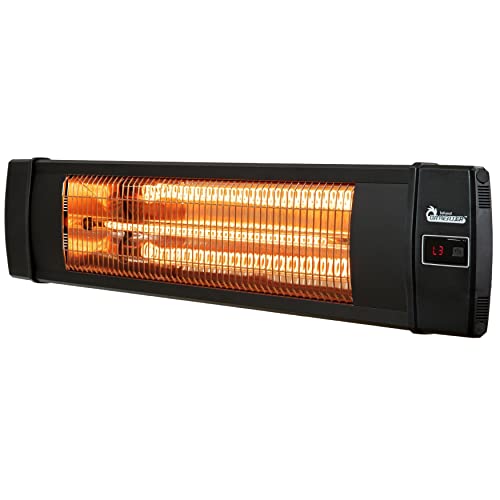
The DR. INFRARED HEATER Portable Infrared Indoor is a carbon-lamp infrared heater with three listed power settings: 900W, 1,200W, and 1,500W. Its included wall and ceiling mounting bracket can keep the heater off the floor, while the remote lets you control it from elsewhere in the room. The listing specifies an IP55 rating and indoor and outdoor use, which may appeal to buyers considering a covered patio or a garage exposed to dust and water spray.
Reasons to buy:- Three power settings let you select among 900W, 1,200W, and 1,500W.
- The included wall and ceiling bracket supports overhead placement.
- The listing specifies IP55 and describes the heater as suitable for indoor and outdoor use.
- The published details say it has no thermostat, so it does not offer the DR-968’s stated temperature range.
- Buyers must plan mounting location and installation rather than relying on a caster-equipped floor cabinet.
Who should skip it: Skip it if automatic room-temperature control matters more than overhead placement or adjustable wattage.
How to Choose the Best Garage Heater
Choose heat delivery for your workspace
Infrared heat is useful when you want warmth directed toward people or objects instead of relying only on warming the air throughout a room. A fan-equipped cabinet can circulate warmed air, while an overhead radiant model directs heat from its mounted position. The published product information describes the DR-968 as using a quartz infrared tube and PTC element with a blower. It describes the second model as a carbon-lamp infrared heater.
Neither description establishes how quickly a specific garage will warm or how much area either unit will heat effectively. Insulation, ceiling height, drafts, and the distance between heater and work area all affect the result. Check manufacturer coverage guidance for your space before buying, since the published details do not state a dependable room-size rating.
Compare thermostat control with power settings
A thermostat can reduce the need for manual switching when you want a set temperature. The DR-968 lists an electronic thermostat from 50°F to 85°F. The overhead model instead lists three wattage settings and no thermostat. That makes its controls adjustable, but does not provide automatic temperature regulation according to the published information.
Consider how you use the garage. For longer work sessions in an enclosed space, thermostat control may be convenient. For brief tasks at one work area, selecting a power level and turning the heater off when finished may be enough. Confirm how each control works in the complete product documentation before purchase.
Plan placement and clearance
A portable heater can move with you, but it occupies floor area and can be blocked by tools, stored items, or vehicles. The DR-968 lists caster wheels and weighs 19 lb. An overhead heater can free floor space, but needs a suitable mounting location and a clear path for radiant heat. The second model’s listing says a wall and ceiling bracket is included; verify that the proposed location and mounting surface suit the manufacturer’s instructions.
Keep heaters away from combustible materials and follow the clearance distances in the manual. Garages often contain wood, fabric, fuel, solvents, and dust, so placement deserves attention before the unit is switched on. Do not assume that a particular mounting height or distance is safe unless the manufacturer specifies it.
Check electrical load and outlet access
Both products list operation at 120V, and their maximum listed setting is 1,500W. At that rating, current draw is about 12.5A, calculated as watts divided by volts. That can use much of a 15A branch circuit’s capacity, especially if tools or other appliances share it. Check your circuit rating and what else runs on it, and consult a qualified electrician if you are unsure.
The DR-968 listing specifies a 72-inch power cord. The published details for the overhead model do not state cord length, so check the full listing and manual for outlet reach and installation requirements. Do not use an extension cord or power strip unless the manufacturer explicitly permits it and specifies suitable ratings. Plugging a high-wattage heater into an unsuitable cord can create an overheating and fire hazard.
Match the enclosure to the location
The overhead model’s listing specifies IP55 and describes indoor and outdoor use. An IP rating concerns protection against dust and water ingress under defined conditions; it does not mean a heater can be exposed to every weather condition or direct water flow. Check the manual for permitted placement, exposure, and mounting requirements before using it outdoors.
The supplied DR-968 details do not state an IP rating or outdoor approval. Treat it as an indoor-use option unless its manufacturer documentation says otherwise. For a damp or semi-open location, choose only a heater explicitly approved for that environment and install it as directed.
How We Compared These Garage Heaters
This comparison uses the published product specifications and design details, including heating elements, controls, power ratings, mounting provisions, and stated enclosure protection. We considered how those details relate to common garage situations, such as limited floor space, a need for thermostat control, or a semi-open location. The supplied materials do not provide comparable room-coverage measurements, so this guide does not rank the heaters by a specific garage size.
For more options across the category, browse space heaters. You can also explore the broader home appliances category or compare air-cleaning choices in our Levoit Air Purifier vs. Coway Airmega guide.
Frequently Asked Questions
Can a 1,500W heater warm a two-car garage?
The published product details do not establish that either model can heat an entire two-car garage. A 1,500W electric heater may provide focused warmth, but results depend on insulation, outdoor temperature, drafts, ceiling height, and garage size. Check the manufacturer’s coverage guidance and consider whether you need warmth at one work area or throughout the whole space.
Which model is better for a garage with limited floor space?
The DR. INFRARED HEATER Portable Infrared Indoor is the more suitable candidate based on its included wall and ceiling bracket. Overhead placement can leave the floor clearer, provided you have a suitable mounting location and follow the manual. The DR-968 is portable, but its cabinet occupies floor space while in use.
Which heater has automatic temperature control?
The DR-968 lists an electronic thermostat with a 50°F to 85°F range. The overhead model is specified as having no thermostat, although it offers 900W, 1,200W, and 1,500W settings. If automatic temperature regulation is important, verify the control description in the current manufacturer documentation before selecting a heater.
Can the overhead model be used outdoors?
Its product listing describes indoor and outdoor use and specifies IP55. That rating does not replace the manufacturer’s instructions about exposure, installation, and safe clearances. Confirm whether the intended location, such as a covered patio, meets those instructions before use.
Can I run a garage heater from an extension cord?
Do not assume an extension cord is suitable for a 1,500W heater. The listed maximum output corresponds to about 12.5A at 120V, which can overheat an undersized cord. Follow the heater manual and electrical guidance, use an appropriate wall outlet, and ask a qualified electrician if the circuit or connection is uncertain.
Do electric garage heaters need exhaust ventilation?
These listed models are electric heaters, not fuel-burning heaters, so their product descriptions do not specify combustion exhaust. Follow each manual’s ventilation and placement instructions. Do not apply guidance for electric equipment to propane or other fuel-burning heaters, which have different ventilation and carbon monoxide risks.




Write Your Review
No reviews yet. Be the first to share your experience!