

Heating a basement can be tricky: open rooms may need more warmth than a small enclosed space, while outlets and furniture can limit where a heater can go. This guide to the best space heater for basement use explains what the listed Dr Infrared Heater DR-968 offers, where its features may fit, and what to check before bringing any portable heater into your home.
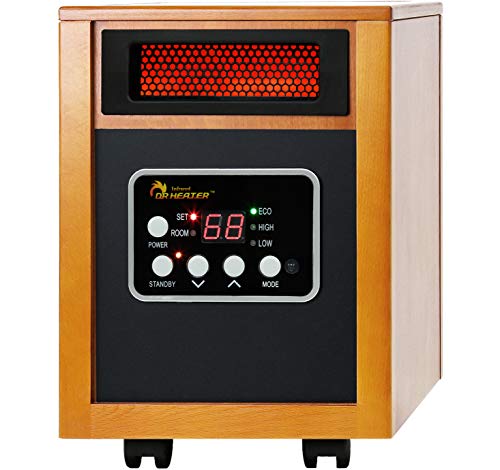
Pros
- Dual infrared quartz and PTC heating
- Adjustable thermostat from 50 to 85°F
- Remote control and 12-hour timer
- Caster wheels for moving between rooms
Cons
- Skip if you need a lightweight heater for frequent carrying
The Best Space Heaters by Use Case
Only one product was supplied for this guide, so there is no basis for comparing several models or naming multiple distinct picks. The DR-968 may suit a larger basement where a portable heater with thermostat control, a timer, and caster wheels is useful. Actual comfort depends on room conditions, placement, insulation, and other factors not specified in the listing.
Best for Larger Basements: Dr Infrared Heater DR-968 Portable Space Heater
The Dr Infrared Heater DR-968 Portable Space Heater combines an infrared quartz tube with a PTC heating element. The listing describes it as suitable for a large room and gives an output rating of around 5,200 BTU, but it does not state a precise coverage area. Its 50°F to 85°F electronic thermostat, high and low settings, and 12-hour automatic shut-off timer give you several ways to manage operation. Compare other space heaters if you need a model with a stated room-size recommendation.
Reasons to buy:
- Dual heating system pairs an infrared quartz tube with a PTC element, according to the listing.
- Thermostat range of 50°F to 85°F and high and low settings provide adjustable operation.
- Remote control, caster wheels, and a 12-hour timer may help when you want convenient controls and easier repositioning.
Reasons to avoid:
- The listing does not give a defined square-foot coverage figure, so buyers cannot match it to a basement area by stated capacity alone.
- It draws 12.5 amps at 1,500 watts, so check outlet access and the circuit’s other loads before choosing a location.
Skip it if you need a heater with a clearly specified coverage area, or if your basement does not have a suitable outlet and placement location.
How to Choose the Best Space Heater for Basement Use
Match heating claims to your room
Basements vary widely: a finished room with a door differs from a large, open basement with several connected areas. A heater’s advertised room suitability can help narrow choices, but it does not guarantee even warmth in every layout. The DR-968 listing calls it suitable for a large room and states around 5,200 BTU, yet gives no square-foot figure. That missing figure makes a direct room-size match difficult.
Before buying, estimate the area you want to warm and consider whether it is one enclosed room or an open space. Check the product listing and manual for a coverage recommendation, if available. If the manufacturer does not state one, do not treat a general phrase such as “large room” as a precise capacity promise. A portable heater may also warm one area more effectively than a whole basement with several rooms.
Check wattage, amperage, and outlet location
Electrical demand affects whether a heater is practical in your chosen spot. The DR-968 is rated at 1,500 watts and 12.5 amps, and its cord is listed as 72 inches long. Those details can help you check whether an outlet is close enough and whether the circuit has capacity for the heater alongside other appliances. The figures do not establish that every outlet or circuit in a basement is suitable.
Review the heater manual and follow its electrical and placement instructions. Avoid relying on an extension cord or power strip unless the manufacturer specifically permits that setup. If you are unsure about the circuit or outlet condition, ask a qualified electrician before use. Never place a portable heater where its cord will be pinched, run through a walkway, or exposed to water.
Choose controls that fit your routine
A thermostat can help maintain a chosen setting, while selectable heat levels let you adjust operation. The DR-968 lists an electronic thermostat from 50°F to 85°F, high and low settings, and an automatic shut-off timer of up to 12 hours. It also includes an infrared remote control. These features may be convenient if you want to adjust settings without walking to the heater, but the listing does not establish how quickly it warms a particular basement or how closely room temperature tracks the thermostat setting.
Think about when and where you will use the heater. A timer may suit a scheduled period in a basement living area, while a thermostat may be useful when you want a chosen temperature rather than constant high output. Check the manual to understand timer operation, thermostat behavior, and what happens after a power interruption. Do not treat a timer as a substitute for following safety guidance or supervising operation as appropriate.
Consider movement, noise, and storage
Portable heaters can be repositioned as your needs change, but weight and dimensions matter when you need to move or store one. The DR-968 weighs 19 pounds and has caster wheels, which may help when moving it across a suitable floor. The listing does not provide dimensions, so check them if storage space, a narrow path, or a particular placement area is a concern.
The listed noise level is 39 dB, described by the manufacturer as super quiet. Treat that as a stated specification rather than a guarantee of how noticeable the heater will be in your room. If you plan to use it near a television, desk, or sleeping area, consider that sound perception varies with background noise and placement. The listing also mentions a high-pressure, low-noise blower, but does not provide separate operating-noise figures for different settings.
Review safety details and placement instructions
The DR-968 listing specifies tip-over protection and overheat protection. Those are useful listed safeguards, but they do not remove the need for careful placement. Keep a portable heater away from water, damp areas, curtains, bedding, furniture, and other materials that could obstruct airflow or create a fire hazard. Follow the clearances and operating instructions in the product manual.
Before purchasing, check the complete product information for any safety certification or other details important to you; none are provided in the published product data. Use the heater only in a dry location and on a stable surface, and do not cover it. If your basement is prone to moisture or flooding, verify that the intended location is appropriate before using an electric heater. For more home equipment guidance, visit our Home Appliances category.
How We Compared
This guide draws on the published product listing details, including its stated heating system, wattage, amperage, thermostat range, timer, controls, weight, cord length, and listed protection features. The listing provides a general large-room claim but no defined coverage area, and the published rating information is internally inconsistent, so neither is used as proof of real-world performance or customer consensus. Only one product was provided, which limits the comparison to assessing its stated features against common basement-heating needs. For additional models, browse the space heater category.
Frequently Asked Questions
Can the DR-968 heat an entire basement?
The listing describes the DR-968 as suitable for a large room, but it does not state a square-foot coverage area. Whether it can warm your basement depends on the space’s layout and conditions. Treat the large-room wording as a general claim, not a guarantee that it will heat every room or corner evenly.
What is the difference between infrared and PTC heating?
The DR-968 listing says it combines an infrared quartz tube and a PTC element in a dual heating system. It does not provide comparative measurements showing how each component performs in a particular basement. If the heating method matters to you, review the manufacturer’s explanation and compare it with your room needs rather than assuming the combination guarantees a specific result.
Does the DR-968 have adjustable temperature settings?
Yes. The published specifications list an electronic thermostat with a range from 50°F to 85°F, along with high and low heat settings. The listing does not explain thermostat accuracy or temperature uniformity, so consult the manual for operating details.
Can I use the heater in a damp basement?
The published product information does not state that the DR-968 is rated for wet or damp locations. Do not use it where it could contact water, and check the manual for location restrictions. If your basement has persistent moisture or flooding risk, confirm that any proposed heater location is dry and appropriate before use.
What should I check before plugging in a 1,500-watt heater?
Check the outlet location, the circuit’s other electrical loads, and the product manual’s power instructions. The DR-968 is listed at 1,500 watts and 12.5 amps, with a 72-inch cord. Do not assume an outlet is suitable based only on its location; seek qualified electrical advice if you have concerns.




Write Your Review
No reviews yet. Be the first to share your experience!