

Choosing the best wireless earbuds under $50 means deciding which compromises matter most: secure fit for exercise, a neckband that will not separate from its earpieces, or true wireless convenience with noise control. This guide compares published features and helps you weigh battery claims, water ratings, call microphones, and phone compatibility before you choose.
These models suit different routines rather than one universal listener. Check the details that affect your use, especially the stated battery conditions, the fit style, and the Samsung model’s regional-stock listing.

Pros
- Earhooks designed for a secure sports fit
- IPX7 water-resistance rating
- Transparency mode and battery display
Cons
- Up to 8 hours per charge
- Skip if you need more than 8 hours per charge

Pros
- Up to 25 hours of battery life
- Flexible neckband design
- Physical playback and volume controls
- IPX4 splash resistance
Cons
- Ear tip fit affects sound and call performance
- Who should skip it: listeners who prefer fully wireless earbuds
Pros
- Adjustable Smart Ambient listening
- Customizable EQ through JBL Headphones app
- Four microphones for calls
- IP54 dust and water resistance
Cons
- Skip if you need stated battery life with ANC enabled

Pros
- Bluetooth 5.4 connectivity
- Active noise cancellation
- Up to 35 hours of listed playback
Cons
- Codec support and ANC-on battery life are unspecified
- Who should skip it: shoppers needing confirmed codec compatibility
Pros
- Active noise cancellation and transparency mode
- Earhooks and customizable ear tips
- IPX7 water-resistance rating
- Dual LED battery displays
Cons
- Skip if you need more than 8 hours per charge
The Best Wireless Earbuds by Use Case
Best for Secure Workouts: GNMN Active Noise Cancelling Ear Buds
The GNMN Active Noise Cancelling Ear Buds suit exercise where a stable fit matters more than a low-profile shape. The listing specifies soft earhooks, customizable ear tips, an IPX7 water-resistance rating, and up to eight hours of playback per charge. It also claims up to 96 hours with the case, but that is a manufacturer figure rather than a guarantee of everyday runtime.
Reasons to buy:
- Earhooks and customizable tips are designed to help keep the earbuds in place during movement.
- The listed IPX7 rating and claimed sweat protection suit sweaty workouts and rain exposure within the limits of the rating.
- The case has a dual LED display, and the earbuds support USB-C charging.
Reasons to avoid:
- The stated 96-hour total depends on case recharges; the listing gives eight hours per earbud charge.
- The listing does not identify a companion app or an adjustable equalizer.
Who should skip it: Choose another design if you prefer compact earbuds without earhooks or need documented app-based sound controls.
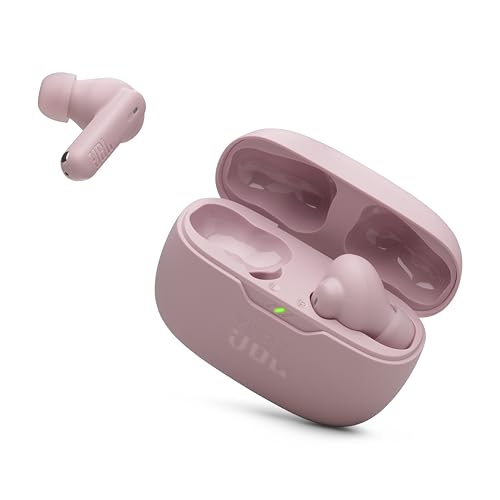
Best for App-Based Sound Controls: JBL Vibe Beam 2 – True Wireless Noise Cancelling
The JBL Vibe Beam 2 – True Wireless Noise Cancelling is a practical fit for listeners who want to adjust sound and hear their surroundings without removing the earbuds. Its listing specifies active noise cancelling, Smart Ambient modes, four microphones, and access to EQ options through the JBL Headphones app. JBL lists up to 10 hours of playback per charge and up to 40 hours total with the case, with ANC off.
Reasons to buy:
- The app offers preset EQ choices and custom sound adjustment.
- Four microphones, two in each earbud, are intended to pick up the wearer’s voice for calls.
- ANC and Smart Ambient provide options for reducing noise or hearing more of the surroundings.
Reasons to avoid:
- The 40-hour total is specified with ANC off, so do not assume the same runtime with noise cancelling enabled.
- The IP54 rating covers dust and water resistance, but it is not a swimming rating.
Who should skip it: Look elsewhere if you need earhooks for vigorous movement or a model explicitly listed with an IPX7 rating.
Best Neckband Design: Sony WI-C100 Wireless in-Ear Bluetooth Headphones
The Sony WI-C100 Wireless in-Ear Bluetooth Headphones take a different approach: the earpieces connect through a flexible neckband instead of sitting loose in a charging case. That format can suit people who often remove one or both earbuds during errands or work. Sony lists up to 25 hours of battery life, physical button controls, an IPX4 rating, and support for the Sony Headphones Connect app.
Reasons to buy:
- The neckband keeps the earpieces connected when they are out of your ears.
- Physical buttons control playback, track skipping, and volume without relying on touch gestures.
- The app offers sound adjustment, and Sony lists DSEE processing for compressed audio.
Reasons to avoid:
- This is not a true wireless design, so the band rests around your neck while listening.
- IPX4 is a splash and sweat rating, not a rating for submersion.
Who should skip it: Pick a true wireless model if you want a separate charging case, active noise cancelling, or an unobstructed neck.
Best for Samsung Ecosystem Shoppers: Samsung Galaxy Buds Core SM-R410 (2025)
The Samsung Galaxy Buds Core SM-R410 (2025) may suit Samsung shoppers who want true wireless earbuds with active noise cancellation and Bluetooth 5.4. The listing claims up to 35 hours of music playback, but it does not specify the conditions behind that total. The product is identified as Latin American stock, so check the seller’s regional details and confirm any phone or service requirements before buying.
Reasons to buy:
- Bluetooth 5.4 is specified for wireless connectivity and device pairing.
- Active noise cancellation is included according to the listing.
- The listing describes touch controls and claims up to 35 hours of music playback.
Reasons to avoid:
- The available product information does not provide a water-resistance rating, microphone count, or companion-app details.
- Regional stock makes it important to verify model details and compatibility for your market.
Who should skip it: Choose a model with a clearly stated water rating or more complete app and call specifications if those features are priorities.
Also Considered
The second listing for GNMN Active Noise Cancelling Ear Buds describes the same V7 features, including earhooks, IPX7, and claimed 96-hour total playback, but it is a separate listing with a different ASIN; compare seller and model details before treating it as interchangeable with the first.
How to Choose Wireless Earbuds Under $50
Pick a fit that matches your routine
Fit affects comfort, stability, and passive noise isolation. Earhooks, as listed for the GNMN model, may be useful during workouts, while the Sony neckband keeps its earpieces connected when removed. Stem or bean-style true wireless earbuds are less encumbered by a band, but the published data does not establish how any model will fit your ears. Check which tip sizes the listing includes, and consider whether your activity calls for a more secure shape.
Read battery figures with their conditions
Per-charge playback and case-supported total playback answer different questions. JBL specifies 10 hours per charge and up to 40 hours total with ANC off; GNMN lists eight hours per charge and up to 96 hours with its case. These are manufacturer claims, and actual runtime can vary with listening volume and feature use. Sony lists up to 25 hours for its neckband design, which has no separate earbud charging case.
Match noise control to where you listen
Active noise cancelling can help reduce surrounding sound, while transparency or ambient modes let more outside sound reach you. JBL lists both ANC and Smart Ambient, and GNMN lists ANC and transparent mode. A product listing does not prove how well either feature handles voices, traffic, or other specific sounds. If hearing nearby people matters, check for a transparency feature and use it where awareness is important.
Check the water rating and exercise needs
Water-resistance labels are not interchangeable. The GNMN listing specifies IPX7, JBL specifies IP54, and Sony specifies IPX4. These ratings do not mean that earbuds are suitable for every water exposure, and the Samsung listing available here does not state a rating. Check the manufacturer’s care instructions before using earbuds in rain or during exercise, and do not infer swimming suitability from sweat resistance.
Consider controls, calls, and phone compatibility
Physical controls can be easier to operate by touch, while touch controls keep the earbud surface smooth. Sony lists buttons for volume and playback; Samsung lists touch controls. JBL specifies four microphones and app-based EQ, while the published information for the other models gives less detail about call processing. The listings do not provide codec support or a complete compatibility matrix, so verify your phone’s operating-system requirements and any app availability before purchase.
How We Compared These Models
This guide compares the published product listings, including stated battery life, fit designs, noise-control features, microphone information, water ratings, controls, and app support. Manufacturer playback and noise-cancelling claims are presented as listing claims, not as independently confirmed results. Where product details are missing, such as the Samsung model’s water rating or codec support across these products, the guide identifies what to verify instead of filling the gap with assumptions.
Frequently Asked Questions
Will these earbuds work with an iPhone or Android phone?
The listings describe Bluetooth connectivity, but do not give a complete compatibility table for every phone and operating-system version. Confirm the product requirements before purchase, especially for the Samsung regional-stock model. App features also differ: JBL and Sony list companion apps, while the published details do not identify one for GNMN or Samsung.
Are active noise cancelling and transparency mode the same thing?
No. Active noise cancelling is intended to reduce some outside noise, while transparency or ambient modes let more outside sound through. GNMN lists ANC and transparent mode, and JBL lists ANC and Smart Ambient. Neither feature should replace attention to your surroundings.
Which model makes sense for exercise?
The GNMN design has earhooks and a listed IPX7 rating, making it the clearest fit here for buyers prioritizing a secure sports-style design. JBL lists IP54 resistance, while Sony lists IPX4 and a neckband. Check the rating and manufacturer care guidance against your workout, and do not assume any of these models is suitable for swimming.
Does a longer total battery claim mean longer listening per charge?
No. Total playback can include extra charges stored in the case. For example, the GNMN listing gives up to eight hours per charge and up to 96 hours with its case; JBL specifies up to 10 hours per charge and 40 hours total with ANC off. Compare the per-charge figure if you need long uninterrupted listening.
Are neckband headphones a good alternative to true wireless earbuds?
A neckband keeps the earpieces connected and can be convenient when you frequently take them out. The Sony WI-C100 uses this format and lists physical controls and up to 25 hours of battery life. True wireless models avoid a band around the neck and use a charging case, so your choice depends on which form is easier to carry and manage.
What should I check about the Samsung model before buying?
Confirm that the SM-R410 listing matches the model and regional version you intend to buy. The published listing identifies Latin American stock and gives Bluetooth 5.4, ANC, touch controls, and a claimed 35-hour playback total, but does not specify a water rating or detailed phone requirements. Check those missing details with the seller if they affect your decision.



Write Your Review
No reviews yet. Be the first to share your experience!