

A water monitor that tracks household flow is different from a leak sensor that closes a main valve, and pipe size or network needs can narrow your options quickly. This guide to the best smart water monitor compares whole-home monitoring, automatic shutoff, leak detection sensitivity, and connection requirements so you can match a system to your plumbing and routine.

Pros
- Remote flow and usage monitoring
- Customizable app-based flow alerts
- Manual valve control when offline
Cons
- Installation is described as somewhat complex
- DN25/1-inch option has DN20/3/4-inch valve body
- Skip if you need app control during outages
Pros
- Real-time water usage reports
- App-based flow alerts
- Manual valve control
- Backup battery for power outages
Cons
- Supports 2.4GHz Wi-Fi only
- Installation is somewhat complex
- Skip if you need app control during power outages
Pros
- Automatic shutoff capability
- Remote alerts and app control
- Daily and monthly usage reports
- NSF/ANSI 61 and 372 certified
Cons
- Requires power for network access
- Professional installation recommended
- Skip if no outlet is available for network access

Pros
- Wi-Fi not required
- Includes wired and wireless sensors
- Supports up to eight wireless sensors
- Fits 3/4-inch and 1-inch pipes
Cons
- Who should skip it: homes with other pipe sizes

Pros
- Automatic valve shutoff
- Remote app control and alerts
- Flow and pressure monitoring
- Adapters for two pipe sizes
Cons
- Requires power to connect to network
- Professional installation recommended
- Who should skip it: buyers seeking a battery-powered monitor
The Best Smart Water Monitors by Use Case
Best for 3/4-Inch Pipes: GreenVation Water Flow Meter, 0.1gal/min Water Flow Monitor
GreenVation’s Water Flow Meter, 0.1gal/min Water Flow Monitor suits buyers whose main line uses a 3/4-inch connection and who want app-based flow monitoring with a shutoff valve. The listing specifies W-Type ultrasonic measurement with water-consumption detection accuracy of 0.1 gal, plus configurable flow alarms through Tuya or Smart Life. It supports 2.4GHz Wi-Fi, so check your network before buying.
Reasons to buy:
- 3/4-inch valve size matches the listed pipe option.
- Shows real-time flow and water-use data in the app.
- A manual button can operate the valve when the network is offline.
Reasons to avoid:
- App connection is limited to 2.4GHz Wi-Fi.
- The listing describes installation as somewhat complex, and app control is unavailable during a power outage.
Skip it if you need automatic shutoff triggered by a dedicated leak sensor or want a system that does not depend on Wi-Fi for app monitoring.
Best for Fine-Flow Detection: Frizzlife LP365 Smart Water Monitor and Automatic
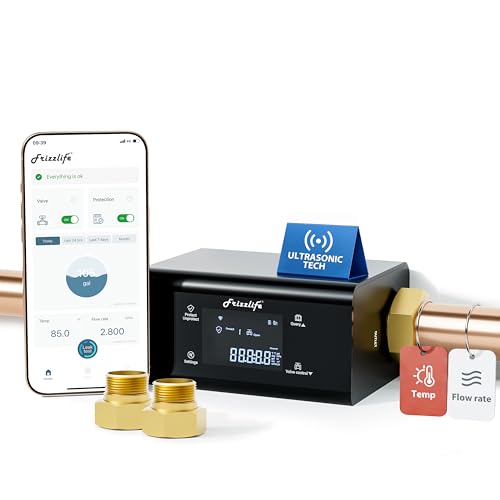
For households prioritizing small-flow detection, FRIZZLIFE’s Frizzlife LP365 Smart Water Monitor and Automatic lists ultrasonic monitoring down to 0.01 GPM, automatic valve shutoff, and alerts by app notification, SMS, and phone call. It reports flow and temperature, and the listing says the system supports daily and monthly water monitoring. It fits listed 3/4-inch and 1-inch pipe connections, with professional installation recommended by the manufacturer.
Reasons to buy:
- 0.01 GPM monitoring threshold is specified for detecting small changes in flow.
- Automatic shutoff and several alert methods provide more than app-only notification.
- Reports flow and temperature, with daily and monthly usage views listed.
Reasons to avoid:
- The system needs a powered connection for networking.
- Professional installation is recommended, so setup may involve a plumber.
Skip it if you only need a simple usage monitor or cannot provide the listed power connection at the installation point.
Best Without Wi-Fi: AIWSH Smart Automatic Water Shutoff Valve & Leak
AIWSH’s Smart Automatic Water Shutoff Valve & Leak is aimed at homes where Wi-Fi coverage near the main line is unreliable or where leak protection should not depend on an internet connection. The listing specifies LoRa communication, automatic shutoff when a leak is detected, and included wired and wireless leak sensors. It also says the system supports up to eight wireless sensors, with a stated wireless coverage claim of up to 1,640 feet.
Reasons to buy:
- LoRa communication is specified, and the listing says leak protection continues during internet outages.
- Includes wired and wireless leak sensors for different placement needs.
- Supports expansion with up to eight wireless sensors and lists 3/4-inch and 1-inch pipe compatibility.
Reasons to avoid:
- The listing does not specify app control, usage reports, or flow-monitoring details.
- The stated wireless range is a listing claim, not a guarantee of coverage in every home.
Skip it if you want detailed water-use reporting or remote app control, since those features are not specified in the published listing.
Best for Pressure Monitoring: FRIZZLIFE Frizzlife LP365-P Smart Water Monitor
FRIZZLIFE’s Frizzlife LP365-P Smart Water Monitor is the variant to consider when pressure readings matter alongside flow monitoring. Its listing distinguishes it from LP365 by specifying pressure and flow display, while both models share the listed automatic shutoff, 0.01 GPM ultrasonic detection, and app alerts. It fits 3/4-inch and 1-inch pipes, and the manufacturer recommends professional installation.
Reasons to buy:
- Adds water-pressure display to flow monitoring.
- Lists automatic shutoff and alerts by app notification, SMS, and phone call.
- Includes the same stated 0.01 GPM ultrasonic monitoring feature as the LP365.
Reasons to avoid:
- Choose the LP365 instead if temperature readings matter more than pressure.
- The listing says the device needs to be plugged in to be networked.
Skip it if you do not need pressure readings and would rather compare the temperature-reporting LP365 variant.
Best for a 1-Inch Connection: GreenVation Water Flow Meter, 0.1gal/min Water Flow Monitor
For a 1-inch installation, GreenVation’s Water Flow Meter, 0.1gal/min Water Flow Monitor lists the same app monitoring and manual valve operation as its 3/4-inch counterpart. The listing notes an important fitting detail: the valve body remains DN20, or 3/4 inch, while a DN25 adapter is included for connection to DN25 piping. Confirm your actual pipe and fitting requirements before ordering rather than relying on the product title alone.
Reasons to buy:
- Includes a DN25 adapter for the listed DN25 piping option.
- Shows flow and water-use information in Smart Life or Tuya.
- Has a manual button for valve operation when the network is offline.
Reasons to avoid:
- The valve body itself is DN20, not DN25, according to the listing.
- Installation is described as somewhat complex, and app use is limited to 2.4GHz Wi-Fi.
Skip it if your plumbing needs a full DN25 valve body rather than an adapter, unless the manufacturer confirms this fitting arrangement works for your setup.
How to Choose the Best Smart Water Monitor
Match the valve to your main pipe
Pipe size and connection type are the first checks because a whole-home valve installs on the main water line. The listed products list 3/4-inch and 1-inch options, but GreenVation’s 1-inch listing specifically describes a DN20 valve body with a DN25 adapter. Compare the product’s fitting details with your pipe measurement, thread type, and available installation space. If the listing does not clarify a connection, ask the seller or a plumber before purchase.
Decide whether you need flow monitoring or sensor-based leak alerts
Flow monitors observe water moving through the main line and can flag patterns that cross a set threshold. The GreenVation models list flow alarms and usage information, while the Frizzlife models specify ultrasonic monitoring down to 0.01 GPM and automatic shutoff. AIWSH instead emphasizes included wired and wireless leak sensors and says its valve closes when a leak is detected. Choose according to the type of event you want to catch, and check exactly how each listing describes detection and shutoff behavior.
Check network, app, and outage behavior
GreenVation requires 2.4GHz Wi-Fi for app features and names Smart Life and Tuya. The Frizzlife listings describe Smart Life app control and say the devices must be plugged in to network. AIWSH uses LoRa and says protection continues during internet outages, but the published details do not specify app controls or water-use reporting. GreenVation also states that its backup battery preserves power during an outage, but valve operation then requires the manual button and app control is unavailable. These distinctions matter if your home has weak Wi-Fi at the water line or you need to manage the valve remotely during a power interruption.
Compare information and alert channels
Some buyers want daily usage history, while others care most about receiving notice when water is detected where it should not be. The Frizzlife LP365 reports flow and temperature, and the LP365-P reports flow and pressure. Both list app, SMS, and phone-call alerts. GreenVation offers real-time flow and water-use information, while AIWSH lists audible alerts and sensor-based detection. Confirm which readings, notification methods, and history views are included in the exact model you select.
Plan installation and power before ordering
These products connect to plumbing, so installation is more involved than placing a battery-powered leak puck under a sink. GreenVation describes installation as somewhat complex; Frizzlife recommends professional installation and lists an included power cable for LP365. AIWSH describes its system as designed for DIY installation with basic tools, but that does not confirm every plumbing setup will be straightforward. Check whether you can safely access the main line, provide the required power, and install the specified fittings. Contact a qualified plumber if your pipe layout or local requirements are unclear.
How We Compared
This comparison uses the published product listings, including stated pipe compatibility, monitoring features, connectivity, power details, sensors, and alert methods. We kept model differences separate, especially the Frizzlife LP365 temperature display and LP365-P pressure display, and treated coverage and detection statements as manufacturer specifications rather than independently verified results. Customer-review evidence was not supplied, so this guide does not infer buyer consensus or long-term reliability.
Frequently Asked Questions
Does a smart water monitor need Wi-Fi?
It depends on the model and feature. GreenVation lists 2.4GHz Wi-Fi for app-based control and notifications, and Frizzlife lists Wi-Fi and app control. AIWSH uses LoRa and says leak protection continues during internet outages. Check whether the features you need, such as remote viewing or alerts, work without internet.
What is the difference between a flow monitor and a leak sensor?
A flow monitor measures water movement through the main line and can report use or flag flow patterns. A leak sensor detects water at its placement point, such as near a sink or water heater. Some systems combine monitoring or sensors with an automatic shutoff valve, but their trigger methods differ. Read the model’s listing to confirm what detects a leak and what action follows.
Can these devices shut off water automatically?
The Frizzlife LP365 and LP365-P listings specify automatic shutoff, and AIWSH lists automatic shutoff after leak detection. GreenVation describes a smart water valve that can be controlled through its app or manual button, but the published details do not specify automatic leak-triggered shutoff. Confirm this distinction if automatic response is essential.
How do I know whether I need the LP365 or LP365-P?
The listing says LP365 displays temperature and flow rate, while LP365-P displays pressure and flow rate. Other listed functions are described as identical. Choose based on which extra reading matters for your household, and verify the model label before ordering.
Should I install a whole-home shutoff valve myself?
Installation involves the main water line, and product guidance differs. Frizzlife recommends professional installation, GreenVation describes setup as somewhat complex, and AIWSH describes its system as designed for DIY installation. Pipe material, fittings, access, and local plumbing rules can change the job. If you are unsure about any connection or shutoff step, consult a qualified plumber.


Write Your Review
No reviews yet. Be the first to share your experience!